Thank you for visiting SNEWPapers!
Sign up free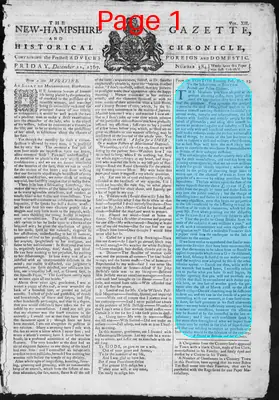
The New Hampshire Gazette And Historical Chronicle
Portsmouth, Greenland, Rockingham County, New Hampshire
What is this article about?
A letter in the Boston Evening-Post urges Boston inhabitants to continue frugality, industry, and non-importation of dutiable goods and woolens from March 1768 to 1769, in response to British trade burdens and potential new taxes like the Stamp Act, to benefit colonies and convince Britain of policy errors.
Clipping
OCR Quality
Full Text
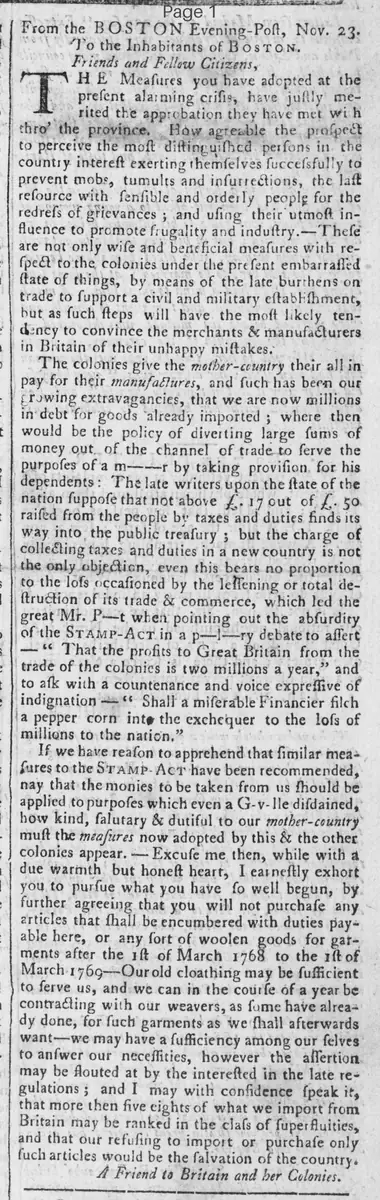
To the Inhabitants of Boston.
Friends and Fellow Citizens,
THE measures you have adopted at the present alarming crisis, have justly merited the approbation they have met with thro' the province. How agreeable the prospect to perceive the most distinguished persons in the country interested exerting themselves successfully to prevent mobs, tumults and insurrections, the last resource with sensible and orderly people for the redress of grievances: and using their utmost influence to promote frugality and industry.--These are not only wise and beneficial measures with respect to the colonies under the present embarrassed state of things, by means of the late burthens on trade to support a civil and military establishment, but as such steps will have the most likely tendency to convince the merchants & manufacturers in Britain of their unhappy mistakes.
The colonies give the mother-country their all in pay for their manufactures, and such has been our growing extravagancies, that we are now millions in debt for goods already imported; where then would be the policy of diverting large sums of money out of the channel of trade to serve the purposes of a minister by taking provision. for his dependents: The late writers upon the state of the nation suppose that not above £. 17 out of £. 50 raised from the people by taxes and duties finds its way into the public treasury; but the charge of collecting taxes and duties in a new country is not the only objection, even this bears no proportion to the loss occasioned by the lessening or total destruction of its trade & commerce, which led the great Mr. P--t when pointing out the absurdity of the Stamp-Act in a par--liam--ntary debate to assert "That the profits to Great Britain from the trade of the colonies is two millions a year," and to ask with a countenance and voice expressive of indignation "Shall a miserable Financier filch a pepper corn into the exchequer to the loss of millions to the nation."
If we have reason to apprehend that similar measures to the Stamp- Act have been recommended, nay that the monies to be taken from us should be applied to purposes which even a G--v--rnor disdained, how kind, salutary & dutiful to our mother-country must the measures now adopted by this & the other colonies appear. - Excuse me then, while with a due warmth but honest heart, I earnestly exhort you to pursue what you have so well begun, by further agreeing that you will not purchase any articles that shall be encumbered with duties payable here, or any sort of woolen goods for garments after the 1st of March 1768 to the 1st of March 1769--Our old cloathing may be sufficient to serve us, and we can in the course of a year be contracting with our weavers, as some have already done, for such garments as we shall afterwards want-we may have a sufficiency among ourselves to answer our necessities, however the assertion may be flouted at by the interested in the late regulations; and I may with confidence speak it, that more than five eights of what we import from Britain may be ranked in the class of superfluities. and that our refusing to import or purchase only such articles would be the salvation of the country
A Friend to Britain and her Colonies.
What sub-type of article is it?
What keywords are associated?
Where did it happen?
Domestic News Details
Primary Location
Boston
Event Date
Nov. 23
Event Details
Anonymous letter praises colonial measures against mobs and for frugality/industry amid trade burdens from British civil/military establishments; argues against new taxes like Stamp Act, which harm trade profits; exhorts non-purchase of dutiable articles and woolen goods from March 1, 1768, to March 1, 1769, relying on local production to counter superfluities and save the country.