Thank you for visiting SNEWPapers!
Sign up free
The Guardian
Boston, Suffolk County, Massachusetts
What is this article about?
The U.S. Senate passed Senator Robert Wagner's amendment to the Burke-Wadsworth conscription bill by a 53-21 vote, barring racial prejudice in Army and Navy enlistment after a bitter debate. The amendment now heads to the House.
Merged-components note: Merged continuation from page 1 to page 4; relabeled to domestic_news as content pertains to U.S. national policy on conscription and race.
Clippings
1 of 2
OCR Quality
Full Text
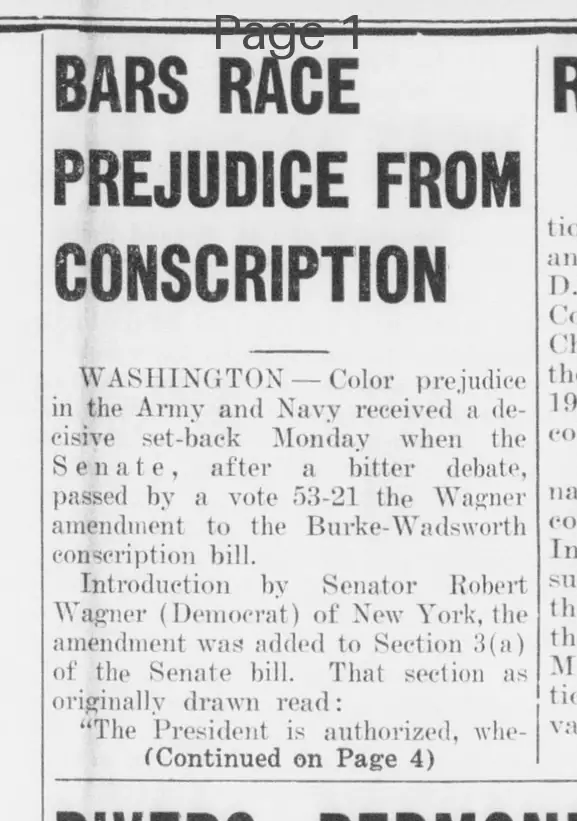
WASHINGTON - Color prejudice in the Army and Navy received a decisive set-back Monday when the Senate, after a bitter debate, passed by a vote 53-21 the Wagner amendment to the Burke-Wadsworth conscription bill.
Introduction by Senator Robert Wagner (Democrat) of New York. the amendment was added to Section 3(a) of the Senate bill. That section as originally drawn read:
"The President is authorized, whether or not a state of war exists, to select for training and service in the manner herein provided, and to induct into the land and naval forces of the United States, such number of men between such ages as in his judgment is required for such forces in the national interest:
"Provided, That any person between the ages of 18 and 35 shall be afforded an opportunity voluntarily to enlist and be inducted into the land or naval forces of the United States for the training and service prescribed..."
As amended by Senator Wagner and approved by the Senate Monday the last part of the section reads:
"Provided, That any person between the ages of 18 and 35, regardless of race or color, shall be afforded an opportunity voluntarily to enlist and be inducted into the land or naval forces, including aviation, of the United States for the training and services prescribed..."
In all three votes were cast. The first vote, a voice vote, sounded about even to listeners in the gallery. The second, a division by standing, resulted in a 22-21 count in favor of the amendment. The vote was so close that a roll-call was demanded. On this final vote the count favoring passage of the amendment was 53 to 21.
Vigorously supporting his amendment Senator Wagner charged that the War Department had discriminated against colored men who desired to enlist. Senator Pat Connally of Texas could not forego the opportunity to reel off one of his characteristic diatribes of race hatred although his state of Texas, observers argue, is faced with the menace of being among the first to suffer attack should England fail.
The Wagner amendment now goes to House for consideration. The sentiment of House members are reported in favor of the amendment. Army and Navy officials may try to fight it, informed sources said.
G
What sub-type of article is it?
What keywords are associated?
What entities or persons were involved?
Where did it happen?
Domestic News Details
Primary Location
Washington
Event Date
Monday
Key Persons
Outcome
passed by senate vote of 53-21; goes to house for consideration, where sentiment is reportedly in favor.
Event Details
The Senate passed the Wagner amendment to the Burke-Wadsworth conscription bill after a bitter debate, adding language to Section 3(a) ensuring enlistment opportunities regardless of race or color. Three votes were held: voice vote even, standing vote 22-21, roll-call 53-21. Wagner accused the War Department of discrimination against colored men; Connally opposed with race hatred remarks.