Thank you for visiting SNEWPapers!
Sign up free
Alexandria Gazette
Alexandria, Alexandria County, District Of Columbia
What is this article about?
In the U.S. House of Representatives, debate on the Navy Pension Bill involved motions to reconsider an amendment repealing the 1837 act, which extended pensions to widows and orphans of navy personnel. Speakers like Adams, Shepard, and others argued over its justice, fund depletion, and procedural issues. Other resolutions on state stock investments and Choctaw affairs were introduced but tabled. The House adjourned without resolution.
Merged-components note: These components contain sequential text continuing the congressional debate on the Navy Pension Bill in the House of Representatives, forming a single logical article.
Clippings
1 of 2
OCR Quality
Full Text
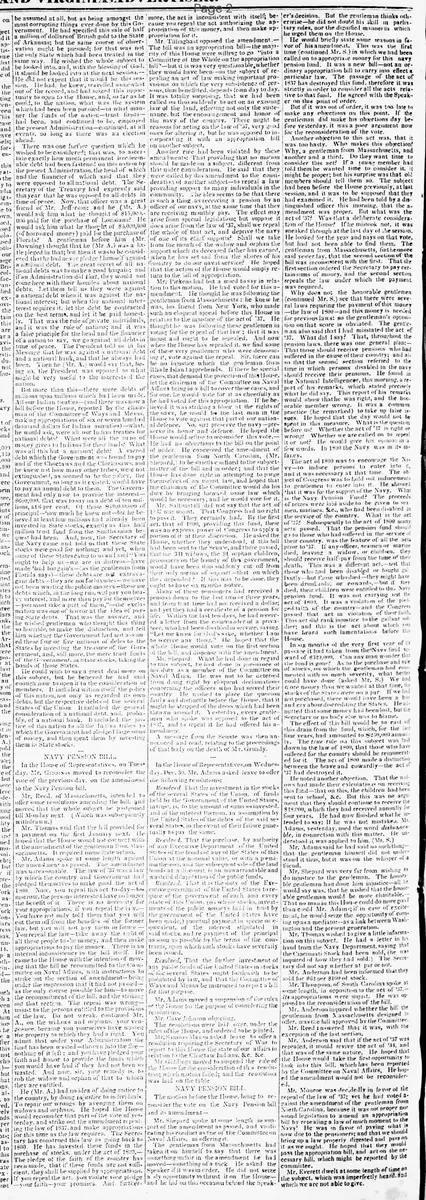
In the House of Representatives, on Tuesday, Mr. Giddings moved to reconsider the vote of the previous day, on the amendment to the Navy Pension bill.
Mr. Reed, of Massachusetts, intended to offer some resolutions amending the bill, and moved that the whole subject be postponed until Monday next. (Which was subsequently withdrawn.)
Mr. Thomas said that the bill provided for a payment on the first January next. He hoped that the House would not connect with it the amendment of the gentleman from Massachusetts. It required immediate action.
Mr. Adams spoke at some length against the amendment as passed. The amendment was unreasonable. The law of '37 was a law by which the country and Government had pledged themselves to make good the act of 1800. Now, you repeal this act to-day-tomorrow, the persons interested have no longer the benefit of it. There is no necessity for your appropriations, if you repeal the law. You have not only told them that you will cut them off from the benefits of the former law, but you will not pay them in future. You repeal the law-take away the right of all these people to the money, and then make appropriations to pay the money. There is an internal inconsistency in the bill itself. He came to the House with the intention of moving that the bill be recommitted to the Committee on Naval Affairs, with instructions to strike out the section of amendment-being under the impression that it had not passed-as the only course possible for him-to move the recommitment of the bill, and the striking out that section. The repeal was wrong unjust to the persons entitled to the provisions of the law. Do not wreak, continued Mr. A., on the widows and orphans, your vengeance, because you yourselves have wasted the property to which they had a right. You admit that under your Administration the fund has been wasted-thrown into the fire-nothing of it left: and you have pledged your faith and honor to provide the funds which you would have had if they had not been so wasted. And now, sir, your remedy is, to rob the widow and orphan of that to which they are entitled.
He (Mr. A.) had no idea of doing justice to the country, by doing injustice to individuals. To repair our wrongs by avenging them on widows and orphans. He hoped the House would reconsider that part of the vote of yesterday, and strike out the amendment repealing the law of 1837, and make appropriations for this time as the law requires. The Secretary has construed this law as going back to 1800. He has invested these funds in the purchase of stocks, under the act of 1800. The pledge of the faith of the country has been made, that if these funds are not sufficient, they shall be supplied by appropriations. If you repeal the act, you violate your pledge-your faith-your promises. And, furthermore, the act is inconsistent with itself; because you repeal the act authorizing the appropriation of this money, and then make appropriation for it.
Mr. Tillinghast opposed the amendment. The bill was an appropriation bill-the majority of this House were willing to go "into a Committee of the Whole on the appropriation bill"-but it was very questionable whether they would have been--on the subject of repealing an act of law making important provisions on which the very subsistence of persons, thus benefitted, depends from day to day. It was totally surprising, that we had been called on thus suddenly to act on an existing law of the land, affecting not only the sustenance, but the encouragement and honor of the navy of the country. There might be reasons for acting on the law of '37, very good ones for altering it, but he was opposed to incorporating it with an appropriation bill on another subject.
Another rule had been violated by these amendments: That providing that no motion should be made on a subject, different from that under consideration. He said that they were called by this amendment to the consideration of another subject-to repeal a law providing support to many individuals in the community. The idea seems to be that there is such a thing as receiving a pension by an officer of our navy, at the same time that they are receiving monthly pay. The effect may arise from special legislation; but suppose it does arise from the law of '37, shall we repeal the whole of that act, and deprive the navy of one of its chief supports? Shall we take from the mouth of the widow and orphan the support which its deceased father has earned, when he has set sail from the shores of his country to do our naval service? He hoped that the action of the House would simply return to the bill of appropriation.
Mr. Pickens had but a word to say in relation to this motion. He had voted for this amendment. He thought he was following the gentleman from Massachusetts : he knew he was, his friend from New York, who made such an eloquent appeal before this House in relation to the injustice of the act of '37. He thought he was following these gentlemen in voting for the repeal of that law ; that it was unjust and ought to be repealed. And now when the House has repealed it, we find some of these very gentlemen who were denouncing it, vote against the repeal. Sir, there can be no injustice which the gentleman from Rhode Island apprehends. If there be special cases, that demand the protection of this House, let the chairman of the Committee on Naval Affairs bring in a bill to cover these cases, and for one, he would vote for it as cheerfully as he had voted for this appropriation. If he believed it was striking a blow at the rights of the navy, he would be the last man in the House to vote against that part of our national defence. No, sir: preserve the navy-preserve its honor and defence. He hoped the House would refuse to reconsider this vote. He had no objections to the bill on the point of order. He conceived the amendment of the gentleman from North Carolina, (Mr. Shepard,) to be strictly confined to the subject matter of the bill and in order; and that the House has done right in attempting to purge themselves of an unjust law, and hoped that the chairman of the Committee would do his duty by bringing forward some law which would be necessary, and he would vote for it.
Mr. Saltonstall did not say that the act of 137 was unjust. That Congress had no right to pass it. They certainly had. By the first act, that of 1800, providing this fund, there was an express power of Congress to apply a portion of it at their discretion. He asked the House, whether they understood, if this bill had been sent to the Senate, and there passed, that the 31 widows, the 91 orphan children, pensioners on the bounty of this government, would have been thus suddenly cut off from their only means of support-that on which they depended? If this was to be done, they ought to have six months notice.
Many of these pensioners had received a pension down to the last two or three years, and from that time had not received a dollar; and yet they had a certificate of a pension for life. Within the last ten days, he had received a letter from the commander of a privateer, who had been disabled in service, saying "Let me know for God's sake, whether I am to receive any thing." He hoped that the whole House would vote on the first section of the bill, and dispense with the amendment.
Mr. Shepard. What he had done in regard to this subject, he had done in pursuance of his duty as a member of the Committee on Naval Affairs. He was not to be deterred from doing right by eloquent declamations concerning the officers who had served their country. He wished to place the question fairly and distinctly before the House, that it might be stripped of the dress which had been thrown around it. Yesterday, every gentleman who spoke was opposed to the act of 1-37, and to repeal it he had offered his amendment.
A message from the Senate was then announced and read, relating to the proceedings of that body on the death of Mr. Grundy.
In the House of Representatives, on Wednesday, Dec. 30. Mr. Adams asked leave to offer the following resolutions:
Resolved, That the investment in the stocks of the several States of the Union, of funds held by the Government of the United States in trust, is, to the amount of sums so invested, and of the interest thereon, an assumption by the United States of the debts of the said several States, in the event of their failure punctually to pay the same.
Resolved, That the purchase, by authority of any Executive Department of the United States of the bonds of any of the states of this Union at the nominal value, or with a premium thereon, and the subsequent sale of the same bonds at a discount is an unwarrantable and wasteful dilapidation of the public funds.
Resolved, That it is the duty of the Executive government of the United States to require of the government of each and every State of this Union, to whose stocks, investments of the public moneys held in trust by the government of the United States have been made,) punctual payment in specie or equivalent, of the interest stipulated in said stocks, and re-payment of the principal as soon as possible by the terms of the contracts, upon which such stocks have severally been issued.
Resolved, That the further investment of any public funds of the United States in stocks of the several States ought forthwith to be prohibited by law, and that the Committee of Ways and Means be instructed to report a bill for that purpose.
Mr. Adams moved a suspension of the rules of the House for the purpose of considering the resolutions.
Mr. Cave Johnson objecting
The resolutions were laid over, under the rules of the House, and ordered to be printed.
Mr. Samson Mason asked leave to offer a resolution requiring the Secretary of War to report to this House the state of our affairs in relation to the Choctaw Indians, &c. &c.
Mr Giddings moved to suspend the rule of the House for the consideration of this resolution; which motion failed; and the resolution was laid on the table
NAVY PENSION BILL
The motion before the House, being to reconsider the vote-on the Navy Pension bill and its amendment-
Mr. Shepard spoke at some length in support of the amendment as passed, and vindicating his conduct as one of the Committee on Naval Affairs, in offering it.
The gentleman from Massachusetts had taken it on himself to say that there was something unfair in the amendment he had moved-something of a trick He asked the Speaker if it was in order. He did not seize a sly opportunity to thrust it on the House--and he hid on this occasion behind the Speaker's decision. But the gentleman thinks otherwise-he did not doubt his skill in parliamentary rules, nor the dignified manner in which he urged them on the House.
He would briefly state some reasons in favor of his amendment. This was the first time (continued Mr. S.) in which we had been called on to appropriate money for this navy pension fund. It was a new bill-not an ordinary appropriation bill to carry into effect a particular law. The passage of the act of 1837 has destroyed this fund, therefore it was strictly in order to consider all the acts relative to that fund. He agreed with the Speaker on this point of order.
But if it was out of order, it was too late to make any objections on this point. If the gentleman did make his objections day before yesterday, it was a poor argument now for the reconsideration of the vote.
Another objection to this act was, that it was too hasty. Who makes this objection? Why, a gentleman from Massachusetts, and another and a third. Do they want time to consider this act? If a young member had told them he wanted time to consider it, it might be proper; but his surprise was that old members should tell them so. The subject had been before the House previously, at last session, and it was to be supposed that they had examined it. He had been told by a distinguished officer this morning, that the amendment was proper. But what was the act of '37? Was that a deliberate consideration of the House? If he mistook not, it was sneaked through at the last day of the session. He looked for the yeas and nays on that vote, but had not been able to find them. The gentleman from Massachusetts, furthermore said yesterday, that the second section of the bill was inconsistent with the first. That the first section ordered the Secretary to pay certain sums of money, and the second section repeals the law under which the payment was required.
Why does not the honorable gentleman (continued Mr. S.) see that there were several laws requiring the payment of this money-the law of 1800-and this money is needed for previous laws: so the gentleman's opposition on that score is obviated. The gentleman also said that I had misstated the act of '37. What did I say? That, throughout the pension laws, there was one general plan:-That those should receive pensions who had suffered in the cause of their country; and also that the second section referred to the time in which persons disabled in the navy should receive their pensions. He found in the National Intelligencer, this morning, a report of his remarks, which stated precisely what he did say. This report of his remarks would show that he was right, and the honorable member wrong. It was a common practice (he remarked) to take up false issues. He hoped that the day would not be spent in this measure. What is the question before us? Whether the act of '37 is right or wrong? Whether we are called on to repeal it or not? He would give his opinion in a few words. In 1800 the Navy was in its infancy.
The act of 1800 was to encourage the Navy-to induce persons to enter into it, and it was necessary at that time. The object of Congress was to hold out inducements to gentlemen to enter into it. He showed that it was for the support of the Navy. What is the Navy Pension Fund? The proceeds of prizes were laid aside to be given to seamen, marines, &c., who had been disabled in the service of the country. What is the act of 37? Subsequently to the act of 1800 many acts passed. That the pension fund should go to those who had suffered in the service of their country, was the feature of all the acts prior to '37. If any officer, seaman or marine died, leaving a widow, or children, they should receive half-pay from the time of their death, This was a different act,-not that those who had been disabled or fought gallantly-but those who died-they might have been drunkards, or cowards,-but if they died, their children were entitled to this Navy pension fund. It was not carrying out the act of 1800. It was a violation of the pledge of faith of the country-and the Congress passed that act in violation of their faith.
This act did rank injustice to the gallant soldier; and this is the act about which you have heard such lamentations before this House.
In six months of the very first year of its passage it had taken from the Navy fund upward of $329,000. Can any man wonder that the fund is gone? As to the purchase and sale of stocks, on which the gentleman had commented with so much severity, what better could have been done (asked Mr. S.) We had more money than we wanted at that time, the stocks of the States were on a par. If we had not purchased, there would have been a hue and cry about discrediting the States. He admitted that some money had been lost. but the Secretary or no body else was to blame.
The effect of this bill would be to cast-off this drain from the fund, which, for the last four years, had amounted to $250,000 annually.
The true rule of this subject was laid down in the law of 1800, that those who have suffered for the country should be remunerated for it. The act of 1800 made a distinction between the brave and cowardly-the act of '37 had destroyed it.
He noted another objection. That the widows had made their calculations on receiving this fund-that on this, the children had been sent to school, &c. But this was no argument that they should continue to receive the $150,000, which they had received annually for four years. He had now finished what he intended to say: If he was not mistaken, Mr. Adams, yesterday, used the word dishonorable, in connection with this matter. He understood it was applied to him. (Mr. S.)
Mr. Adams said he had said no such thing-that the gentleman himself did not understand it thus, but it was on the whisper of a friend.
Mr. Shepard was very far from wishing to do injustice to the gentleman. The honorable gentleman has done him justice-all he would say was, that he wished that the honorable gentleman would be more charitable.-That no man in this House could do more good than could Mr. Adams: if in case of excitement, he would seize the opportunity of coming up as a mediator--as a link between Washington and the present generation.
Mr. Thomas wished to give a little information on this subject. He had a letter in his hand from the Navy Department, saying that the Cincinnati Stock had been sold, (he was inquired of how they had sold.) The Secretary did not say whether at par or not.
Mr. Anderson had been informed that they sold for $62 per $100 of stock.
Mr. Thompson, of South Carolina spoke at some length, in opposition to the act of 37.-its appropriations were unjust. He was opposed to the reconsideration of the bill.
Mr. Anderson inquired whether the bill the gentleman from Massachusetts designed to offer, was the bill approved by the Committee.
Mr. Reed answered that it was, with the exception of the last section.
Mr. Anderson said that if the act of '37 was repealed, it would revive the act of '34, and that was of the same nature. He hoped that the House would take the first opportunity to look into this bill, which has been reported by the Committee on Naval Affairs. He hoped the amendment would not be reconsidered.
Mr. Monroe was decidedly in favor of the repeal of the law of '37; yet he had voted against the amendment of the gentleman from North Carolina, because it was not proper nor sound legislation to amend an appropriation bill by repealing a law of much moment to the Navy! He was in favor of paying what is now due to the pensioners; and that we should bring up a law properly digested and pass on it as we ought. He hoped that they would pass the appropriation bill, and act on the necessary bill, which might be reported by the committee.
Mr. Everett dwelt at some length on the subject, which was imperfectly heard, and on which we are not able to give.
Mr. Reed had been reported somewhat erroneously as to his debate on the subject. He did not mean to denounce with so much severity the act of '37. But it was indiscreet and unwise. He opposed paying pensions according to the act of 1837. He spoke of his constituents-they had done more fighting the battles of the country than any other, and there had never come here to ask for pensions. He hoped the House would reconsider this bill, leaving out the amendments, and take up the bill brought forward by him and adopt it.
Mr. Naylor was in favor of bringing the discussion to an end. He thought the rate respecting the law of '37 hasty and unwise. That all laws when originated were imperfect, and it was by the emendations of experience that the most perfect laws were formed. That part of the law of '37 was defective, and ought to be repealed, leaving that which was sound. He hoped that the motion would be re-considered-that the appropriation bill brought forward obviating the defects of the law of '37 would be passed, and that some bill would be passed leaving out the defects of the law of '37.
Mr. Jameson moved the previous question.
Mr. Turney moved that the House adjourn, which was carried.
And the House adjourned.
What sub-type of article is it?
What keywords are associated?
What entities or persons were involved?
Where did it happen?
Domestic News Details
Primary Location
House Of Representatives
Event Date
Tuesday; Wednesday, Dec. 30
Key Persons
Outcome
house adjourned without final decision on the bill; resolutions by adams and mason tabled.
Event Details
Debate on reconsidering vote to amend Navy Pension Bill by repealing 1837 act extending pensions to widows and orphans; arguments on justice, fund waste, procedural order; interruptions for Senate message on Mr. Grundy's death and other resolutions on state investments and Choctaw Indians.