Thank you for visiting SNEWPapers!
Sign up free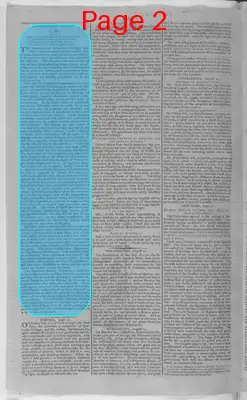
Literary
September 1, 1790
Gazette Of The United States
New York, New York County, New York
What is this article about?
Excerpt from 'Discourses on Davila' No. XIX, featuring a French quatrain on the Guise family, followed by a historical narrative on the spread of Calvinism in France under kings Francis II and Henry II, involving figures like Coligni, Luther, Calvin, Beza, and the Bourbons' alliance with Huguenots.
Clipping
OCR Quality
95%
Excellent
Full Text
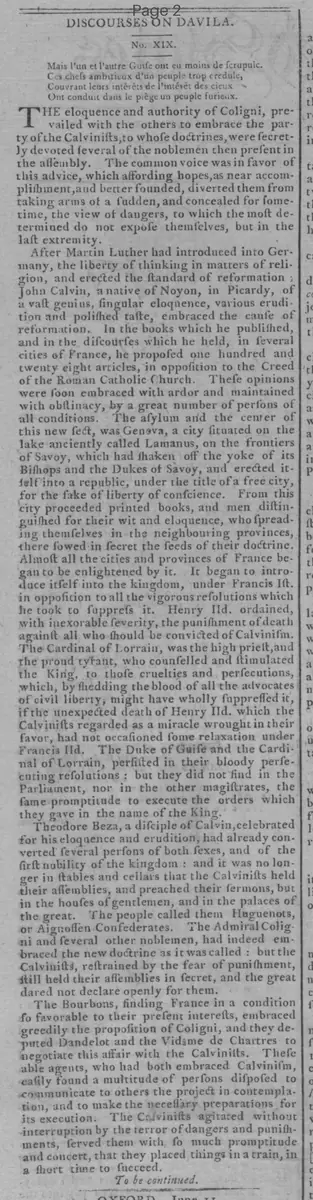
DISCOURSES ON DAVILA.
No. XIX.
Mais l'un et l'autre Guise ont eu moins de scrupules.
Ces chefs ambitieux d'un peuple trop crédule,
Couvrant leurs intérêts de l'intérêt des cieux
Ont conduit dans le piège un peuple furieux.
THE eloquence and authority of Coligni, prevailed with the others to embrace the party of the Calvinists, to whose doctrines, were secretly devoted several of the noblemen then present in the assembly. The common voice was in favor of this advice, which affording hopes, as near accomplishment, and better founded, diverted them from taking arms of a sudden, and concealed for some time, the view of dangers, to which the most determined do not expose themselves, but in the last extremity.
After Martin Luther had introduced into Germany, the liberty of thinking in matters of religion, and erected the standard of reformation; John Calvin, a native of Noyon, in Picardy, of a vast genius, singular eloquence, various erudition and polished taste, embraced the cause of reformation. In the books which he published, and in the discourses which he held, in several cities of France, he proposed one hundred and twenty eight articles, in opposition to the Creed of the Roman Catholic Church. These opinions were soon embraced with ardor and maintained with obstinacy, by a great number of persons of all conditions. The asylum and the center of this new sect, was Geneva, a city situated on the lake anciently called Lemanus, on the frontiers of Savoy, which had shaken off the yoke of its Bishops and the Dukes of Savoy, and erected itself into a republic, under the title of a free city, for the sake of liberty of conscience. From this city proceeded printed books, and men distinguished for their wit and eloquence, who spreading themselves in the neighbouring provinces, there sowed in secret the seeds of their doctrine. Almost all the cities and provinces of France began to be enlightened by it. It began to introduce itself into the kingdom, under Francis IIt. in opposition to all the vigorous resolutions which he took to suppress it. Henry IId. ordained, with inexorable severity, the punishment of death against all who should be convicted of Calvinism. The Cardinal of Lorrain, was the high priest, and the proud tyrant, who counselled and stimulated the King, to those cruelties and persecutions, which, by shedding the blood of all the advocates of civil liberty, might have wholly suppressed it, if the unexpected death of Henry IId. which the Calvinists regarded as a miracle wrought in their favor, had not occasioned some relaxation under Francis IId. The Duke of Guise and the Cardinal of Lorrain, persisted in their bloody persecuting resolutions: but they did not find in the Parliament, nor in the other magistrates, the same promptitude to execute the orders which they gave in the name of the King.
Theodore Beza, a disciple of Calvin, celebrated for his eloquence and erudition, had already converted several persons of both sexes, and of the first nobility of the kingdom: and it was no longer in tables and cellars that the Calvinists held their assemblies, and preached their sermons, but in the houses of gentlemen, and in the palaces of the great. The people called them Huguenots, or Aignonen Confederates. The Admiral Coligni and several other noblemen, had indeed embraced the new doctrine as it was called: but the Calvinists, restrained by the fear of punishment, still held their assemblies in secret, and the great dared not declare openly for them.
The Bourbons, finding France in a condition so favorable to their present interests, embraced greedily the proposition of Coligni, and they deputed Dandelot and the Vidame de Chartres to negotiate this affair with the Calvinists. These able agents, who had both embraced Calvinism, easily found a multitude of persons disposed to communicate to others the project in contemplation, and to make the necessary preparations for its execution. The Calvinists agitated without interruption by the terror of dangers and punishments, served them with so much promptitude and concert, that they placed things in a train, in a short time to succeed.
To be continued.
No. XIX.
Mais l'un et l'autre Guise ont eu moins de scrupules.
Ces chefs ambitieux d'un peuple trop crédule,
Couvrant leurs intérêts de l'intérêt des cieux
Ont conduit dans le piège un peuple furieux.
THE eloquence and authority of Coligni, prevailed with the others to embrace the party of the Calvinists, to whose doctrines, were secretly devoted several of the noblemen then present in the assembly. The common voice was in favor of this advice, which affording hopes, as near accomplishment, and better founded, diverted them from taking arms of a sudden, and concealed for some time, the view of dangers, to which the most determined do not expose themselves, but in the last extremity.
After Martin Luther had introduced into Germany, the liberty of thinking in matters of religion, and erected the standard of reformation; John Calvin, a native of Noyon, in Picardy, of a vast genius, singular eloquence, various erudition and polished taste, embraced the cause of reformation. In the books which he published, and in the discourses which he held, in several cities of France, he proposed one hundred and twenty eight articles, in opposition to the Creed of the Roman Catholic Church. These opinions were soon embraced with ardor and maintained with obstinacy, by a great number of persons of all conditions. The asylum and the center of this new sect, was Geneva, a city situated on the lake anciently called Lemanus, on the frontiers of Savoy, which had shaken off the yoke of its Bishops and the Dukes of Savoy, and erected itself into a republic, under the title of a free city, for the sake of liberty of conscience. From this city proceeded printed books, and men distinguished for their wit and eloquence, who spreading themselves in the neighbouring provinces, there sowed in secret the seeds of their doctrine. Almost all the cities and provinces of France began to be enlightened by it. It began to introduce itself into the kingdom, under Francis IIt. in opposition to all the vigorous resolutions which he took to suppress it. Henry IId. ordained, with inexorable severity, the punishment of death against all who should be convicted of Calvinism. The Cardinal of Lorrain, was the high priest, and the proud tyrant, who counselled and stimulated the King, to those cruelties and persecutions, which, by shedding the blood of all the advocates of civil liberty, might have wholly suppressed it, if the unexpected death of Henry IId. which the Calvinists regarded as a miracle wrought in their favor, had not occasioned some relaxation under Francis IId. The Duke of Guise and the Cardinal of Lorrain, persisted in their bloody persecuting resolutions: but they did not find in the Parliament, nor in the other magistrates, the same promptitude to execute the orders which they gave in the name of the King.
Theodore Beza, a disciple of Calvin, celebrated for his eloquence and erudition, had already converted several persons of both sexes, and of the first nobility of the kingdom: and it was no longer in tables and cellars that the Calvinists held their assemblies, and preached their sermons, but in the houses of gentlemen, and in the palaces of the great. The people called them Huguenots, or Aignonen Confederates. The Admiral Coligni and several other noblemen, had indeed embraced the new doctrine as it was called: but the Calvinists, restrained by the fear of punishment, still held their assemblies in secret, and the great dared not declare openly for them.
The Bourbons, finding France in a condition so favorable to their present interests, embraced greedily the proposition of Coligni, and they deputed Dandelot and the Vidame de Chartres to negotiate this affair with the Calvinists. These able agents, who had both embraced Calvinism, easily found a multitude of persons disposed to communicate to others the project in contemplation, and to make the necessary preparations for its execution. The Calvinists agitated without interruption by the terror of dangers and punishments, served them with so much promptitude and concert, that they placed things in a train, in a short time to succeed.
To be continued.
What sub-type of article is it?
Essay
What themes does it cover?
Religious
Political
Liberty Freedom
What keywords are associated?
Calvinism
Huguenots
Guise
Coligni
Reformation
France
Persecution
Bourbons
Literary Details
Title
Discourses On Davila. No. Xix.
Key Lines
Mais L'un Et L'autre Guise Ont Eu Moins De Scrupules.
Ces Chefs Ambitieux D'un Peuple Trop Crédule,
Couvrant Leurs Intérêts De L'intérêt Des Cieux
Ont Conduit Dans Le Piège Un Peuple Furieux.
John Calvin, A Native Of Noyon, In Picardy, Of A Vast Genius, Singular Eloquence, Various Erudition And Polished Taste, Embraced The Cause Of Reformation.
The Cardinal Of Lorrain, Was The High Priest, And The Proud Tyrant, Who Counselled And Stimulated The King, To Those Cruelties And Persecutions, Which, By Shedding The Blood Of All The Advocates Of Civil Liberty, Might Have Wholly Suppressed It...