Thank you for visiting SNEWPapers!
Sign up free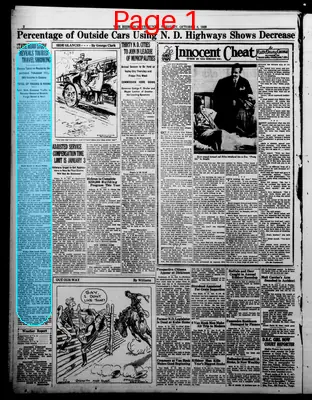
The Bismarck Tribune
Bismarck, Mandan, Burleigh County, Morton County, North Dakota
What is this article about?
North Dakota's 1929 highway traffic census shows a decline in foreign-registered vehicles to 21.3% from 25%, indicating shrinking tourist travel, while trucks rose to 7.9%. Total vehicles counted: 111,989. Heaviest traffic on Mandan Memorial Bridge at 3,531 daily.
Clipping

OCR Quality
Full Text
REVEALS TOURIST
TRAVEL SHRINKING
Census Taken on Routes by Department Tabulated 111,989 Vehicles in Classes
TOTAL OF TRUCKS IS RISING
Link With Greatest Traffic Is Mandan Memorial Stretch; Fargo Street is Next
Marked decrease in the number of foreign automobiles using North Dakota highways was recorded in the annual traffic census made during the summer, according to a report by the maintenance division of the state highway department.
Last year 67 per cent of the vehicles counted were registered in North Dakota and 25 per cent were registered in other states and the Canadian provinces.
This year the number of cars registered in the state lifted slightly to 67.4 per cent, but the number of foreign owned cars dropped to 21.3.
The total number of vehicles counted this year was 111,989 of which 76,700 were passenger automobiles owned in North Dakota. 24,267 passenger cars owned in other states. 267 transport line buses and 891 transport line trucks: 8,557 were trucks of less than two tons capacity and 1,198 were horse-drawn vehicles.
Although traffic was heavier during last summer than during a corresponding period in 1928, the exact percentage of increase has not been estimated. It may be impossible to obtain accurate figures on this since the traffic count was taken at more places this year than last.
Bad Roads at Heavy Points
The biggest increases in traffic, by classifications, were recorded by commercial truck lines and privately owned light trucks. Transport trucks on the highways jumped from 5 per cent of the total in 1928 to 7.9 per cent this year. Privately-owned light trucks jumped from 5 per cent a year ago to 7.5 per cent this year. The only other increase was shown in horse-drawn vehicles. This year they constituted 1.1 per cent of the total whereas, last year, they totaled only 0.7 per cent.
The number of heavy privately-owned trucks remained stationary at 1.6 per cent and the number of transport buses at 2 per cent.
Despite the decrease in percentage of foreign-owned passenger automobiles the state has made 6 per cent increase in this classification since 1925, when 15 per cent of the total number of such vehicles were of foreign registry.
Although horse-drawn vehicles made something of a comeback this year, the percentage was less than half that of 1925 when "Old Dobbin" furnished the motive power for 2.3 per cent of the vehicles counted.
The traffic count is taken annually by the highway department as a guide to both its maintenance and construction divisions. Arrangements are made in the annual budget to spend maintenance money more freely where traffic is heavy than where it is light, and the traffic count also is a factor in determining where new roads are to be built, the idea being to place roads where they will benefit the most people, insofar as possible.
Bridge Here Leads Traffic
A traffic census map issued by the highway department shows that traffic is heaviest at certain designated points near the state's principal cities.
Traffic over the Liberty Memorial bridge between Bismarck and Mandan still leads by a wide margin, the daily average number of vehicles for seven days being 3,531.
Next in order came the north road between Fargo and West Fargo with 1,819 and the road west of Valley City with 1,725. The south road from Fargo to West Fargo showed a count of 1,341, making the total average number of vehicles between Fargo and the suburb 3,160.
West of West Fargo the number of vehicles dropped to 1,632 but remained above 1,000 at all points until a point west of Buffalo, where it dropped to 970. East of Valley City the count was 1,134 but west of it the count was 1,725.
On U. S. No. 2, the main route in the northern part of the state, the banner count was 1,395 just west of Grand Forks. Just west of Minot it was 1,253.
No other routes in the state showed traffic counts above 1,000 per day, although north and south routes near some of the larger cities approached that figure.
The average daily number of vehicles using the Sanish bridge across the Missouri river was 335, while the average number using the Missouri river bridge at Williston was 403.
What sub-type of article is it?
What keywords are associated?
Where did it happen?
Domestic News Details
Primary Location
North Dakota
Event Date
Summer
Outcome
foreign-owned cars dropped to 21.3% of total vehicles (from 25% in 1928); trucks increased to 7.9%; total vehicles counted: 111,989; used to guide highway maintenance and construction.
Event Details
Annual traffic census by state highway department recorded 111,989 vehicles on North Dakota routes, showing decline in foreign automobiles indicating shrinking tourist travel, rise in trucks, and heaviest traffic on Mandan Memorial Bridge.