Thank you for visiting SNEWPapers!
Sign up free
Southern Christian Advocate
Charleston, Charleston County, South Carolina
What is this article about?
In 1523, inquisitors in the Low Countries captured and executed two young Augustinian monks, Esch and Voes, by burning in Brussels for refusing to recant Reformation beliefs. Lambert, the third, initially hesitated but later died similarly, inspiring widespread support for the gospel.
Clipping
OCR Quality
Full Text
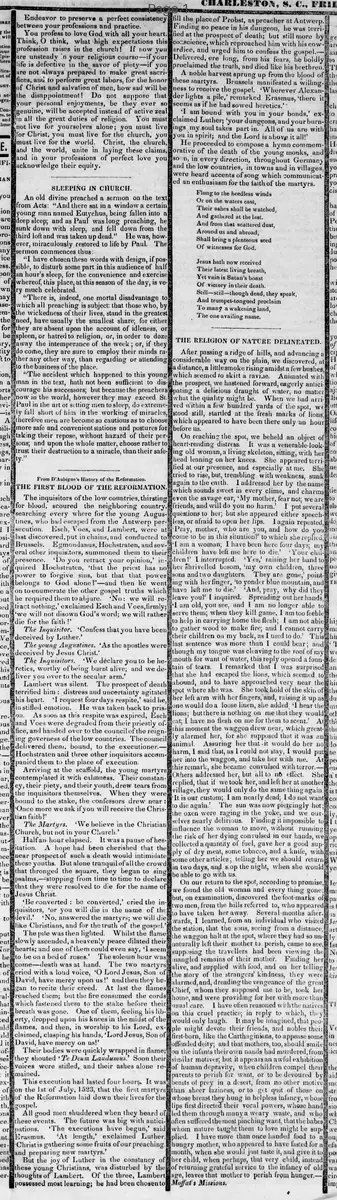
THE FIRST BLOOD OF THE REFORMATION
The inquisitors of the low countries, thirsting for blood, scoured the neighboring country searching every where for the young Augustines, who had escaped from the Antwerp persecution. Esch, Voes, and Lambert, were at last discovered, put in chains, and conducted to Brussels. Egmondanus, Hochstraten, and several other inquisitors, summoned them to their presence. 'Do you retract your opinion,' inquired Hochstraten, 'that the priest has no power to forgive sins, but that that power belongs to God alone?'—and then he went on to enumerate the other gospel truths which he required them to abjure. 'No: we will retract nothing,' exclaimed Esch and Voes, firmly 'we will not disown God's word; we will rather die for the faith!'
The Inquisitor. 'Confess that you have been deceived by Luther.'
The young Augustines. 'As the apostles were deceived by Jesus Christ.'
The Inquisitors. 'We declare you to be heretics, worthy of being burnt alive; and we deliver you over to the secular arm.'
Lambert was silent. The prospect of death terrified him: distress and uncertainty agitated his heart. 'I request four days respite,' said he in stifled emotion. He was taken back to prison. As soon as this respite was expired, Esch and Voes were degraded from their priestly office, and handed over to the council of the reigning governess of the low countries. The council delivered them, bound, to the executioner.—Hochstraten and three other inquisitors accompanied them to the place of execution.
Arriving at the scaffold, the young martyrs contemplated it with calmness. Their constancy, their piety, and their youth, drew tears from the inquisitors themselves. When they were bound to the stake, the confessors drew near: Once more we ask if you will receive the Christian faith?'
The Martyrs. 'We believe in the Christian Church, but not in your Church.'
Half an hour elapsed. It was a pause of hesitation. A hope had been cherished that the near prospect of such a death would intimidate these youths. But alone tranquil of all the crowd that thronged the square, they began to sing psalms,—stopping from time to time to declare that they were resolved to die for the name of Jesus Christ.
'Be converted: be converted,' cried the inquisitors, 'or you will die in the name of the devil.' 'No, answered the martyrs; we will die like Christians, and for the truth of the gospel.'
The pile was then lighted. Whilst the flame slowly ascended, a heavenly peace dilated their hearts; and one of them could even say, 'I seem to be on a bed of roses.' The solemn hour was come—death was at hand. The two martyrs cried with a loud voice, 'O Lord Jesus, Son of David, have mercy upon us!' and then they began to recite their creed. At last the flames reached them; but the fire consumed the cords which fastened them to the stake before their breath was gone. One of them, feeling his liberty, dropped upon his knees in the midst of the flames, and then, in worship to his Lord, exclaimed, clasping his hands, 'Lord Jesus, Son of David, have mercy on us!'
Their bodies were quickly wrapped in flame; they shouted 'Te Deum Laudamus.' Soon their voices were stifled, and their ashes alone remained.
This execution had lasted four hours. It was on the 1st of July, 1523, that the first martyrs of the Reformation laid down their lives for the gospel.
All good men shuddered when they heard of these events. The future was big with anticipations.
'The executions have begun,' said Erasmus.
'At length,' exclaimed Luther 'Christ is gathering some fruits of our preaching and preparing new martyrs.'
But the joy of Luther in the constancy of these young Christians, was disturbed by the thoughts of Lambert. Of the three, Lambert possessed most learning; he had been chosen to fill the place of Probst, as preacher at Antwerp. Finding no peace in his dungeon, he was terrified at the prospect of death; but still more by conscience, which reproached him with his cowardice, and urged him to confess the gospel.—Delivered, ere long, from his fears, he boldly proclaimed the truth, and died like his brethren.
A noble harvest sprung up from the blood of these martyrs. Brussels manifested a willingness to receive the gospel. 'Wherever Alexander lights a pile,' remarked Erasmus, 'there it seems as if he had sowed heretics.'
'I am bound with you in your bonds,' exclaimed Luther: 'your dungeons, and your burnings my soul takes part in. All of us are with you in spirit; and the Lord is above it all!'
He proceeded to compose a hymn commemorative of the death of the young monks, and soon, in every direction, throughout Germany and the low countries, in towns and in villages were heard accents of song which communicated an enthusiasm for the faith of the martyrs.
Flung to the heedless winds
Or on the waters cast,
Their ashes shall be watched,
And gathered at the last.
And from that scattered dust,
Around us and abroad,
Shall spring a plenteous seed
Of witnesses for God.
Jesus hath now received
Their latest living breath,
Yet vain is Satan's boast
Of victory in their death.
Still—still—though dead, they speak
And trumpet-tongued proclaim
To many a wakening land,
The one availing name.
What sub-type of article is it?
What keywords are associated?
What entities or persons were involved?
Where did it happen?
Foreign News Details
Primary Location
Low Countries, Brussels
Event Date
1st Of July, 1523
Key Persons
Outcome
esch and voes burnt alive; lambert later executed similarly; inspired gospel reception in brussels and hymns across germany and low countries.
Event Details
Inquisitors captured escaped Augustines Esch, Voes, and Lambert, demanding they retract beliefs that priests cannot forgive sins and other gospel truths. Esch and Voes refused, comparing their stance to apostles with Christ, leading to their degradation and execution by burning on July 1, 1523. They sang psalms and recited creed amid flames. Lambert hesitated but later confessed and died. The event produced hymns and enthusiasm for the faith.