Thank you for visiting SNEWPapers!
Sign up free
Independent Statesman
Concord, Merrimack County, New Hampshire
What is this article about?
Editorial defends Sen. Blaine's conciliatory speech in Richmond, Va., against 'gush' label, comparing it favorably to Pres. Hayes' 1877 Southern tour remarks praising Confederate valor and prioritizing white Southern interests over freedmen's federal protections. (214 chars)
Clipping
OCR Quality
Full Text
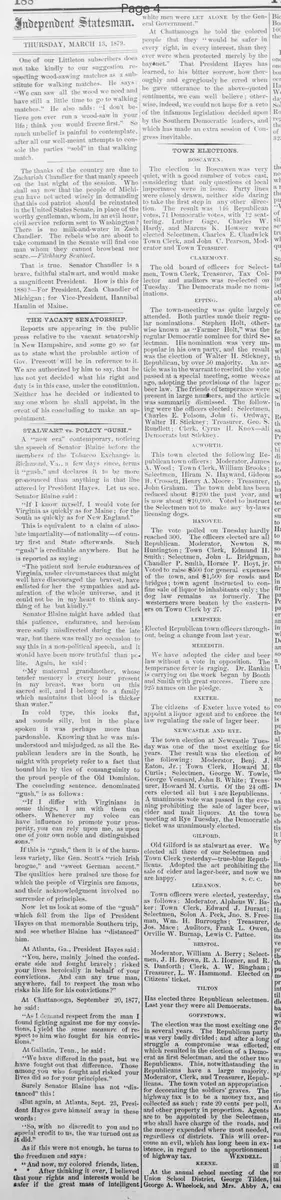
A "new era" contemporary, noticing the speech of Senator Blaine before the members of the Tobacco Exchange in Richmond, Va., a few days since, terms it "gush," and declares it to be more pronounced than anything in that line uttered by President Hayes. Let us see what Senator Blaine said:
"If I know myself, I would vote for Virginia as quickly as for Maine; for the South as quickly as for New England."
This is equivalent to a claim of absolute impartiality-of nationality-of country first and State afterwards. Such "gush" is creditable anywhere. But he is reported as saying:
"The patient and heroic endurances of Virginia, under circumstances that might well have discouraged the bravest, have enlisted for her the sympathies and admiration of the whole universe, and it could not be in my heart to think anything of her but kindly."
Senator Blaine might have added that this patience, endurance, and heroism were sadly misdirected during the late war, but there was really no occasion to say this in a non-political speech, and it would have been more truthful than polite. Again, he said:
"My maternal grandmother, whose tender memory is every hour present in my breast, was born on this sacred soil, and I belong to a family which maintains that blood is thicker than water."
In cold type, this looks flat and sounds silly, but in the place spoken it was perhaps more than pardonable. Knowing that he was misunderstood and misjudged, as all the Republican leaders are in the South, he might with propriety refer to a fact that bound him by ties of consanguinity to the proud people of the Old Dominion.
The concluding sentence, denominated "gush," is as follows:
"If I differ with Virginians in some things, I am with them on others. Whenever my voice can have influence to promote your prosperity, you can rely upon me, as upon one of your own noble and distinguished sons."
If this is "gush," then it is of the harmless variety, like Gen. Scott's "rich Irish brogue," and "sweet German accent." The qualities here praised are those for which the people of Virginia are famous, and their acknowledgment involved no surrender of principles.
Now let us look at some of the "gush" which fell from the lips of President Hayes on that memorable Southern trip, and see whether Blaine has "distanced" him.
At Atlanta, Ga., President Hayes said:
"You, here, mainly joined the confederate side and fought bravely: risked your lives heroically in behalf of your convictions. And can any true man, anywhere, fail to respect the man who risks his life for his convictions?"
At Chattanooga, September 20, 1877 he said:
"As I demand respect from the man I found fighting against me for my convictions, I yield the same measure of respect to him who fought for his convictions."
At Gallatin, Tenn., he said:
"We have differed in the past, but we have fought out that difference. Those among you who fought and risked your lives did so for your principles."
Surely Senator Blaine has not "distanced" this!
But again, at Atlanta, Sept. 23, President Hayes gave himself away in these words:
"So, with no discredit to you and no special credit to us, the war turned out as it did."
As if this were not enough, he turns to the freedmen and says:
"And now, my colored friends, listen. After thinking it over, I believed that your rights and interests would be safer if the great mass of intelligent white men were let alone by the General Government."
At Chattanooga he told the colored people that they "would be safer in every right, in every interest, than they ever were when protected merely by the bayonet." That President Hayes has learned, to his bitter sorrow, how thoroughly and egregiously he erred when he gave utterance to the above-quoted sentiments, we can well believe; otherwise, indeed, we could not hope for a veto of the infamous legislation decided upon by the Southern Democratic leaders, and which has made an extra session of Congress inevitable.
What sub-type of article is it?
What themes does it cover?
What keywords are associated?
What entities or persons were involved?
Where did it happen?
Story Details
Key Persons
Location
Richmond, Va.; Atlanta, Ga.; Chattanooga; Gallatin, Tenn.
Event Date
September 20, 1877; September 23, 1877
Story Details
Article defends Senator Blaine's speech in Richmond against criticism of 'gush,' highlighting his impartiality, family ties to Virginia, and support for Southern prosperity. Compares to President Hayes' Southern speeches praising Confederate bravery and suggesting policy shifts favoring white Southerners over federal protection for freedmen.