Thank you for visiting SNEWPapers!
Sign up free
Story
December 12, 1855
The Daily Gate City
Keokuk, Lee County, Iowa
What is this article about?
Review of Rev. Mr. Beers' lecture on 'Jonathan,' an allegory for America, praising its material and intellectual progress while urging balanced spiritual development to avoid barbarism. Notes the lecture's strengths and minor flaws in structure, and promotes the local Lyceum series.
Clipping
OCR Quality
98%
Excellent
Full Text
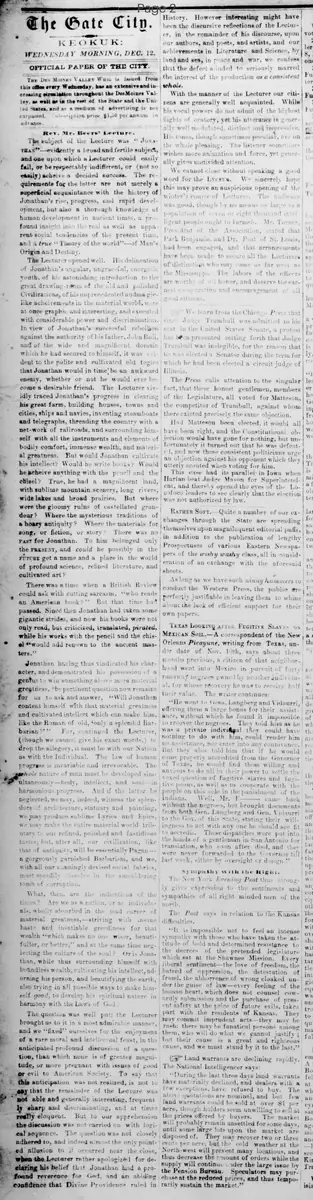
Rev. Mr. Beers' Lecture.
The subject of the Lecture was "Jonathan" evidently a broad and fertile subject, and one upon which a Lecturer could easily fail, or be respectfully indifferent, or (not so easily) achieve a decided success. The requirements for the latter are not merely a superficial acquaintance with the history of Jonathan's rise, progress, and rapid development, but also a thorough knowledge of human development in ancient times, a profound insight into the real as well as apparent social tendencies of the present time, and a true "Theory of the world"—of Man's Origin and Destiny.
The Lecturer opened well. His delineation of Jonathan's angular, ungraceful, energetic youth, of his astonishing introduction to the great drawing-room of the old and polished Civilizations, of his unprecedented and magic-like achievements in the material world, were at once graphic and interesting, and executed with considerable power and discrimination.
In view of Jonathan's successful rebellion against the authority of his father, John Bull, and of the wide and magnificent domain which he had secured to himself, it was evident to the polite and cultivated old fogies that Jonathan would in time be an awkward enemy, whether or not he would ever become a desirable friend. The Lecturer vividly traced Jonathan's progress in clearing his great farm, building houses, towns and cities, ships and navies, inventing steamboats and telegraphs, threading the country with a net-work of railroads, and surrounding himself with all the instruments and elements of bodily comfort, immense wealth, and material greatness. But would Jonathan cultivate his intellect? Would he write books? Would he achieve anything with the pencil and the chisel? True, he had a magnificent land, with sublime mountain scenery, long rivers, wide lakes and broad prairies. But where were the gloomy ruins of castellated grandeur? Where the mysterious traditions of a hoary antiquity? Where the materials for song, or fiction, or story? There was no Past for Jonathan. To him belonged only the Present, and could he possibly in the Future get a name and a place in the world of profound science, refined literature, and cultivated art?
There was a time when a British Review could ask with cutting sarcasm, "who reads an American book?" But that time has passed. Since then Jonathan had taken some gigantic strides, and now his books were not only read, but criticized, translated, pirated, while his works with the pencil and the chisel would add renown to the ancient masters.
Jonathan having thus vindicated his character, and demonstrated his possession of a genius to win something above mere material greatness, the pertinent question now remains for us to ask and answer. "Will Jonathan content himself with that material greatness and cultivated intellect which can make him, like the Roman of old, 'only a splendid Barbarian?'" For, continued the Lecturer, (though we cannot give his exact words,) to drop the allegory, it must be with our Nation as with the Individual. The law of human progress is invariable and irrevocable. The whole nature of man must be developed simultaneously—body, intellect, and soul—in harmonious progress. And if the latter be neglected, we may, indeed, witness the splendors of architecture, statuary and painting, we may produce sublime Lyries and Epics, we may make the entire material world tributary to our refined, polished and fastidious tastes; but, after all, our civilization, like that of antiquity, will be essentially Pagan—a gorgeously garnished Barbarism, and we, with all our cunningly devised social fabrics, must speedily dissolve in the smouldering tomb of corruption.
What, then, are the indications of the times? Are we as a nation, or as individuals, wholly absorbed in the mad career of material greatness,—striving with insane haste and insatiable greediness for that wealth "which makes no one wiser, beautifuller, or better," and at the same time neglecting the culture of the soul? Or is Jonathan, while thus surrounding himself with boundless wealth, cultivating his intellect, adorning his person, and beautifying the earth, also trying in all possible ways to make himself good, to develop his spiritual nature in harmony with the Laws of God?
The question was well put; the Lecturer brought us to it in a most admirable manner, and we "fixed" ourselves for the enjoyment of a rare moral and intellectual feast, in the anticipated profound discussion of a question, than which none is of greater magnitude, or more pregnant with issues of good or evil to American Society. To say that this anticipation was not realized, is not to say that the remainder of the Lecture was not able and generally interesting, frequently sharp and discriminating, and at times really eloquent. But to our apprehension the discussion was not carried on with logical sequence. The question was not closely adhered to, and indeed almost the only pointed allusion to it occurred near the close, when the Lecturer rather apologized for declaring his belief that Jonathan had a profound reverence for God, and an abiding confidence that Divine Providence ruled in History. However interesting might have been the discursive reflections of the Lecturer, in the remainder of his discourse, upon our authors, and poets, and artists, and our achievements in Literature and Science, by land and sea, in peace and war, we confess that the defect alluded to seriously marred the interest of the production as a consistent whole.
With the manner of the Lecturer our citizens are generally well acquainted. While his vocal powers do not admit of the highest flights of oratory, yet his utterance is generally well modulated, distinct and impressive. His tones, though sometimes peculiar, are on the whole pleasing. The listener sometimes wishes more animation and force, yet generally gives undivided attention.
We cannot close without speaking a good word for the Lyceum. We sincerely hope this may prove an auspicious opening of the winter's course of Lectures. The audience was good, though by no means so large as a population of seven or eight thousand intelligent people ought to furnish. Mr. Turner, President of the Association, stated that Park Benjamin, and Dr. Post of St. Louis, had been engaged, and that arrangements have been made to secure all the Lecturers of distinction who may come as far west as the Mississippi. The labors of the officers are worthy of all honor, and deserve the earnest cooperation and encouragement of all our citizens.
The subject of the Lecture was "Jonathan" evidently a broad and fertile subject, and one upon which a Lecturer could easily fail, or be respectfully indifferent, or (not so easily) achieve a decided success. The requirements for the latter are not merely a superficial acquaintance with the history of Jonathan's rise, progress, and rapid development, but also a thorough knowledge of human development in ancient times, a profound insight into the real as well as apparent social tendencies of the present time, and a true "Theory of the world"—of Man's Origin and Destiny.
The Lecturer opened well. His delineation of Jonathan's angular, ungraceful, energetic youth, of his astonishing introduction to the great drawing-room of the old and polished Civilizations, of his unprecedented and magic-like achievements in the material world, were at once graphic and interesting, and executed with considerable power and discrimination.
In view of Jonathan's successful rebellion against the authority of his father, John Bull, and of the wide and magnificent domain which he had secured to himself, it was evident to the polite and cultivated old fogies that Jonathan would in time be an awkward enemy, whether or not he would ever become a desirable friend. The Lecturer vividly traced Jonathan's progress in clearing his great farm, building houses, towns and cities, ships and navies, inventing steamboats and telegraphs, threading the country with a net-work of railroads, and surrounding himself with all the instruments and elements of bodily comfort, immense wealth, and material greatness. But would Jonathan cultivate his intellect? Would he write books? Would he achieve anything with the pencil and the chisel? True, he had a magnificent land, with sublime mountain scenery, long rivers, wide lakes and broad prairies. But where were the gloomy ruins of castellated grandeur? Where the mysterious traditions of a hoary antiquity? Where the materials for song, or fiction, or story? There was no Past for Jonathan. To him belonged only the Present, and could he possibly in the Future get a name and a place in the world of profound science, refined literature, and cultivated art?
There was a time when a British Review could ask with cutting sarcasm, "who reads an American book?" But that time has passed. Since then Jonathan had taken some gigantic strides, and now his books were not only read, but criticized, translated, pirated, while his works with the pencil and the chisel would add renown to the ancient masters.
Jonathan having thus vindicated his character, and demonstrated his possession of a genius to win something above mere material greatness, the pertinent question now remains for us to ask and answer. "Will Jonathan content himself with that material greatness and cultivated intellect which can make him, like the Roman of old, 'only a splendid Barbarian?'" For, continued the Lecturer, (though we cannot give his exact words,) to drop the allegory, it must be with our Nation as with the Individual. The law of human progress is invariable and irrevocable. The whole nature of man must be developed simultaneously—body, intellect, and soul—in harmonious progress. And if the latter be neglected, we may, indeed, witness the splendors of architecture, statuary and painting, we may produce sublime Lyries and Epics, we may make the entire material world tributary to our refined, polished and fastidious tastes; but, after all, our civilization, like that of antiquity, will be essentially Pagan—a gorgeously garnished Barbarism, and we, with all our cunningly devised social fabrics, must speedily dissolve in the smouldering tomb of corruption.
What, then, are the indications of the times? Are we as a nation, or as individuals, wholly absorbed in the mad career of material greatness,—striving with insane haste and insatiable greediness for that wealth "which makes no one wiser, beautifuller, or better," and at the same time neglecting the culture of the soul? Or is Jonathan, while thus surrounding himself with boundless wealth, cultivating his intellect, adorning his person, and beautifying the earth, also trying in all possible ways to make himself good, to develop his spiritual nature in harmony with the Laws of God?
The question was well put; the Lecturer brought us to it in a most admirable manner, and we "fixed" ourselves for the enjoyment of a rare moral and intellectual feast, in the anticipated profound discussion of a question, than which none is of greater magnitude, or more pregnant with issues of good or evil to American Society. To say that this anticipation was not realized, is not to say that the remainder of the Lecture was not able and generally interesting, frequently sharp and discriminating, and at times really eloquent. But to our apprehension the discussion was not carried on with logical sequence. The question was not closely adhered to, and indeed almost the only pointed allusion to it occurred near the close, when the Lecturer rather apologized for declaring his belief that Jonathan had a profound reverence for God, and an abiding confidence that Divine Providence ruled in History. However interesting might have been the discursive reflections of the Lecturer, in the remainder of his discourse, upon our authors, and poets, and artists, and our achievements in Literature and Science, by land and sea, in peace and war, we confess that the defect alluded to seriously marred the interest of the production as a consistent whole.
With the manner of the Lecturer our citizens are generally well acquainted. While his vocal powers do not admit of the highest flights of oratory, yet his utterance is generally well modulated, distinct and impressive. His tones, though sometimes peculiar, are on the whole pleasing. The listener sometimes wishes more animation and force, yet generally gives undivided attention.
We cannot close without speaking a good word for the Lyceum. We sincerely hope this may prove an auspicious opening of the winter's course of Lectures. The audience was good, though by no means so large as a population of seven or eight thousand intelligent people ought to furnish. Mr. Turner, President of the Association, stated that Park Benjamin, and Dr. Post of St. Louis, had been engaged, and that arrangements have been made to secure all the Lecturers of distinction who may come as far west as the Mississippi. The labors of the officers are worthy of all honor, and deserve the earnest cooperation and encouragement of all our citizens.
What sub-type of article is it?
Biography
Historical Event
What themes does it cover?
Moral Virtue
Triumph
Providence Divine
What keywords are associated?
Lecture Review
American Allegory
National Progress
Spiritual Development
Lyceum Series
Material Greatness
What entities or persons were involved?
Rev. Mr. Beers
Jonathan
John Bull
Mr. Turner
Park Benjamin
Dr. Post
Where did it happen?
West Of The Mississippi
Story Details
Key Persons
Rev. Mr. Beers
Jonathan
John Bull
Mr. Turner
Park Benjamin
Dr. Post
Location
West Of The Mississippi
Story Details
Rev. Mr. Beers lectures on 'Jonathan' as an allegory for America's rise from rebellion against John Bull (England), material achievements like railroads and inventions, intellectual progress in literature and arts, and the need for spiritual development to achieve true civilization, warning against pagan barbarism if soul is neglected.