Thank you for visiting SNEWPapers!
Sign up free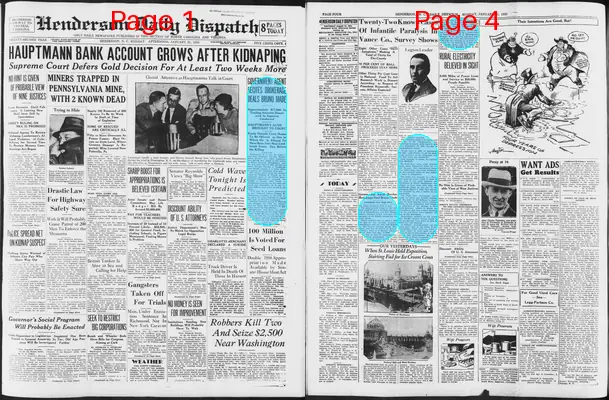
Henderson Daily Dispatch
Henderson, Vance County, North Carolina
What is this article about?
In the Bruno Hauptmann trial for the Lindbergh baby kidnapping and murder, a U.S. Treasury agent testifies that Hauptmann and his wife added $44,486 to their assets after the 1932 ransom payment, including ransom bills found in his garage. The state presents his car and refutes defense claims implicating Isadore Fisch.
Merged-components note: Continuation of Hauptmann trial brokerage story from page 1 to page 4.
Clippings
1 of 2
OCR Quality
Full Text
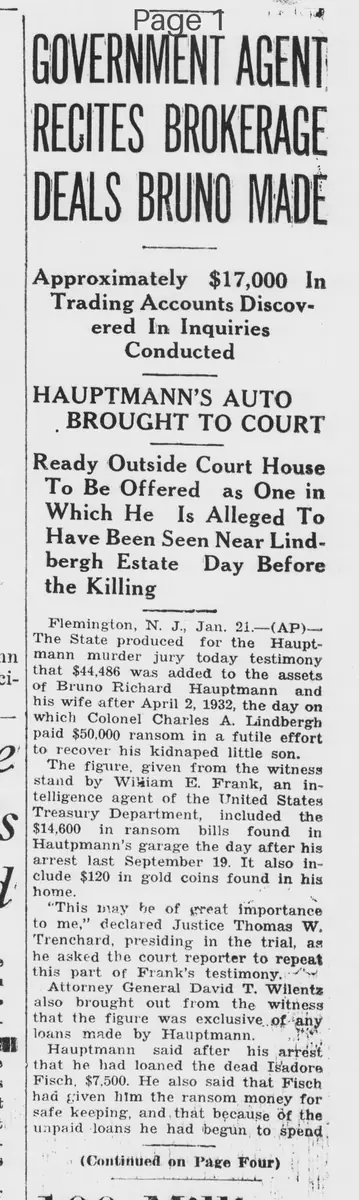
Approximately $17,000 In Trading Accounts Discovered In Inquiries Conducted
HAUPTMANN'S AUTO BROUGHT TO COURT
Ready Outside Court House To Be Offered as One in Which He Is Alleged To Have Been Seen Near Lindbergh Estate Day Before the Killing
Flemington, N. J., Jan. 21.-(AP)- The State produced for the Hauptmann murder jury today testimony that $44,486 was added to the assets of Bruno Richard Hauptmann and his wife after April 2, 1932, the day on which Colonel Charles A. Lindbergh paid $50,000 ransom in a futile effort to recover his kidnaped little son.
The figure, given from the witness stand by William E. Frank, an intelligence agent of the United States Treasury Department, included the $14,600 in ransom bills found in Hauptmann's garage the day after his arrest last September 19. It also included $120 in gold coins found in his home.
"This may be of great importance to me," declared Justice Thomas W. Trenchard, presiding in the trial, as he asked the court reporter to repeat this part of Frank's testimony.
Attorney General David T. Wilentz also brought out from the witness that the figure was exclusive of any loans made by Hauptmann.
Hauptmann said after his arrest that he had loaned the dead Isadore Fisch, $7,500. He also said that Fisch had given him the ransom money for safe keeping, and that because of the unpaid loans he had begun to spend
(Continued on Page Four)
Government Agent Recites Brokerage Deal Bruno Made
(Continued from Page One.)
it without knowing what it was.
The State placed Frank on the witness stand to give a detailed accounting of Hauptmann's and Mrs. Hauptmann's finances before and after the payment of the $50,000 ransom for the slain infant.
Frank testified that on April 2. 1932 the day of the ransom payment, Hauptmann and his wife had $203.90 in the Central Savings Bank, New York, and had 50 shares of Warner Brothers stock at a market value of $2 per share that day. or $100.
"So, that on April 2," Attorney General Wilentz emphasized, "the total cash and stock assets of the Hauptmanns was $203.90 in the bank and $100 in stocks."
"Yes," Frank asserted.
Then Wilentz asked how much cash was put by the Hauptmanns into brokerage accounts from April 2. 1932 until September 19, 1934, the day of Hauptmann's arrest.
"From April 2, 1932, to September 19, 1934," said Frank, "in all the brokerage accounts of the defendant and his wife there was $16,942.75."
Cash deposits in banks, he testified were $9,073.25.
He said there were other deposits which were eliminated from his report because they represented transfers. There were also some withdrawals. he testified, which he was unable to trace to disposition.
The State also brought to a driveway near the court, ready to show to the jury, it the court permits. the automobile in which Hauptmann was alleged to have been seen near the Lindbergh home on the day of tne kidnaping March 1, 1932. One witness has testified he saw a ladder in the automobile.
The State also announced itself ready to refute any further attempt on the part of the defense to implicate the dead German furrier, Isadore Fisch, in the kidnaping and murder or collection of the ransom. A New York attorney, Albert D. Kurtz, the prosecutors said, has a diary showing that he and Fisch were together the day of the kidnaping.
Hauptmann claimed on his arrest that $14,600 ransom money found in his garage had been given to him by Fisch for safe keeping.
A defense announcement on the same point was to the effect it had information Fisch used the name of "John" when he went back to Ger-many to die of tuberculosis. A woman giving this information, Mrs. Kurt Schwartz, a Bronx housewife, has not promised, to testify, however.
The man to whom the ransom money was turned over in St. Raymond's cemetery, the Bronx, by Dr. John F. "Jafsie" Condon, called himself "John." Dr. Condon has sworn this was Hauptmann.
A puzzling development of the day was a report to police by a youth nam ed Robert Grant. 18. at Hastings-on-Hudson, N. Y., that he had been kid-naped by two men who threatened to hold him as a hostage to prevent tes-timony for the defense by a man nam ed Manley. Grant told the police he had furnished Manley's name to the defense.
What sub-type of article is it?
What themes does it cover?
What keywords are associated?
What entities or persons were involved?
Where did it happen?
Story Details
Key Persons
Location
Flemington, N. J.
Event Date
Jan. 21
Story Details
U.S. Treasury agent William E. Frank testifies that Hauptmann and his wife added $44,486 to their assets after the April 2, 1932 ransom payment, including $14,600 in ransom bills found in his garage. Prior assets were minimal at $303.90. Brokerage deposits totaled $16,942.75 and bank deposits $9,073.25 from 1932-1934. The state presents Hauptmann's car allegedly seen near the Lindbergh home on March 1, 1932, and refutes defense claims implicating Isadore Fisch, supported by attorney Kurtz's diary. A youth reports being kidnapped to prevent defense testimony.