Thank you for visiting SNEWPapers!
Sign up free
Editorial
February 4, 1803
The National Intelligencer And Washington Advertiser
Washington, District Of Columbia
What is this article about?
The Aurora exposes a pamphlet titled 'Memoir to Bonaparte on the Utility of Colonizing Louisiana' as a forgery, accusing British agents or Federalists of creating it to incite war with France and Spain. It criticizes Federalist newspapers for promoting it and defends the current administration.
Clipping
OCR Quality
95%
Excellent
Full Text
From the Aurora.
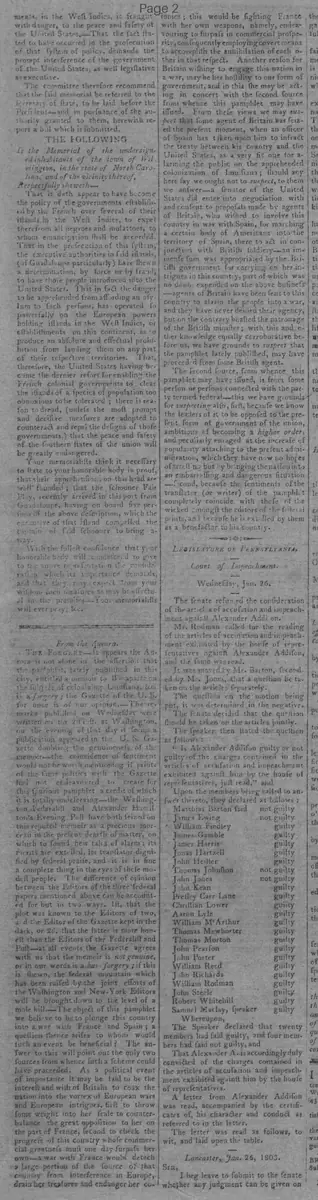
The Forgery—It appears the Aurora is not alone in the assertion that the pamphlet lately published in this city, entitled a memoir to Bonaparte on the utility of colonizing Louisiana, &c. is a forgery; the Gazette of the U. S. for once is of our opinion. The remarks published on Wednesday were written on the 21st. at Washington; on the evening of that day it appears a publication appeared in the U. S. Gazette doubting the genuineness of the memoir—the coincidence of sentiment would not be worth mentioning if prints of the same politics with the Gazette had not endeavored to create for this curious pamphlet a credit of which it is totally undeserving—the Washington Federalist and Alexander Hamilton's Evening Post have both seized on this reputed memoir as a precious morceau in the present dearth of matter, on which to found new tales of alarm: its merits are extolled, its translator dignified by federal praise, and it is in fine a complete thing in the eyes of these mode people. The difference of opinion between the Editors of the three federal papers mentioned above can be accounted for but in two ways. 1st, that the plot was known to the Editors of two, and the Editor of the Gazette kept in the dark, or 2d. that the latter is more honest than the Editors of the Federalist and Post—at all events the Gazette agrees with us that the memoir is not genuine, or in our words is a base forgery; if this is shown, the federal mountain which has been raised by the joint efforts of the Washington and New-York Editors will be brought down to the level of a mole hill.
The object of this pamphlet we believe to be to plunge this country into a war with France and Spain; a question thence arises to whom would such an event be beneficial? The answer to this will point out the only two sources from whence such a scheme could have proceeded. As a political event of importance it may be said to be the interest and wish of Britain to coax the nation into the vortex of European wars and European intrigues, first to throw some weight into her scale to counterbalance the great opposition to her on the part of France, second to check the progress of this country whose commercial greatness must one day surpass her own—a war with France would detach a large portion of the source of that country from interference in Europe, drain her treasures and endanger her colonies; this would be fighting France with her own weapons, namely, endeavoring to surpass in commercial prosperity, consequently employing covert means to accomplish the annihilation of each other in that respect. Another reason for Britain wishing to engage this nation in a war, may be her hostility to our form of government, and in this she may be acting in concert with the second source from whence this pamphlet may have issued. From these views we may suspect that some agent of Britain has seized the present moment, when an officer of Spain has taken upon him to infract the treaty between his Country and the United States, as a very fit one for alarming the public on the apprehended Colonization of Louisiana; should any here say we ought not to suspect, to them we answer—a Senator of the United States did enter into negotiation with and consent to proposals made by agents of Britain, who wished to involve this country in war with Spain, for marching a certain body of Americans into the territory of Spain, there to act in conjunction with British soldiery—an immense sum was appropriated by the British government for carrying on her intrigues in this country, part of which was no doubt expended on the above business—agents of Britain have been sent to this Country to alarm the people into a war, and they have never denied their agency, but on the contrary boasted the patronage of the British minister: with this and other knowledge equally corroborative before us, we have grounds to suspect that the pamphlet lately published, may have proceeded from some British agent.
The second source, from whence this pamphlet may have issued, is from some person or persons connected with the party termed federal—this we have grounds for suspecting also, first, because we know the leaders of it to be opposed to the present form of government of the union, ambitious of becoming a higher order, and peculiarly enraged at the increase of popularity attaching to the present administration, which they have now no hopes of arresting but by bringing the nation into an embarrassing and dangerous situation—second, because the sentiments of the translator (or writer) of the pamphlet completely coincide with those of the wicked amongst the editors of the federal prints, and because he is extolled by them as a benefactor to his country.
The Forgery—It appears the Aurora is not alone in the assertion that the pamphlet lately published in this city, entitled a memoir to Bonaparte on the utility of colonizing Louisiana, &c. is a forgery; the Gazette of the U. S. for once is of our opinion. The remarks published on Wednesday were written on the 21st. at Washington; on the evening of that day it appears a publication appeared in the U. S. Gazette doubting the genuineness of the memoir—the coincidence of sentiment would not be worth mentioning if prints of the same politics with the Gazette had not endeavored to create for this curious pamphlet a credit of which it is totally undeserving—the Washington Federalist and Alexander Hamilton's Evening Post have both seized on this reputed memoir as a precious morceau in the present dearth of matter, on which to found new tales of alarm: its merits are extolled, its translator dignified by federal praise, and it is in fine a complete thing in the eyes of these mode people. The difference of opinion between the Editors of the three federal papers mentioned above can be accounted for but in two ways. 1st, that the plot was known to the Editors of two, and the Editor of the Gazette kept in the dark, or 2d. that the latter is more honest than the Editors of the Federalist and Post—at all events the Gazette agrees with us that the memoir is not genuine, or in our words is a base forgery; if this is shown, the federal mountain which has been raised by the joint efforts of the Washington and New-York Editors will be brought down to the level of a mole hill.
The object of this pamphlet we believe to be to plunge this country into a war with France and Spain; a question thence arises to whom would such an event be beneficial? The answer to this will point out the only two sources from whence such a scheme could have proceeded. As a political event of importance it may be said to be the interest and wish of Britain to coax the nation into the vortex of European wars and European intrigues, first to throw some weight into her scale to counterbalance the great opposition to her on the part of France, second to check the progress of this country whose commercial greatness must one day surpass her own—a war with France would detach a large portion of the source of that country from interference in Europe, drain her treasures and endanger her colonies; this would be fighting France with her own weapons, namely, endeavoring to surpass in commercial prosperity, consequently employing covert means to accomplish the annihilation of each other in that respect. Another reason for Britain wishing to engage this nation in a war, may be her hostility to our form of government, and in this she may be acting in concert with the second source from whence this pamphlet may have issued. From these views we may suspect that some agent of Britain has seized the present moment, when an officer of Spain has taken upon him to infract the treaty between his Country and the United States, as a very fit one for alarming the public on the apprehended Colonization of Louisiana; should any here say we ought not to suspect, to them we answer—a Senator of the United States did enter into negotiation with and consent to proposals made by agents of Britain, who wished to involve this country in war with Spain, for marching a certain body of Americans into the territory of Spain, there to act in conjunction with British soldiery—an immense sum was appropriated by the British government for carrying on her intrigues in this country, part of which was no doubt expended on the above business—agents of Britain have been sent to this Country to alarm the people into a war, and they have never denied their agency, but on the contrary boasted the patronage of the British minister: with this and other knowledge equally corroborative before us, we have grounds to suspect that the pamphlet lately published, may have proceeded from some British agent.
The second source, from whence this pamphlet may have issued, is from some person or persons connected with the party termed federal—this we have grounds for suspecting also, first, because we know the leaders of it to be opposed to the present form of government of the union, ambitious of becoming a higher order, and peculiarly enraged at the increase of popularity attaching to the present administration, which they have now no hopes of arresting but by bringing the nation into an embarrassing and dangerous situation—second, because the sentiments of the translator (or writer) of the pamphlet completely coincide with those of the wicked amongst the editors of the federal prints, and because he is extolled by them as a benefactor to his country.
What sub-type of article is it?
Foreign Affairs
Partisan Politics
War Or Peace
What keywords are associated?
Pamphlet Forgery
Louisiana Colonization
British Intrigue
Federalist Plot
War With France
War With Spain
Political Alarm
What entities or persons were involved?
Aurora
Gazette Of The U. S.
Washington Federalist
Alexander Hamilton's Evening Post
Bonaparte
Britain
France
Spain
Federal Party
British Agents
Senator Of The United States
Editorial Details
Primary Topic
Exposure Of Forged Memoir On Louisiana Colonization To Incite War
Stance / Tone
Anti Federalist Suspicion Of British And Federalist Intrigue
Key Figures
Aurora
Gazette Of The U. S.
Washington Federalist
Alexander Hamilton's Evening Post
Bonaparte
Britain
France
Spain
Federal Party
British Agents
Senator Of The United States
Key Arguments
The Pamphlet Is A Forgery, As Confirmed By The Gazette Of The U. S.
Federalist Papers Promoted It Despite Doubts To Create Alarm.
The Forgery Aims To Plunge The U. S. Into War With France And Spain.
Britain Benefits By Counterbalancing France And Checking U. S. Commercial Growth.
Britain Opposes U. S. Government Form And May Collaborate With Federalists.
A U. S. Senator Negotiated With British Agents To Involve America In War With Spain.
Federalists Oppose The Current Administration And Seek To Embarrass It Through War.