Thank you for visiting SNEWPapers!
Sign up free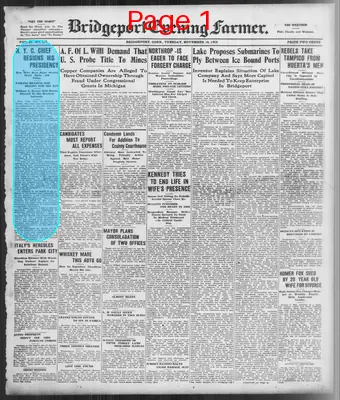
The Bridgeport Evening Farmer
Bridgeport, Fairfield County, Connecticut
What is this article about?
William C. Brown, 60-year-old president of New York Central Lines with 44 years in railroads, resigned on Nov. 18 due to failing hearing and long service; effective Jan. 1, 1914. A. H. Smith to succeed; Brown to pursue Western interests.
Clipping
OCR Quality
Full Text
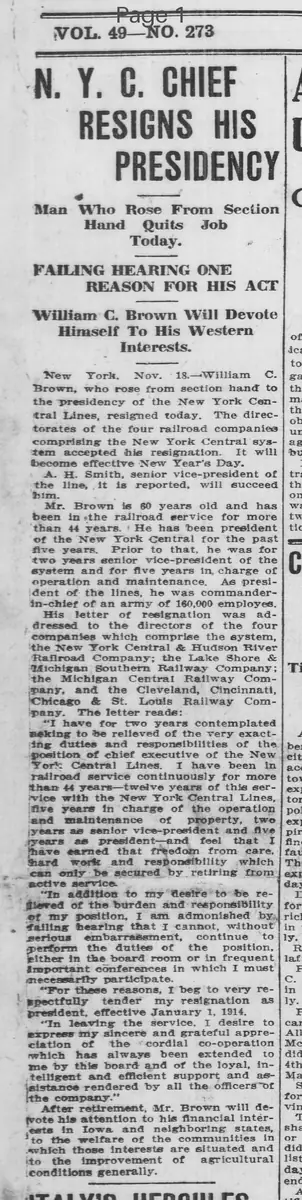
N. Y. C. CHIEF RESIGNS HIS PRESIDENCY
Man Who Rose From Section Hand Quits Job Today.
FAILING HEARING ONE REASON FOR HIS ACT
William C. Brown Will Devote Himself To His Western Interests.
New York, Nov. 18.—William C. Brown, who rose from section hand to the presidency of the New York Central Lines, resigned today. The directorates of the four railroad companies comprising the New York Central system accepted his resignation. It will become effective New Year's Day.
A. H. Smith, senior vice-president of the line, it is reported, will succeed him.
Mr. Brown is 60 years old and has been in the railroad service for more than 44 years. He has been president of the New York Central for the past five years. Prior to that, he was for two years senior vice-president of the system and for five years in charge of operation and maintenance. As president of the lines, he was commander-in-chief of an army of 160,000 employes.
His letter of resignation was addressed to the directors of the four companies which comprise the system, the New York Central & Hudson River Railroad Company; the Lake Shore & Michigan Southern Railway Company; the Michigan Central Railway Company, and the Cleveland, Cincinnati, Chicago & St. Louis Railway Company. The letter reads:
"I have for two years contemplated seeking to be relieved of the very exacting duties and responsibilities of the position of chief executive of the New York Central Lines. I have been in railroad service continuously for more than 44 years—twelve years of this service with the New York Central Lines, five years in charge of the operation and maintenance of property, two years as senior vice-president and five years as president—and feel that I have earned that freedom from care, hard work and responsibility which can only be secured by retiring from active service.
"In addition to my desire to be relieved of the burden and responsibility of my position, I am admonished by failing hearing that I cannot, without serious embarrassment, continue to perform the duties of the position, either in the board room or in frequent important conferences in which I must necessarily participate.
"For these reasons, I beg to very respectfully tender my resignation as president, effective January 1, 1914.
In leaving the service, I desire to express my sincere and grateful appreciation of the cordial co-operation which has always been extended to me by this board and of the loyal, intelligent and efficient support and assistance rendered by all the officers of the company."
After retirement, Mr. Brown will devote his attention to his financial interests in Iowa and neighboring states, to the welfare of the communities in which those interests are situated and to the improvement of agricultural conditions generally.
What sub-type of article is it?
What keywords are associated?
What entities or persons were involved?
Where did it happen?
Domestic News Details
Primary Location
New York
Event Date
Nov. 18
Key Persons
Outcome
resignation accepted by directorates of the four railroad companies; effective january 1, 1914; a. h. smith reported to succeed him; brown to focus on financial interests in iowa and neighboring states, community welfare, and agricultural improvements.
Event Details
William C. Brown, who rose from section hand to presidency of the New York Central Lines, resigned due to failing hearing and desire for relief from duties after 44 years in railroad service. His letter expressed appreciation for cooperation and support.