Thank you for visiting SNEWPapers!
Sign up free
Kentucky Gazette
Lexington, Fayette County, Kentucky
What is this article about?
Andrew Jackson reports a U.S. victory at Fort Bowyer on September 15, 1814, where Major Lawrence's forces repelled a British naval and land attack led by Sir W. H. Percy and Col. Nicholls, resulting in the destruction of the British ship Hermes. Includes general orders and Nicholls's proclamation to Louisiana inhabitants.
Clipping
OCR Quality
Full Text
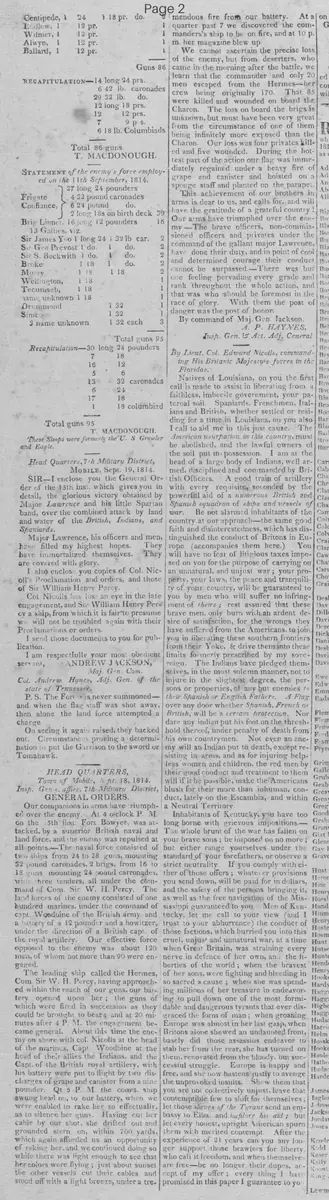
Head Quarters, 7th Military District,
MOBILE, Sept. 19, 1814.
SIR—I enclose you the General Order of the 15th inst. which gives you in detail, the glorious victory obtained by Major Lawrence and his little Spartan band, over the combined attack by land and water of the British, Indians, and Spaniards.
Major Lawrence, his officers and men, have fulfilled my highest hopes. They have immortalized themselves. They are covered with glory.
I also enclose you copies of Col. Nicholls's Proclamation and orders, and those of Sir William Henry Percy.
Col. Nicholls has lost an eye in the late engagement, and Sir William Henry Percy a ship, from which it is fair to presume we will not be troubled again with their Proclamations or orders.
I send those documents to you for publication.
I am respectfully your most obedient servant,
ANDREW JACKSON,
Maj. Gen. Com.
Col. Andrew Hynes, Adj. Gen. of the state of Tennessee.
P. S. The Fort was never summoned—and when the flag staff was shot away, then alone the land force attempted a charge. On seeing it again raised, they backed out. Circumstances proving a determination to put the Garrison to the sword or Tomahawk.
HEAD QUARTERS,
Town of Mobile, Sept. 18, 1814.
Ins. Gen.'s office, 7th Military District,
GENERAL ORDERS.
Our companions in arms have triumphed over the enemy. At 4 o'clock P. M. on the 15th inst. Fort Bowyer, was attacked, by a superior British naval and land force, and the enemy was repulsed at all points.—The naval force consisted of two ships from 24 to 28 guns, mounting 32 pound carronades, 2 brigs, from 16 to 18 guns mounting 24 pound carronades, with three tenders, all under the command of Com. Sir W. H. Percy. The land forces of the enemy consisted of one hundred marines, under the command of Capt. Woodbine of the British army, and a battery of a 12 pounder and a howitzer, under the direction of a British Capt. of the royal artillery. Our effective force opposed to the enemy was about 120 men, of whom not more than 90 were engaged.
The leading ship called the Hermes, Com. Sir W. H. Percy, having approached within the reach of our guns, our battery opened upon her; the guns of which were fired in succession as they could be brought to bear; and at 20 minutes after 4 P. M. the engagement became general. About this time the enemy on shore with col. Nicholls at the head of the marines, Capt. Woodbine at the head of their allies the Indians, and the Capt. of the British royal artillery, with his battery were put to flight by two discharges of grape and canister from a nine pounder. At 5 P. M. the com.'s. ship swung head on, to our battery, when we were enabled to rake her so effectually, as to silence her guns. Having cut her cable by our shot, she drifted out and grounded stern on, within 700 yards, which again afforded us an opportunity of raking her, and we continued doing so while there was light enough to see that her colors were flying; just about sunset the other vessels cut their cables and stood off with a light breeze, under a tremendous fire from our battery. At a quarter past 7 we discovered the commander's ship to be on fire, and at 10 p. m. her magazine blew up.
We cannot ascertain the precise loss of the enemy, but from deserters, who came in the morning after the battle, we learn that the commander and only 20 men escaped from the Hermes—her crew being originally 170. That 85 were killed and wounded on board the Charon. The loss on board the brigs is unknown, but must have been very great from the circumstance of one of them being infinitely more exposed than the Charon. Our loss was four privates killed and five wounded. During the hottest part of the action our flag was immediately regained under a heavy fire of grape and canister and hoisted on a sponge staff and planted on the parapet.
This achievement of our brothers in arms is dear to us, and calls for, and will have the gratitude of a grateful country!
Our arms have triumphed over the enemy—The brave officers, non-commissioned officers and privates under the command of the gallant major Lawrence, have done their duty, and in point of cool and determined courage their conduct cannot be surpassed.—There was but one feeling pervading every grade and rank throughout the whole action, and that was who should be foremost in the race of glory. With them the post of danger was the post of honor.
By command of Maj. Gen. Jackson.
A. P. HAYNES.
Ins. Gen. & Act. Adj. General.
By Lieut. Col. Edward Nicholls, commanding His Britannic Majesty's forces in the Floridas.
Natives of Louisiana, on you the first call is made to assist in liberating from a faithless, imbecile government, your paternal soil. Spaniards, Frenchmen, Italians and British, whether settled or residing for a time in Louisiana, on you also I call to aid me in this just cause. The American usurpation in this country, must be abolished, and the lawful owners of the soil put in possession. I am at the head of a large body of Indians, well armed, disciplined and commanded by British Officers. A good train of artillery with every requisite, seconded by the powerful aid of a numerous British and Spanish squadron of ships and vessels of war.
Be not alarmed inhabitants of the country at our approach—the same good faith and disinterestedness, which has distinguished the conduct of Britons in Europe (accompanies them here.) You will have no fear of litigious taxes imposed on you for the purpose of carrying on an unnatural, and unjust war; your property, your laws, the peace and tranquility of your country, will be guaranteed to you by men who will suffer no infringement of theirs; rest assured that these brave men, only burn with an ardent desire of satisfaction, for the wrongs they have suffered from the Americans. to join you in liberating these southern frontiers from their Yoke, & drive them into these limits formerly prescribed by my sovereign. The Indians have pledged themselves, in the most solemn manner, not to injure in the slightest degree, the persons or properties, of any but enemies to their Spanish or English Fathers. A Flag over any door whether Spanish, French or British, will be a certain protection. Nor dare any Indian put his foot on the threshold thereof, under penalty of death from his own countrymen. Not even an enemy will an Indian put to death, except resisting in arms, and as for injuring helpless women and children, the red men by their good conduct and treatment to them will if it be possible, make the Americans blush for their more than inhuman, conduct, lately on the Escambia, and within a Neutral Territory.
Inhabitants of Kentucky, you have too long borne with grievous impositions.—The whole brunt of the war has fallen on your brave sons; be imposed on no more; but either range yourselves under the standard of your forefathers, or observe a strict neutrality. If you comply with either of those offers; whatever provisions you send down, will be paid for in dollars, and the safety of the persons bringing it, as well as the free navigation of the Mississippi guaranteed to you. Men of Kentucky, let me call to your view (and I trust to your abhorrence) the conduct of those factions, which hurried you into this cruel, unjust and unnatural war, at a time when Great Britain, was straining every nerve in defence of her own, and the liberties of the world; when the bravest of her sons, were fighting and bleeding in so sacred a cause; when she was spending millions of her treasure in endeavoring to pull down one of the most formidable and dangerous tyrants that ever disgraced the form of man; when groaning Europe was almost in her last gasp, when Britons alone shewed an undaunted front, basely did those assassins endeavor to stab her from the rear, she has turned on them, renovated from the bloody. but successful struggle. Europe is happy and free, and she now hastens justly to avenge the unprovoked insults. Shew them that you are not collectively unjust, leave that contemptible few to shift for themselves, let those slaves of the Tyrant send an embassy to Elba, and implore his aid; but let every honest, upright American spurn them with merited contempt. After the experience of 21 years can you any longer support those brawlers for liberty. who call it freedom, and when themselves are free—be no longer their dupes, accept of my offer; every thing I have promised in this paper I guarantee to you
What sub-type of article is it?
What keywords are associated?
What entities or persons were involved?
Where did it happen?
Domestic News Details
Primary Location
Fort Bowyer, Mobile
Event Date
Sept. 15, 1814
Key Persons
Outcome
u.s. loss: four privates killed, five wounded. british: hermes crew originally 170, commander and 20 escaped; 85 killed and wounded on charon; hermes ship destroyed by explosion. enemy repulsed at all points.
Event Details
Fort Bowyer attacked by superior British naval force (Hermes, other ships under Sir W. H. Percy) and land force (marines, Indians under Col. Nicholls and Capt. Woodbine). U.S. forces of about 120 men, 90 engaged, repelled attack starting at 4 P.M. Hermes grounded, raked by fire, caught fire, magazine exploded at 10 P.M. Land forces fled after artillery discharge.