Thank you for visiting SNEWPapers!
Sign up free
Story
March 28, 1911
The Daily Ardmoreite
Ardmore, Carter County, Oklahoma
What is this article about?
Ancient 'Guarnacci Hercules' statue, believed carved by Lysippus 2,200 years ago, rediscovered in London warehouse after 15 years; to be displayed at Earl's Court exhibition following eventful history from Rome to Paris.
Clipping
OCR Quality
78%
Good
Full Text
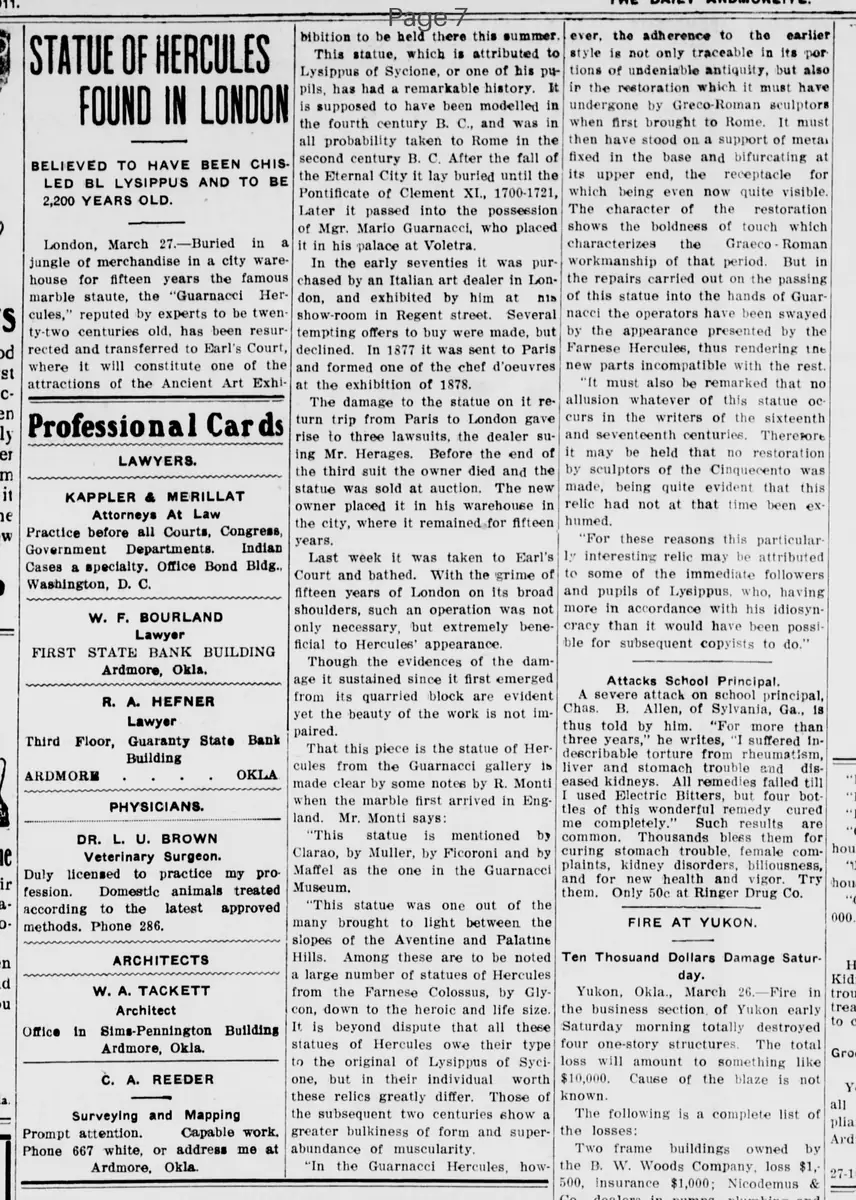
STATUE OF HERCULES FOUND IN LONDON
BELIEVED TO HAVE BEEN CHISELED BY LYSIPPUS AND TO BE 2,200 YEARS OLD.
London, March 27.-Buried in a jungle of merchandise in a city warehouse for fifteen years the famous marble statue, the "Guarnacci Hercules," reputed by experts to be twenty-two centuries old, has been resurrected and transferred to Earl's Court, where it will constitute one of the attractions of the Ancient Art Exhibition to be held there this summer.
This statue, which is attributed to Lysippus of Sicyone or one of his pupils, has had a remarkable history. It is supposed to have been modelled in the fourth century B. C., and was in all probability taken to Rome in the second century B. C. After the fall of the Eternal City it lay buried until the Pontificate of Clement XI., 1700-1721. Later it passed into the possession of Mgr. Mario Guarnacci, who placed it in his palace at Volterra. In the early seventies it was purchased by an Italian art dealer in London, and exhibited by him at his show-room in Regent street. Several tempting offers to buy were made, but declined. In 1877 it was sent to Paris and formed one of the chef d'oeuvres at the exhibition of 1878. The damage to the statue on its return trip from Paris to London gave rise to three lawsuits, the dealer suing Mr. Herages. Before the end of the third suit the owner died and the statue was sold at auction. The new owner placed it in his warehouse in the city, where it remained for fifteen years. Last week it was taken to Earl's Court and bathed. With the grime of fifteen years of London on its broad shoulders, such an operation was not only necessary, but extremely beneficial to Hercules' appearance. Though the evidences of the damage it sustained since it first emerged from its quarried block are evident yet the beauty of the work is not impaired. That this piece is the statue of Hercules from the Guarnacci gallery is made clear by some notes by R. Monti when the marble first arrived in England. Mr. Monti says: "This statue is mentioned by Claraco, by Muller, by Ficoroni and by Maffei as the one in the Guarnacci Museum. "This statue was one out of the many brought to light between the slopes of the Aventine and Palatine Hills. Among these are to be noted a large number of statues of Hercules from the Farnese Colossus, by Glycon, down to the heroic and life size. It is beyond dispute that all these statues of Hercules owe their type to the original of Lysippus of Sicyone, but in their individual worth these relics greatly differ. Those of the subsequent two centuries show a greater bulkiness of form and superabundance of muscularity. "In the Guarnacci Hercules, however, the adherence to the earlier style is not only traceable in its portions of undeniable antiquity, but also in the restoration which it must have undergone by Greco-Roman sculptors when first brought to Rome. It must then have stood on a support of metal fixed in the base and bifurcating at its upper end, the receptacle for which being even now quite visible. The character of the restoration shows the boldness of touch which characterizes the Graeco-Roman workmanship of that period. But in the repairs carried out on the passing of this statue into the hands of Guarnacci the operators have been swayed by the appearance presented by the Farnese Hercules, thus rendering the new parts incompatible with the rest. "It must also be remarked that no allusion whatever of this statue occurs in the writers of the sixteenth and seventeenth centuries. Therefore it may be held that no restoration by sculptors of the Cinquecento was made, being quite evident that this relic had not at that time been exhumed. "For these reasons this particularly interesting relic may be attributed to some of the immediate followers and pupils of Lysippus, who, having more in accordance with his idiosyncrasy than it would have been possible for subsequent copyists to do."
BELIEVED TO HAVE BEEN CHISELED BY LYSIPPUS AND TO BE 2,200 YEARS OLD.
London, March 27.-Buried in a jungle of merchandise in a city warehouse for fifteen years the famous marble statue, the "Guarnacci Hercules," reputed by experts to be twenty-two centuries old, has been resurrected and transferred to Earl's Court, where it will constitute one of the attractions of the Ancient Art Exhibition to be held there this summer.
This statue, which is attributed to Lysippus of Sicyone or one of his pupils, has had a remarkable history. It is supposed to have been modelled in the fourth century B. C., and was in all probability taken to Rome in the second century B. C. After the fall of the Eternal City it lay buried until the Pontificate of Clement XI., 1700-1721. Later it passed into the possession of Mgr. Mario Guarnacci, who placed it in his palace at Volterra. In the early seventies it was purchased by an Italian art dealer in London, and exhibited by him at his show-room in Regent street. Several tempting offers to buy were made, but declined. In 1877 it was sent to Paris and formed one of the chef d'oeuvres at the exhibition of 1878. The damage to the statue on its return trip from Paris to London gave rise to three lawsuits, the dealer suing Mr. Herages. Before the end of the third suit the owner died and the statue was sold at auction. The new owner placed it in his warehouse in the city, where it remained for fifteen years. Last week it was taken to Earl's Court and bathed. With the grime of fifteen years of London on its broad shoulders, such an operation was not only necessary, but extremely beneficial to Hercules' appearance. Though the evidences of the damage it sustained since it first emerged from its quarried block are evident yet the beauty of the work is not impaired. That this piece is the statue of Hercules from the Guarnacci gallery is made clear by some notes by R. Monti when the marble first arrived in England. Mr. Monti says: "This statue is mentioned by Claraco, by Muller, by Ficoroni and by Maffei as the one in the Guarnacci Museum. "This statue was one out of the many brought to light between the slopes of the Aventine and Palatine Hills. Among these are to be noted a large number of statues of Hercules from the Farnese Colossus, by Glycon, down to the heroic and life size. It is beyond dispute that all these statues of Hercules owe their type to the original of Lysippus of Sicyone, but in their individual worth these relics greatly differ. Those of the subsequent two centuries show a greater bulkiness of form and superabundance of muscularity. "In the Guarnacci Hercules, however, the adherence to the earlier style is not only traceable in its portions of undeniable antiquity, but also in the restoration which it must have undergone by Greco-Roman sculptors when first brought to Rome. It must then have stood on a support of metal fixed in the base and bifurcating at its upper end, the receptacle for which being even now quite visible. The character of the restoration shows the boldness of touch which characterizes the Graeco-Roman workmanship of that period. But in the repairs carried out on the passing of this statue into the hands of Guarnacci the operators have been swayed by the appearance presented by the Farnese Hercules, thus rendering the new parts incompatible with the rest. "It must also be remarked that no allusion whatever of this statue occurs in the writers of the sixteenth and seventeenth centuries. Therefore it may be held that no restoration by sculptors of the Cinquecento was made, being quite evident that this relic had not at that time been exhumed. "For these reasons this particularly interesting relic may be attributed to some of the immediate followers and pupils of Lysippus, who, having more in accordance with his idiosyncrasy than it would have been possible for subsequent copyists to do."
What sub-type of article is it?
Historical Event
Curiosity
What themes does it cover?
Fortune Reversal
What keywords are associated?
Hercules Statue
Lysippus
Guarnacci
Ancient Sculpture
London Warehouse
Art Exhibition
What entities or persons were involved?
Lysippus
Mario Guarnacci
R. Monti
Where did it happen?
London
Story Details
Key Persons
Lysippus
Mario Guarnacci
R. Monti
Location
London
Event Date
March 27
Story Details
The 'Guarnacci Hercules' marble statue, reputedly 2,200 years old and attributed to Lysippus or his pupils, was rediscovered in a London warehouse after 15 years of storage and prepared for exhibition at Earl's Court, revealing its remarkable history from ancient Rome to modern times.