Thank you for visiting SNEWPapers!
Sign up free
Letter to Editor
February 10, 1831
Richmond Enquirer
Richmond, Richmond County, Virginia
What is this article about?
The Temperance Orator writes to the Enquirer to clarify that he did not intend an indiscriminate censure of the House of Delegates in his temperance speech, disclaims any such misquotation, refers critics to prior reports, and declines further formal response to 'A Friend to Truth,' ending the controversy.
Clipping
OCR Quality
95%
Excellent
Full Text
For The Enquirer.
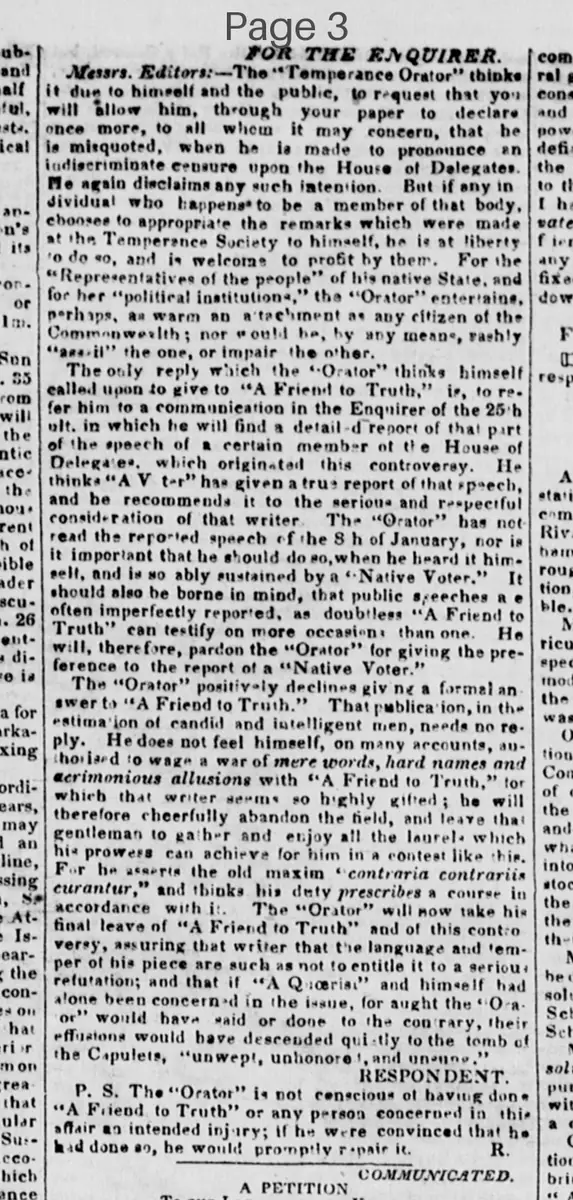
Messrs. Editors:—The "Temperance Orator" thinks it due to himself and the public, to request that you will allow him, through your paper to declare once more, to all whom it may concern, that he is misquoted, when he is made to pronounce an indiscriminate censure upon the House of Delegates. He again disclaims any such intention. But if any individual who happens to be a member of that body, chooses to appropriate the remarks which were made at the Temperance Society to himself, he is at liberty to do so, and is welcome to profit by them. For the "Representatives of the people" of his native State, and for her "political institutions," the "Orator" entertains, perhaps, as warm an attachment as any citizen of the Commonwealth; nor would he, by any means, rashly "assail" the one, or impair the other.
The only reply which the "Orator" thinks himself called upon to give to "A Friend to Truth," is, to refer him to a communication in the Enquirer of the 25th ult. in which he will find a detailed report of that part of the speech of a certain member of the House of Delegates, which originated this controversy. He thinks "A V——r" has given a true report of that speech, and he recommends it to the serious and respectful consideration of that writer. The "Orator" has not read the reported speech of the 5th of January, nor is it important that he should do so, when he heard it himself, and is so ably sustained by a "Native Voter." It should also be borne in mind, that public speeches are often imperfectly reported, as doubtless "A Friend to Truth" can testify on more occasions than one. He will, therefore, pardon the "Orator" for giving the preference to the report of a "Native Voter."
The "Orator" positively declines giving a formal answer to "A Friend to Truth." That publication, in the estimation of candid and intelligent men, needs no reply. He does not feel himself, on many accounts, authorized to wage a war of mere words, hard names and acrimonious allusions with "A Friend to Truth," for which that writer seems so highly gifted; he will therefore cheerfully abandon the field, and leave that gentleman to gather and enjoy all the laurel which his powers can achieve for him in a contest like his. For he asserts the old maxim contraria contrariis curantur." and thinks his duty prescribes a course in accordance with it. The "Orator" will now take his final leave of "A Friend to Truth" and of this controversy, assuring that writer that the language and temper of his piece are such as not to entitle it to a serious refutation; and that if "A Querist" and himself had alone been concerned in the issue, for aught the Orator would have said or done to the contrary, their effusions would have descended quietly to the tomb of the Capulets, "unwept, unhonored, and unsung."
RESPONDENT
P. S. The "Orator" is not conscious of having done "A Friend to Truth" or any person concerned in this affair any intended injury; if he were convinced that he had done so, he would promptly repair it.
R.
Messrs. Editors:—The "Temperance Orator" thinks it due to himself and the public, to request that you will allow him, through your paper to declare once more, to all whom it may concern, that he is misquoted, when he is made to pronounce an indiscriminate censure upon the House of Delegates. He again disclaims any such intention. But if any individual who happens to be a member of that body, chooses to appropriate the remarks which were made at the Temperance Society to himself, he is at liberty to do so, and is welcome to profit by them. For the "Representatives of the people" of his native State, and for her "political institutions," the "Orator" entertains, perhaps, as warm an attachment as any citizen of the Commonwealth; nor would he, by any means, rashly "assail" the one, or impair the other.
The only reply which the "Orator" thinks himself called upon to give to "A Friend to Truth," is, to refer him to a communication in the Enquirer of the 25th ult. in which he will find a detailed report of that part of the speech of a certain member of the House of Delegates, which originated this controversy. He thinks "A V——r" has given a true report of that speech, and he recommends it to the serious and respectful consideration of that writer. The "Orator" has not read the reported speech of the 5th of January, nor is it important that he should do so, when he heard it himself, and is so ably sustained by a "Native Voter." It should also be borne in mind, that public speeches are often imperfectly reported, as doubtless "A Friend to Truth" can testify on more occasions than one. He will, therefore, pardon the "Orator" for giving the preference to the report of a "Native Voter."
The "Orator" positively declines giving a formal answer to "A Friend to Truth." That publication, in the estimation of candid and intelligent men, needs no reply. He does not feel himself, on many accounts, authorized to wage a war of mere words, hard names and acrimonious allusions with "A Friend to Truth," for which that writer seems so highly gifted; he will therefore cheerfully abandon the field, and leave that gentleman to gather and enjoy all the laurel which his powers can achieve for him in a contest like his. For he asserts the old maxim contraria contrariis curantur." and thinks his duty prescribes a course in accordance with it. The "Orator" will now take his final leave of "A Friend to Truth" and of this controversy, assuring that writer that the language and temper of his piece are such as not to entitle it to a serious refutation; and that if "A Querist" and himself had alone been concerned in the issue, for aught the Orator would have said or done to the contrary, their effusions would have descended quietly to the tomb of the Capulets, "unwept, unhonored, and unsung."
RESPONDENT
P. S. The "Orator" is not conscious of having done "A Friend to Truth" or any person concerned in this affair any intended injury; if he were convinced that he had done so, he would promptly repair it.
R.
What sub-type of article is it?
Persuasive
Political
Reflective
What themes does it cover?
Temperance
Politics
Morality
What keywords are associated?
Temperance Orator
House Of Delegates
Friend To Truth
Speech Controversy
Native Voter
Political Institutions
Misquotation
What entities or persons were involved?
The Temperance Orator (Respondent, R.)
Messrs. Editors
Letter to Editor Details
Author
The Temperance Orator (Respondent, R.)
Recipient
Messrs. Editors
Main Argument
the temperance orator clarifies he did not intend indiscriminate censure of the house of delegates, refers to prior reports for context, and declines formal engagement with 'a friend to truth,' choosing to end the controversy.
Notable Details
Misquotation Regarding House Of Delegates
Reference To Enquirer Communication Of 25th Ult.
Preference For 'Native Voter' Report Over January 5th Speech Report
Latin Maxim 'Contraria Contrariis Curantur'
Shakespeare Allusion 'Unwept, Unhonored, And Unsung'