Thank you for visiting SNEWPapers!
Sign up free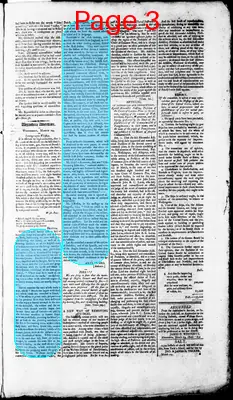
Editorial
March 24, 1802
Alexandria Advertiser And Commercial Intelligencer
Alexandria, Virginia
What is this article about?
The editorial harshly criticizes the British East-India Company's avaricious conquests in India since 1600, particularly under Clive in 1757, which destroyed millions and depopulated the region. It compares merchants to wolves and warns against hospitality to foreigners, referencing Jefferson's message and historical betrayals.
Clipping
OCR Quality
95%
Excellent
Full Text
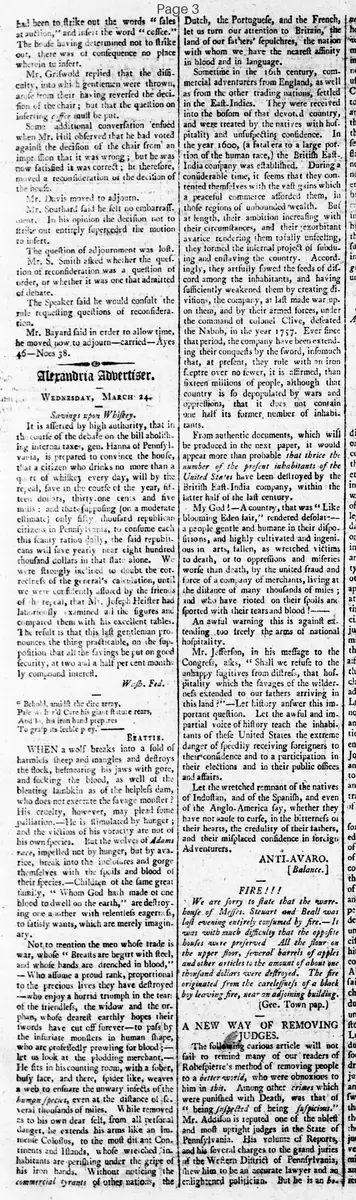
When a wolf breaks into a fold of harmless sheep and mangles and destroys the flock, besmearing his jaws with gore, and sucking the blood, as well of the bleating lambkin as of the helpless dam, who does not execrate the savage monster? His cruelty, however, may plead some palliation.—He is stimulated by hunger; and the victims of his voracity are not of his own species. But the wolves of Adams race, impelled not by hunger, but by avarice, break into the inclosures and gorge themselves with the spoils and blood of their species.—Children of the same great family. "Whom God hath made of one blood to dwell on the earth," are destroying one another with relentless eagerness, to satisfy wants, which are merely imaginary.
Not to mention the men whose trade is war, whose "Breasts are begirt with steel, and whose hands are drenched in blood,"—Who assume a proud rank, proportional to the precious lives they have destroyed—who enjoy a horrid triumph in the tears of the friendless, the widow and the orphan, whose dearest earthly hopes their swords have cut off forever—to pass by the infuriate monsters in human shape, who are professedly prowling for blood;—let us look at the plodding merchant.—He sits in his counting room, with a sour face, and there, spider like, weaves a web to ensnare the unwary insects of the human species, even at the distance of several thousands of miles. While removed as to his own dear self, from all personal danger, he extends his arms like an immense Colossus, to the most distant Continents and Islands, whose wretched inhabitants are perishing under the gripe of his iron hands. Without noticing the commercial tyrants of other nations, the Dutch, the Portuguese, and the French, let us turn our attention to Britain, the land of our fathers' sepulchres, the nation with whom we have the nearest affinity in blood and in language.
Sometime in the 16th century, commercial adventurers from England, as well as from the other trading nations, settled in the East-Indies. They were received into the bosom of that devoted country, and were treated by the natives with hospitality and unsuspicious confidence. In the year 1600, (a fatal era to a large portion of the human race,) the British East-India company was established. During a considerable time, it seems that they contented themselves with the vast gains which a peaceful commerce afforded them, in those regions of unbounded wealth. But at length, their ambition increasing with their circumstances, and their exorbitant avarice rendering them totally unfeeling, they formed the infernal project of subduing and enslaving the country. Accordingly, they artfully sowed the seeds of discord among the inhabitants, and having sufficiently weakened them by creating divisions, the company, at last made war upon them, and by their armed forces, under the command of colonel Clive, defeated the Nabob, in the year 1757. Ever since that period, the company have been extending their conquests by the sword, insomuch that, at present, they rule with an iron sceptre over no fewer, it is affirmed, than sixteen millions of people, although that country is so depopulated by wars and oppressions, that it does not contain one half its former number of inhabitants.
From authentic documents, which will be produced in the next paper, it would appear more than probable that thrice the number of the present inhabitants of the United States have been destroyed by the British East-India company, within the latter half of the last century.
My God!—A country, that was "Like blooming Eden fair," rendered desolate:—a people gentle and humane in their dispositions, and highly cultivated and ingenious in arts, fallen, as wretched victims to death, or to oppressions and miseries worse than death, by the united fraud and force of a company of merchants, living at the distance of many thousands of miles; and who have rioted on their spoils and sported with their tears and blood!
An awful warning this is against extending too freely the arms of national hospitality.
Mr. Jefferson, in his message to the Congress, asks, "Shall we refuse to the unhappy fugitives from distress, that hospitality which the savages of the wilderness extended to our fathers arriving in this land?"—Let history answer this important question. Let the awful and impartial voice of history teach the inhabitants of the United States the extreme danger of speedily receiving foreigners to their confidence and to a participation in their elections and in their public offices and affairs.
Let the wretched remnant of the natives of Hindostan, and of the Spanish, and even of the Anglo-American—ay, whether they have not cause to curse, in the bitterness of their hearts, the credulity of their fathers, and their misplaced confidence in foreign Adventurers.
ANTI-AVARO.
Not to mention the men whose trade is war, whose "Breasts are begirt with steel, and whose hands are drenched in blood,"—Who assume a proud rank, proportional to the precious lives they have destroyed—who enjoy a horrid triumph in the tears of the friendless, the widow and the orphan, whose dearest earthly hopes their swords have cut off forever—to pass by the infuriate monsters in human shape, who are professedly prowling for blood;—let us look at the plodding merchant.—He sits in his counting room, with a sour face, and there, spider like, weaves a web to ensnare the unwary insects of the human species, even at the distance of several thousands of miles. While removed as to his own dear self, from all personal danger, he extends his arms like an immense Colossus, to the most distant Continents and Islands, whose wretched inhabitants are perishing under the gripe of his iron hands. Without noticing the commercial tyrants of other nations, the Dutch, the Portuguese, and the French, let us turn our attention to Britain, the land of our fathers' sepulchres, the nation with whom we have the nearest affinity in blood and in language.
Sometime in the 16th century, commercial adventurers from England, as well as from the other trading nations, settled in the East-Indies. They were received into the bosom of that devoted country, and were treated by the natives with hospitality and unsuspicious confidence. In the year 1600, (a fatal era to a large portion of the human race,) the British East-India company was established. During a considerable time, it seems that they contented themselves with the vast gains which a peaceful commerce afforded them, in those regions of unbounded wealth. But at length, their ambition increasing with their circumstances, and their exorbitant avarice rendering them totally unfeeling, they formed the infernal project of subduing and enslaving the country. Accordingly, they artfully sowed the seeds of discord among the inhabitants, and having sufficiently weakened them by creating divisions, the company, at last made war upon them, and by their armed forces, under the command of colonel Clive, defeated the Nabob, in the year 1757. Ever since that period, the company have been extending their conquests by the sword, insomuch that, at present, they rule with an iron sceptre over no fewer, it is affirmed, than sixteen millions of people, although that country is so depopulated by wars and oppressions, that it does not contain one half its former number of inhabitants.
From authentic documents, which will be produced in the next paper, it would appear more than probable that thrice the number of the present inhabitants of the United States have been destroyed by the British East-India company, within the latter half of the last century.
My God!—A country, that was "Like blooming Eden fair," rendered desolate:—a people gentle and humane in their dispositions, and highly cultivated and ingenious in arts, fallen, as wretched victims to death, or to oppressions and miseries worse than death, by the united fraud and force of a company of merchants, living at the distance of many thousands of miles; and who have rioted on their spoils and sported with their tears and blood!
An awful warning this is against extending too freely the arms of national hospitality.
Mr. Jefferson, in his message to the Congress, asks, "Shall we refuse to the unhappy fugitives from distress, that hospitality which the savages of the wilderness extended to our fathers arriving in this land?"—Let history answer this important question. Let the awful and impartial voice of history teach the inhabitants of the United States the extreme danger of speedily receiving foreigners to their confidence and to a participation in their elections and in their public offices and affairs.
Let the wretched remnant of the natives of Hindostan, and of the Spanish, and even of the Anglo-American—ay, whether they have not cause to curse, in the bitterness of their hearts, the credulity of their fathers, and their misplaced confidence in foreign Adventurers.
ANTI-AVARO.
What sub-type of article is it?
Imperialism
Moral Or Religious
Trade Or Commerce
What keywords are associated?
East India Company
British Conquest
Avarice
India Oppression
Clive 1757
Hospitality Foreigners
Jefferson Message
What entities or persons were involved?
British East India Company
Colonel Clive
Nabob
Mr. Jefferson
Natives Of Hindostan
Dutch
Portuguese
French
Britain
Editorial Details
Primary Topic
Critique Of British East India Company's Conquests In India
Stance / Tone
Strongly Condemnatory Of Avarice And Imperialism
Key Figures
British East India Company
Colonel Clive
Nabob
Mr. Jefferson
Natives Of Hindostan
Dutch
Portuguese
French
Britain
Key Arguments
Merchants Driven By Avarice Destroy Fellow Humans Unlike Hunger Driven Wolves
East India Company Established In 1600, Initially Peaceful But Turned To Conquest
Sowed Discord And Defeated Nabob Under Clive In 1757
Conquered And Rule Over 16 Million, Depopulated India By Wars And Oppressions
Destroyed Thrice The Us Population In Latter Half Of 18th Century
Warning Against Hospitality To Foreigners Based On Historical Betrayals
Response To Jefferson's Message On Fugitives