Thank you for visiting SNEWPapers!
Sign up free
Daily National Intelligencer
Washington, District Of Columbia
What is this article about?
U.S. Congress proceedings on March 22, 1819: Senate debates Bankrupt Bill amendment, land claims, and appropriations; House handles petitions, pension law revisions, and opposes increased fortifications funding amid economic concerns.
Merged-components note: These components form a single report on congressional proceedings, including debate; relabeling the third from editorial to domestic_news as it is part of the legislative news.
Clipping
OCR Quality
Full Text
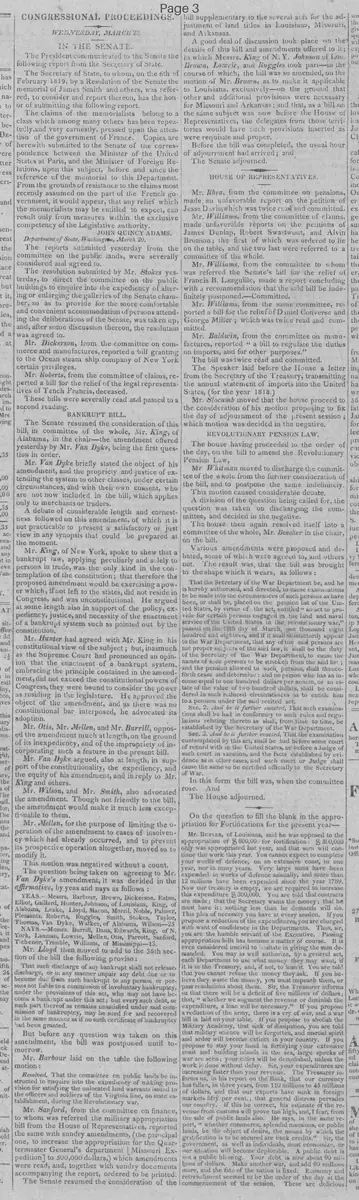
WEDNESDAY, MARCH 22.
IN THE SENATE.
The President communicated to the Senate the following report from the Secretary of State.
The Secretary of State, to whom, on the 6th of February 1819, by a Resolution of the Senate the memorial of James Smith and others, was referred, to consider and report thereon, has the honor of submitting the following report.
The claims of the memorialists belong to a class which among many others has been repeatedly, and very earnestly, pressed upon the attention of the government of France. Copies are herewith submitted to the Senate of the correspondence between the Minister of the United States at Paris, and the Minister of Foreign Relations, upon this subject, before and since the reference of the memorial to this Department.
From the grounds of resistance to the claims most recently assumed on the part of the French government, it would appear, that any relief which the memorialists may be entitled to expect, can result only from measures within the exclusive competency of the Legislative authority.
JOHN QUINCY ADAMS.
Department of State, Washington, March 20.
The reports submitted yesterday from the committee on the public lands, were severally considered and agreed to.
The resolution submitted by Mr. Stokes yesterday, to direct the committee on the public buildings to enquire into the expediency of altering or enlarging the galleries of the Senate chamber, so as to provide for the more comfortable and convenient accommodation of persons attending the deliberations of the Senate, was taken up, and, after some discussion thereon, the resolution was agreed to.
Mr. Dickerson, from the committee on commerce and manufactures, reported a bill granting to the Ocean steam ship company of New York certain privileges.
Mr. Roberts, from the committee of claims, reported a bill for the relief of the legal representatives of Tench Francis, deceased.
These bills were severally read and passed to a second reading.
BANKRUPT BILL.
The Senate resumed the consideration of this bill, in committee of the whole, Mr. King, of Alabama, in the chair—the amendment offered yesterday by Mr. Van Dyke, being the first question in order.
Mr. Van Dyke briefly stated the object of his amendment, and the propriety and justice of extending the system to other classes, under certain circumstances, and with their own consent, who are not now included in the bill, which applies only to merchants or traders.
A debate of considerable length and earnestness followed on this amendment, of which it is not practicable to present a satisfactory or just view in any synopsis that could be prepared at the moment.
Mr. King, of New York, spoke to shew that a bankrupt law, applying peculiarly and solely to persons in trade, was the only kind in the contemplation of the constitution; that therefore the proposed amendment would be exercising a power which, if not left to the states, did not reside in Congress, and was unconstitutional. He argued at some length also in support of the policy, expediency, justice, and necessity of the enactment of a bankrupt system such as pointed out by the constitution,
Mr. Hunter had agreed with Mr. King in his constitutional view of the subject: but, inasmuch as the Supreme Court had pronounced an opinion that the enactment of a bankrupt system, embracing the principle contained in the amendment, did not exceed the constitutional powers of Congress, they were bound to consider the power as residing in the legislature. He approved the object of the amendment, and as there was no constitutional bar interposed, he advocated its adoption.
Mr. Otis, Mr. Mellen, and Mr. Burrill, opposed the amendment much at length, on the ground of its inexpediency, and of the impropriety of incorporating such a feature in the present bill.
Mr. Van Dyke argued, also at length, in support of the constitutionality, the expediency, and the equity of his amendment, and in reply to Mr. King and others.
Mr. Wilson, and Mr. Smith, also advocated the amendment. Though not friendly to the bill, the amendment would make it much less exceptionable to them.
Mr. Mellen, for the purpose of limiting the operation of the amendment to cases of insolvency which had already occurred, and to prevent its prospective operation altogether, moved so to modify it.
This motion was negatived without a count.
The question being taken on agreeing to Mr. Van Dyke's amendment, it was decided in the affirmative, by yeas and nays as follows:
YEAS.—Messrs. Barbour, Brown, Dickerson, Eaton, Elliot, Gaillard, Hunter, Johnson, of Louisiana, King, of Alabama, Leake, Lloyd, Macon, Morril, Noble, Palmer, Pleasants. Roberts, Ruggles, Smith, Stokes, Taylor, Thomas, Van Dyke, Walker, of Alabama, Wilson—25
NAYS.—Messrs. Burrill, Dana, Edwards, King, of N. York, Lanman, Lowrie, Mellen, Otis, Parrott, Sanford, Tichenor, Trimble, Williams, of Mississippi—13.
Mr. Lloyd then moved to add to the 36th section of the bill the following proviso:
That such discharge of any bankrupt shall not release, discharge, or in any manner impair any debt due or to become due from such bankrupt to any person or persons not liable to a commission of involuntary bankruptcy, under the provisions of this act, who may not have become a bankrupt under this act; but every such debt, or such part thereof as remains unsatisfied under said commission of bankruptcy, may be sued for and recovered in the same manner as if no such certificate of bankruptcy had been granted
But before any question was taken on this amendment, the bill was postponed until tomorrow.
Mr. Barbour laid on the table the following motion:
Resolved, That the committee on public lands be instructed to enquire into the expediency of making provision for satisfying the unlocated land warrants issued to the officers and soldiers of the Virginia line, on state establishment, during the Revolutionary war.
Mr. Sanford, from the committee on finance, to whom was referred the military appropriation bill from the House of Representatives, reported the same with sundry amendments, (the principal one, to increase the appropriation for the Quartermaster General's department Missouri Expedition to 500,000 dollars,) which amendments were read, and, together with sundry documents accompanying the report, ordered to be printed.
The Senate resumed the consideration of the
bill supplementary to the several acts for the adjustment of land titles in Louisiana, Missouri and Arkansas.
A good deal of discussion took place on the details of this bill and amendments offered to it: in which Messrs. King of N. Y. Johnson of Lou. Brown, Lowrie, and Ruggles took part—in the course of which, the bill was so amended, on the motion of Mr. Brown, as to make it applicable to Louisiana, exclusively—on the ground that other and additional provisions were necessary for Missouri and Arkansas; and that, as a bill on the same subject was now before the House of Representatives, the delegates from those territories would have such provisions inserted as were requisite and proper.
Before the bill was completed, the usual hour of adjournment had arrived: and
The Senate adjourned.
HOUSE OF REPRESENTATIVES.
Mr. Rhea, from the committee on pensions, made an unfavorable report on the petition of Jesse Davis; which was twice read and committed.
Mr. Williams, from the committee of claims, made unfavorable reports on the petitions of James Dunlap. Robert Swartwout, and Alvin Bronson; the first of which was ordered to lie on the table, and the two last were referred to a committee of the whole.
Mr. Williams, from the committee to whom was referred the Senate's bill for the relief of Francis B. Languille, made a report concluding with a recommendation that the said bill be indefinitely postponed.—Committed
Mr. Williams, from the same committee, reported a bill for the relief of Daniel Converse and George Miller; which was twice read and committed.
Mr. Baldwin, from the committee on manufactures, reported "a bill to regulate the duties on imports, and for other purposes."
The bill was twice read and committed.
The Speaker laid before the House a letter from the Secretary of the Treasury, transmitting the annual statement of imports into the United States, (for the year 1818.)
Mr. Slocumb moved that the house proceed to the consideration of his motion proposing to fix the day of adjournment of the present session; which motion was decided in the negative.
REVOLUTIONARY PENSION LAW.
The house having proceeded to the order of the day, on the bill to amend the Revolutionary Pension Law,
Mr Whitman moved to discharge the committee of the whole from the further consideration of the bill, and to postpone the same indefinitely.
This motion caused considerable debate.
A division of the question being called for, the question was taken on discharging the committee, and decided in the negative.
The house then again resolved itself into a committee of the whole, Mr. Beecher in the chair, on the bill.
Various amendments were proposed and debated, some of which were agreed to, and others not. The result was, that the bill was brought to the shape which it wears, as follows:
That the Secretary of the War Department be, and he is hereby authorised, and directed, to cause examinations to be made into the circumstances of such persons as have been, or shall be, placed on the pension list of the United States, by virtue of the act, entitled "an act to provide for certain persons engaged in the land and naval service of the United States in the revolutionary war," passed on the 18th day of March, one thousand eight hundred and eighteen, and if it shall satisfactorily appear to the War Department, that any of the said persons are not proper subjects of the said law, it shall be the duty of the Secretary of the War Department, to cause the names of such persons to be stricken from the said list; and the pension allowed to such persons, shall thenceforth cease and determine: and no person who has an income equal to one hundred dollars per annum, or an estate of the value of two hundred dollars, shall be considered in such reduced circumstances as to entitle him to a pension under the said recited act.
Sec. 2. And be it further enacted, That such examinations shall be had in conformity to such rules and regulations relating thereto as shall, from time to time, be established by the Secretary of the War Department.
Sec. 3. And be it further enacted, That the examination contemplated by this act, shall be had before some court of record within the United States, or before a Judge of such court in vacation, and the facts established by evidence as in other cases, and such court or Judge shall cause the same to be certified officially to the Secretary of War.
In this form the bill was, when the committee rose. And
The House adjourned.
On the question to fill the blank in the appropriation for Fortifications for the present year——
Mr. Butler, of Louisiana, said he was opposed to the appropriation of $800,000 for fortification: $500,000 only was appropriated last year, and that sum will continue the work this year. You cannot expect to complete your works of defence, on an extensive coast, in one year, nor in many years. Very large sums have been expended in works of defence annually, and more than 12 millions have been expended since the year 1789.
Now our treasury is empty, we are required to increase this expenditure $300,000. You are told that contracts are made; that the Secretary wants the money: that he must have it; nothing less than he demands will do.
This plea of necessity you have at every session. If you propose a reduction of the expenditures, you are charged with want of confidence in the Departments. Thus, sir, you are the humble servant of the Executive. Passing appropriation bills has become a matter of course. It is even considered uncivil to hesitate in giving the sum demanded. You may as well authorize, by a general act, each Department to use what money they may want, if it is in the Treasury, and, if not, to loan it. You are told that you cannot refuse the money they ask. If you believe they waste the money, you must impeach them, or pass resolutions about them. Sir, the Treasurer informs us that there will be a deficit of five millions of dollars; that, "whether we augment the revenue or diminish the expenditure, a loan will be necessary." If you propose a reduction of the army, there is a cry of war, and a war bill is laid on your table. If you propose to abolish the Military Academy, that sink of dissipation, you are told that military science will be forgotten, and martial spirit and ardor will become extinct in your country. If you propose to stay your hand in fortifying your extensive coast and building islands in the sea, large specks of war are seen; your cities will be demolished, unless the work is done without delay. Sir, your expenditures are increasing faster than your revenue. The Treasurer informs us, in his report on the Bank, that our currency has fallen, in three years, from 110 millions to 45 millions of dollars, and that our exports have sunk in foreign markets fifty per cent.; that general distress pervades our country. If this be correct, his estimate of the revenue from customs will prove too high, and, I fear, from the sale of public lands also. He says, in the same report, "whether commerce, splendid mansions, or public lands, be the object of desire, the means by which the gratification is to be secured are bank credits." Sir, the government, as well as individuals, must economize, or our situation will become deplorable. A public debt is not a public blessing. Your debt is now about 90 millions of dollars. Make another war, and add 90 millions more, and the fate of the nation is fixed. Economy and retrenchment seemed to be the order of the day at the commencement of the session. These are delicious
What sub-type of article is it?
What keywords are associated?
What entities or persons were involved?
Where did it happen?
Domestic News Details
Primary Location
Washington
Event Date
March 22, 1819
Key Persons
Event Details
The Senate received a report from the Secretary of State on claims against France; considered reports on public lands and resolutions for Senate chamber improvements; reported bills on steam ship privileges and relief for Tench Francis; debated and passed an amendment to the Bankrupt Bill extending it beyond merchants; postponed the bill with a proposed proviso; instructed committees on land warrants and military appropriations; amended and discussed a bill on Louisiana land titles. In the House, unfavorable reports on petitions; reported bills on relief and duties on imports; received Treasury statement; debated adjournment and Revolutionary Pension Law amendments authorizing examinations and restrictions; discussed fortifications appropriation opposing increase due to financial distress.