Thank you for visiting SNEWPapers!
Sign up free
Letter to Editor
March 18, 1808
The Enquirer
Richmond, Henrico County, Virginia
What is this article about?
A letter signed 'FALKLAND' addresses James Madison, criticizing his political inconsistencies from Federalist contributions to recent administration compromises, accusing him of timidity and ambition, and opposing his presidential candidacy, particularly citing the Yazoo scandal and associations with Federalists.
Clipping
OCR Quality
95%
Excellent
Full Text
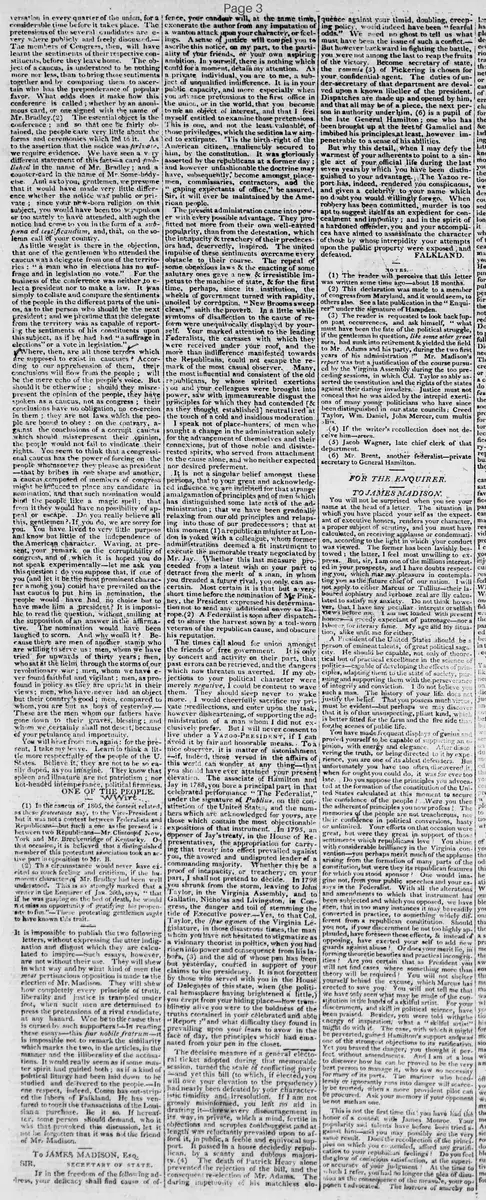
To JAMES MADISON, Esq.
SIR,
SECRETARY OF STATE.
If in the freedom of the following address, your delicacy shall find cause of offence, your candour will, at the same time, exonerate the author from any imputation of a wanton attack upon your character, or feelings. A sense of justice will compel you to ascribe this notice, on my part, to the partiality of your friends, or your own aspiring ambition. In yourself, there is nothing which could for a moment, detain my attention. As a private individual, you are to me, a subject of unqualified indifference. It is in your public capacity, and more especially when you advance pretensions to the first office in the union, or in the world, that you become to me an object of interest, and that I feel myself entitled to examine those pretensions. This is one, and not the least valuable, of those privileges, which the sedition law aimed to extirpate. 'Tis the birth-right of the American citizen, unalienably secured to him, by the constitution. It was gloriously asserted by the republicans at a former day; and however unfashionable the doctrine may have, subsequently, become amongst place-men, commissaries, contractors, and the "gaping expectants of office." be assured, Sir, it will ever be maintained by the American people.
The present administration came into power with every possible advantage. They profited not more from their own well-earned popularity, than from the detestation, which the incapacity & treachery of their predecessors had, deservedly, inspired. The united impulse of these sentiments overcame every obstacle to their course.
The repeal of some obnoxious laws & the enacting of some salutary ones gave a new & irresistible impetus to the machine of state, & for the first time, perhaps, since its institution, the wheels of government turned with rapidity, unoiled by corruption. "New Brooms sweep clean," saith the proverb. In a little while symptoms of disaffection to the cause of reform were unequivocally displayed by yourself. Your marked attention to the leading Federalists, the caresses with which they were received under your roof, and the more than indifference manifested towards the Republicans; could not escape the remark of the most casual observer. Many the most influential and consistent of the old republicans, by whose spirited exertions you and your colleagues were brought into power, saw with immeasurable disgust the principles for which they had contended [& as they thought established] neutralized at the touch of a cold and insidious moderation.
I speak not of place-hunters, or men who sought a change in the administration solely for the advancement of themselves and their connexions, but of those noble and disinterested spirits, who served from attachment to the cause alone, and who neither expected nor desired preferment.
It is not a singular belief amongst these persons, that to your great and acknowledged influence, we are indebted for that strange amalgamation of principles and of men which has distinguished some late acts of the administration; that we have been gradually relaxing from our old principles and relapsing into those of our predecessors; that at this moment (1) a republican minister at London is yoked with a colleague, whom former administrations deemed a fit instrument to execute the memorable treaty negociated by Mr. Jay. Whether this last measure proceeded from a latent wish on your part to detract from the merit of a man, in whom you dreaded a future rival, you only can ascertain. Most certain it is that but a very short time before the nomination of Mr. Pinkney, the President expressed his determination not to send any additional envoy to Europe. (2) A Federalist is soon after dispatched to share the harvest sown by a toil-worn veteran of the republican cause, and obscure his reputation.
The times call aloud for union amongst the friends of free government. It is only by concert and activity on their part, that past errors can be retrieved, and the dangers which now threaten us averted. If my objections to your political character were merely negative, I could be content to waive them. They should sleep never to wake more. I would cheerfully sacrifice my private predilections, and enter upon the task, however disheartening, of supporting the administration of a man whom I did not exclusively prefer. But I will never consent to live under a Yazoo-President, if I can avoid it by fair and honorable means. To a nice observer, it is matter of astonishment if, indeed, those versed in the affairs of this world can wonder at any thing that you should have ever attained your present elevation. The associate of Hamilton and Jay in 1788 you bore a principal part in that celebrated performance "The Federalist," under the signature of Publius, on the constitution of the United States; and the numbers which are acknowledged for yours, are those which contain the most objectionable expositions of that instrument. In 1795, an opposer of Jay's treaty, in the House of Representatives, the appropriation for carrying that treaty into effect prevailed against you, the avowed and undisputed leader of a commanding majority. Whether this be a proof of incapacity, or treachery, on your part, I shall not pretend to decide. In 1798 you shrunk from the storm, leaving to John Taylor, in the Virginia Assembly, and to Gallatin, Nicholas and Livingston, in Congress, the danger and toil of stemming the tide of Executive power. Yes, to that Col. Taylor, the hose agmen of the Virginia Legislature, in those disastrous times, the man whom you have not hesitated to stigmatize as a visionary theorist in politics, when you had risen into power and consequence from his labors, (3) and the aid of whose pen has been but yesterday, courted in support of your claims to the presidency. It is not forgotten by those who served with you in the House of Delegates of this state, when (the political hemisphere having brightened a little,) you crept from your hiding place—how tremblingly alive you were to the boldness of the truths contained in your celebrated and able "Report;" and what difficulty they found in prevailing upon your fears to avow in the face of day, the principles which had emanated from your pen in the closet.
The decisive measure of a general electoral ticket adopted during that memorable session, turned the scale of conflicting party—and yet this bill (to which, if elected, you will owe your elevation to the presidency) had nearly been defeated by your characteristic timidity and irresolution. If I am not grossly misinformed, you lent no aid in drafting it—threw every discouragement in its way, in private, which a mind, fertile in objections and scruples could suggest; and at length was reluctantly prevailed upon to afford it, in public, a feeble and equivocal support. It passed in a house decidedly republican, by a scanty and dubious majority. (4) The death of Patrick Henry alone prevented the rejection of the bill, and the consequent re-election of Mr. Adams. The daring impetuosity of his matchless eloquence against your timid, doubling, creeping policy, would indeed have been "fearful odds." We need no ghost to tell us what must have been the issue of such a conflict.
But however backward in fighting the battle, you were not among the last to reap the fruits of the victory. Become secretary of state, the commis (5) of Pickering is chosen for your confidential agent. The duties of under-secretary of that department are devolved upon a known libeller of the president. Dispatches are made up and opened by him, and that all may be of a piece, the next person in authority under him, (6) is a pupil of the late General Hamilton; one who has been brought up at the feet of Gamaliel and imbibed his principles, at least, however impenetrable to a sense of his abilities.
But why this detail, when I may defy the warmest of your adherents to point to a single act of your official life during the last seven years by which you have been distinguished to your advantage. The Yazoo report has, indeed, rendered you conspicuous, and given a celebrity to your name which no doubt you would willingly forego. When robbery has been committed, murder is too apt to suggest itself as an expedient for concealment and impunity; and in the spirit of a hardened offender, you and your accomplices have aimed to assassinate the character of those by whose intrepidity your attempts upon the public property were exposed; and defeated.
FALKLAND.
NOTES.
(1) The reader will perceive that this letter was written some time ago—about 18 months.
(2) This declaration was made to a member of congress from Maryland, and it would seem, to others also. See a late publication in the "Enquirer" under the signature of Hampden.
(3) The reader is requested to look back upon past occurrences, and ask himself, "what must have been the fate of the political struggle, if the gentleman in question, like some other great men, had sunk into retirement & yielded the field to Mr. Adams and his party, during the two first years of his administration?" Mr. Madison's report was but a justification of the course pursued by the Virginia Assembly during the two preceding sessions, in which Col. Taylor so ably asserted the constitution and the rights of the states against their daring invaders. Justice must not conceal that he was aided by the intrepid exertions of many young politicians who have since been distinguished in our state councils; Creed Taylor, Wm. Daniel, John Mercer, cum multis aliis.
(4) If the writer's recollection does not deceive him—seven.
(5) Jacob Wagner, late chief clerk of that department.
(6) Mr. Brent, another federalist—private secretary to General Hamilton.
SIR,
SECRETARY OF STATE.
If in the freedom of the following address, your delicacy shall find cause of offence, your candour will, at the same time, exonerate the author from any imputation of a wanton attack upon your character, or feelings. A sense of justice will compel you to ascribe this notice, on my part, to the partiality of your friends, or your own aspiring ambition. In yourself, there is nothing which could for a moment, detain my attention. As a private individual, you are to me, a subject of unqualified indifference. It is in your public capacity, and more especially when you advance pretensions to the first office in the union, or in the world, that you become to me an object of interest, and that I feel myself entitled to examine those pretensions. This is one, and not the least valuable, of those privileges, which the sedition law aimed to extirpate. 'Tis the birth-right of the American citizen, unalienably secured to him, by the constitution. It was gloriously asserted by the republicans at a former day; and however unfashionable the doctrine may have, subsequently, become amongst place-men, commissaries, contractors, and the "gaping expectants of office." be assured, Sir, it will ever be maintained by the American people.
The present administration came into power with every possible advantage. They profited not more from their own well-earned popularity, than from the detestation, which the incapacity & treachery of their predecessors had, deservedly, inspired. The united impulse of these sentiments overcame every obstacle to their course.
The repeal of some obnoxious laws & the enacting of some salutary ones gave a new & irresistible impetus to the machine of state, & for the first time, perhaps, since its institution, the wheels of government turned with rapidity, unoiled by corruption. "New Brooms sweep clean," saith the proverb. In a little while symptoms of disaffection to the cause of reform were unequivocally displayed by yourself. Your marked attention to the leading Federalists, the caresses with which they were received under your roof, and the more than indifference manifested towards the Republicans; could not escape the remark of the most casual observer. Many the most influential and consistent of the old republicans, by whose spirited exertions you and your colleagues were brought into power, saw with immeasurable disgust the principles for which they had contended [& as they thought established] neutralized at the touch of a cold and insidious moderation.
I speak not of place-hunters, or men who sought a change in the administration solely for the advancement of themselves and their connexions, but of those noble and disinterested spirits, who served from attachment to the cause alone, and who neither expected nor desired preferment.
It is not a singular belief amongst these persons, that to your great and acknowledged influence, we are indebted for that strange amalgamation of principles and of men which has distinguished some late acts of the administration; that we have been gradually relaxing from our old principles and relapsing into those of our predecessors; that at this moment (1) a republican minister at London is yoked with a colleague, whom former administrations deemed a fit instrument to execute the memorable treaty negociated by Mr. Jay. Whether this last measure proceeded from a latent wish on your part to detract from the merit of a man, in whom you dreaded a future rival, you only can ascertain. Most certain it is that but a very short time before the nomination of Mr. Pinkney, the President expressed his determination not to send any additional envoy to Europe. (2) A Federalist is soon after dispatched to share the harvest sown by a toil-worn veteran of the republican cause, and obscure his reputation.
The times call aloud for union amongst the friends of free government. It is only by concert and activity on their part, that past errors can be retrieved, and the dangers which now threaten us averted. If my objections to your political character were merely negative, I could be content to waive them. They should sleep never to wake more. I would cheerfully sacrifice my private predilections, and enter upon the task, however disheartening, of supporting the administration of a man whom I did not exclusively prefer. But I will never consent to live under a Yazoo-President, if I can avoid it by fair and honorable means. To a nice observer, it is matter of astonishment if, indeed, those versed in the affairs of this world can wonder at any thing that you should have ever attained your present elevation. The associate of Hamilton and Jay in 1788 you bore a principal part in that celebrated performance "The Federalist," under the signature of Publius, on the constitution of the United States; and the numbers which are acknowledged for yours, are those which contain the most objectionable expositions of that instrument. In 1795, an opposer of Jay's treaty, in the House of Representatives, the appropriation for carrying that treaty into effect prevailed against you, the avowed and undisputed leader of a commanding majority. Whether this be a proof of incapacity, or treachery, on your part, I shall not pretend to decide. In 1798 you shrunk from the storm, leaving to John Taylor, in the Virginia Assembly, and to Gallatin, Nicholas and Livingston, in Congress, the danger and toil of stemming the tide of Executive power. Yes, to that Col. Taylor, the hose agmen of the Virginia Legislature, in those disastrous times, the man whom you have not hesitated to stigmatize as a visionary theorist in politics, when you had risen into power and consequence from his labors, (3) and the aid of whose pen has been but yesterday, courted in support of your claims to the presidency. It is not forgotten by those who served with you in the House of Delegates of this state, when (the political hemisphere having brightened a little,) you crept from your hiding place—how tremblingly alive you were to the boldness of the truths contained in your celebrated and able "Report;" and what difficulty they found in prevailing upon your fears to avow in the face of day, the principles which had emanated from your pen in the closet.
The decisive measure of a general electoral ticket adopted during that memorable session, turned the scale of conflicting party—and yet this bill (to which, if elected, you will owe your elevation to the presidency) had nearly been defeated by your characteristic timidity and irresolution. If I am not grossly misinformed, you lent no aid in drafting it—threw every discouragement in its way, in private, which a mind, fertile in objections and scruples could suggest; and at length was reluctantly prevailed upon to afford it, in public, a feeble and equivocal support. It passed in a house decidedly republican, by a scanty and dubious majority. (4) The death of Patrick Henry alone prevented the rejection of the bill, and the consequent re-election of Mr. Adams. The daring impetuosity of his matchless eloquence against your timid, doubling, creeping policy, would indeed have been "fearful odds." We need no ghost to tell us what must have been the issue of such a conflict.
But however backward in fighting the battle, you were not among the last to reap the fruits of the victory. Become secretary of state, the commis (5) of Pickering is chosen for your confidential agent. The duties of under-secretary of that department are devolved upon a known libeller of the president. Dispatches are made up and opened by him, and that all may be of a piece, the next person in authority under him, (6) is a pupil of the late General Hamilton; one who has been brought up at the feet of Gamaliel and imbibed his principles, at least, however impenetrable to a sense of his abilities.
But why this detail, when I may defy the warmest of your adherents to point to a single act of your official life during the last seven years by which you have been distinguished to your advantage. The Yazoo report has, indeed, rendered you conspicuous, and given a celebrity to your name which no doubt you would willingly forego. When robbery has been committed, murder is too apt to suggest itself as an expedient for concealment and impunity; and in the spirit of a hardened offender, you and your accomplices have aimed to assassinate the character of those by whose intrepidity your attempts upon the public property were exposed; and defeated.
FALKLAND.
NOTES.
(1) The reader will perceive that this letter was written some time ago—about 18 months.
(2) This declaration was made to a member of congress from Maryland, and it would seem, to others also. See a late publication in the "Enquirer" under the signature of Hampden.
(3) The reader is requested to look back upon past occurrences, and ask himself, "what must have been the fate of the political struggle, if the gentleman in question, like some other great men, had sunk into retirement & yielded the field to Mr. Adams and his party, during the two first years of his administration?" Mr. Madison's report was but a justification of the course pursued by the Virginia Assembly during the two preceding sessions, in which Col. Taylor so ably asserted the constitution and the rights of the states against their daring invaders. Justice must not conceal that he was aided by the intrepid exertions of many young politicians who have since been distinguished in our state councils; Creed Taylor, Wm. Daniel, John Mercer, cum multis aliis.
(4) If the writer's recollection does not deceive him—seven.
(5) Jacob Wagner, late chief clerk of that department.
(6) Mr. Brent, another federalist—private secretary to General Hamilton.
What sub-type of article is it?
Persuasive
Provocative
Political
What themes does it cover?
Politics
Constitutional Rights
Press Freedom
What keywords are associated?
James Madison
Presidential Candidacy
Republican Principles
Yazoo Affair
Jay Treaty
Federalist Papers
Virginia Resolutions
Sedition Law
What entities or persons were involved?
Falkland
James Madison
Letter to Editor Details
Author
Falkland
Recipient
James Madison
Main Argument
the letter accuses james madison of political inconsistency, timidity, and compromising republican principles through associations with federalists and actions like the yazoo report, urging opposition to his presidential ambitions to preserve free government.
Notable Details
References The Federalist Under Publius
Opposition To Jay's Treaty
Role In Virginia Assembly And Electoral Ticket
Yazoo Scandal And Report
Appointments Of Federalists In State Department
Sedition Law As Threat To Citizen Privileges