Thank you for visiting SNEWPapers!
Sign up free
Editorial
November 2, 1936
The Ironton News
Ironton, Lawrence County, Ohio
What is this article about?
This editorial defends Roosevelt's New Deal policies, attributing the Great Depression's massive losses to Hoover and Republicans, highlighting economic recovery gains like increased income and farm prices, and arguing that taxes under the New Deal are proportionate, beneficial, and lower relative to income compared to prior years or other nations.
Clipping
OCR Quality
95%
Excellent
Full Text
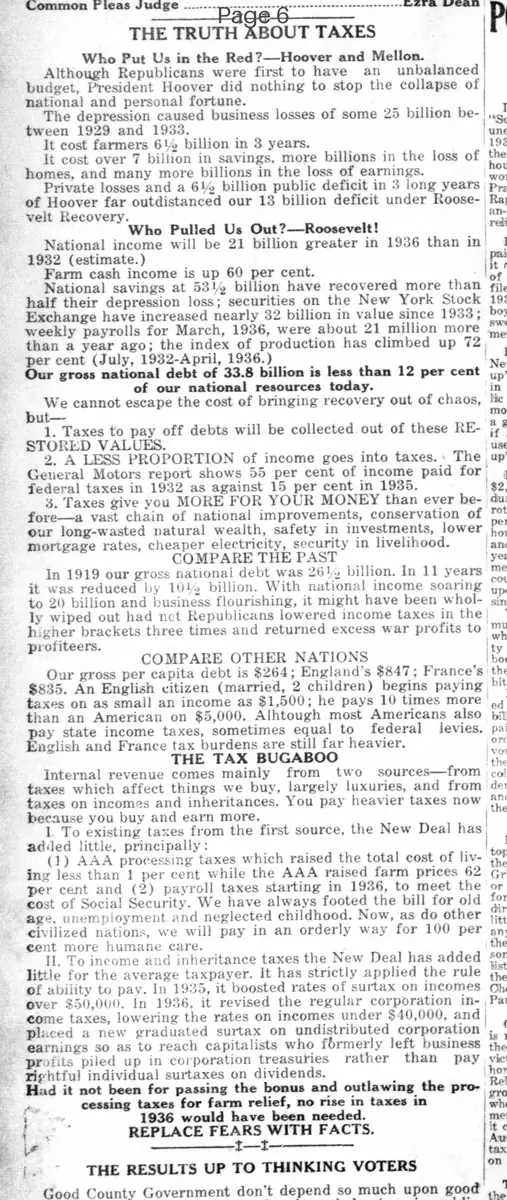
THE TRUTH ABOUT TAXES
Who Put Us in the Red? - Hoover and Mellon.
Although Republicans were first to have an unbalanced budget, President Hoover did nothing to stop the collapse of national and personal fortune.
The depression caused business losses of some 25 billion between 1929 and 1933.
It cost farmers 6½ billion in 3 years.
It cost over 7 billion in savings, more billions in the loss of homes, and many more billions in the loss of earnings.
Private losses and a 6½ billion public deficit in 3 long years of Hoover far outdistanced our 13 billion deficit under Roosevelt Recovery.
Who Pulled Us Out? - Roosevelt!
National income will be 21 billion greater in 1936 than in 1932 (estimate.)
Farm cash income is up 60 per cent.
National savings at 53½ billion have recovered more than half their depression loss; securities on the New York Stock Exchange have increased nearly 32 billion in value since 1933;
weekly payrolls for March, 1936, were about 21 million more than a year ago; the index of production has climbed up 72 per cent (July, 1932 - April, 1936.)
Our gross national debt of 33.8 billion is less than 12 per cent of our national resources today.
We cannot escape the cost of bringing recovery out of chaos, but -
1. Taxes to pay off debts will be collected out of these RESTORED VALUES.
2. A LESS PROPORTION of income goes into taxes. The General Motors report shows 55 per cent of income paid for federal taxes in 1932 as against 15 per cent in 1935.
3. Taxes give you MORE FOR YOUR MONEY than ever before - a vast chain of national improvements, conservation of our long-wasted natural wealth, safety in investments, lower mortgage rates, cheaper electricity, security in livelihood.
COMPARE THE PAST
In 1919 our gross national debt was 26½ billion. In 11 years it was reduced by 10½ billion. With national income soaring to 20 billion and business flourishing, it might have been wholly wiped out had not Republicans lowered income taxes in the higher brackets three times and returned excess war profits to profiteers.
COMPARE OTHER NATIONS
Our gross per capita debt is $264; England's $847; France's $835. An English citizen (married, 2 children) begins paying taxes on as small an income as $1,500; he pays 10 times more than an American on $5,000. Although most Americans also pay state income taxes, sometimes equal to federal levies.
English and France tax burdens are still far heavier.
THE TAX BUGABOO
Internal revenue comes mainly from two sources - from taxes which affect things we buy, largely luxuries, and from taxes on incomes and inheritances. You pay heavier taxes now because you buy and earn more.
I. To existing taxes from the first source, the New Deal has added little, principally: (1) AAA processing taxes which raised the total cost of living less than 1 per cent while the AAA raised farm prices 62 per cent and (2) payroll taxes starting in 1936, to meet the cost of Social Security. We have always footed the bill for old age, unemployment and neglected childhood. Now, as do other civilized nations, we will pay in an orderly way for 100 per cent more humane care.
II. To income and inheritance taxes the New Deal has added little for the average taxpayer. It has strictly applied the rule of ability to pay. In 1935, it boosted rates of surtax on incomes over $50,000. In 1936, it revised the regular corporation income taxes, lowering the rates on incomes under $40,000, and placed a new graduated surtax on undistributed corporation earnings so as to reach capitalists who formerly left business profits piled up in corporation treasuries rather than pay rightful individual surtaxes on dividends.
Had it not been for passing the bonus and outlawing the processing taxes for farm relief, no rise in taxes in 1936 would have been needed.
REPLACE FEARS WITH FACTS.
I 1
THE RESULTS UP TO THINKING VOTERS
Who Put Us in the Red? - Hoover and Mellon.
Although Republicans were first to have an unbalanced budget, President Hoover did nothing to stop the collapse of national and personal fortune.
The depression caused business losses of some 25 billion between 1929 and 1933.
It cost farmers 6½ billion in 3 years.
It cost over 7 billion in savings, more billions in the loss of homes, and many more billions in the loss of earnings.
Private losses and a 6½ billion public deficit in 3 long years of Hoover far outdistanced our 13 billion deficit under Roosevelt Recovery.
Who Pulled Us Out? - Roosevelt!
National income will be 21 billion greater in 1936 than in 1932 (estimate.)
Farm cash income is up 60 per cent.
National savings at 53½ billion have recovered more than half their depression loss; securities on the New York Stock Exchange have increased nearly 32 billion in value since 1933;
weekly payrolls for March, 1936, were about 21 million more than a year ago; the index of production has climbed up 72 per cent (July, 1932 - April, 1936.)
Our gross national debt of 33.8 billion is less than 12 per cent of our national resources today.
We cannot escape the cost of bringing recovery out of chaos, but -
1. Taxes to pay off debts will be collected out of these RESTORED VALUES.
2. A LESS PROPORTION of income goes into taxes. The General Motors report shows 55 per cent of income paid for federal taxes in 1932 as against 15 per cent in 1935.
3. Taxes give you MORE FOR YOUR MONEY than ever before - a vast chain of national improvements, conservation of our long-wasted natural wealth, safety in investments, lower mortgage rates, cheaper electricity, security in livelihood.
COMPARE THE PAST
In 1919 our gross national debt was 26½ billion. In 11 years it was reduced by 10½ billion. With national income soaring to 20 billion and business flourishing, it might have been wholly wiped out had not Republicans lowered income taxes in the higher brackets three times and returned excess war profits to profiteers.
COMPARE OTHER NATIONS
Our gross per capita debt is $264; England's $847; France's $835. An English citizen (married, 2 children) begins paying taxes on as small an income as $1,500; he pays 10 times more than an American on $5,000. Although most Americans also pay state income taxes, sometimes equal to federal levies.
English and France tax burdens are still far heavier.
THE TAX BUGABOO
Internal revenue comes mainly from two sources - from taxes which affect things we buy, largely luxuries, and from taxes on incomes and inheritances. You pay heavier taxes now because you buy and earn more.
I. To existing taxes from the first source, the New Deal has added little, principally: (1) AAA processing taxes which raised the total cost of living less than 1 per cent while the AAA raised farm prices 62 per cent and (2) payroll taxes starting in 1936, to meet the cost of Social Security. We have always footed the bill for old age, unemployment and neglected childhood. Now, as do other civilized nations, we will pay in an orderly way for 100 per cent more humane care.
II. To income and inheritance taxes the New Deal has added little for the average taxpayer. It has strictly applied the rule of ability to pay. In 1935, it boosted rates of surtax on incomes over $50,000. In 1936, it revised the regular corporation income taxes, lowering the rates on incomes under $40,000, and placed a new graduated surtax on undistributed corporation earnings so as to reach capitalists who formerly left business profits piled up in corporation treasuries rather than pay rightful individual surtaxes on dividends.
Had it not been for passing the bonus and outlawing the processing taxes for farm relief, no rise in taxes in 1936 would have been needed.
REPLACE FEARS WITH FACTS.
I 1
THE RESULTS UP TO THINKING VOTERS
What sub-type of article is it?
Economic Policy
Taxation
Partisan Politics
What keywords are associated?
Taxes
Depression
Recovery
New Deal
Hoover
Roosevelt
National Debt
Social Security
What entities or persons were involved?
Hoover
Mellon
Roosevelt
Republicans
New Deal
General Motors
Editorial Details
Primary Topic
Defense Of New Deal Economic Recovery And Tax Policies Against Republican Blame
Stance / Tone
Pro Roosevelt And New Deal, Critical Of Hoover And Republicans
Key Figures
Hoover
Mellon
Roosevelt
Republicans
New Deal
General Motors
Key Arguments
Republicans Under Hoover Caused Unbalanced Budgets And Depression Losses Exceeding $25 Billion
Roosevelt's Recovery Increased National Income By $21 Billion From 1932 To 1936
Farm Income Up 60%, National Savings Recovered Over Half, Stock Values Up $32 Billion
Gross National Debt Is 12% Of Resources, Taxes Collected From Restored Values
Lower Proportion Of Income To Taxes: 55% In 1932 Vs 15% In 1935
Taxes Provide More Value Through Improvements, Conservation, Security
Compared To 1919, Debt Reduced Despite Tax Cuts For Wealthy
Us Per Capita Debt Lower Than England And France
New Deal Added Little To Taxes: Aaa Processing Taxes Raised Living Costs <1% But Farm Prices 62%
Payroll Taxes For Social Security Provide Orderly Humane Care
Income Taxes Targeted High Earners And Corporations, No Rise Needed Without Bonus And Farm Relief