Thank you for visiting SNEWPapers!
Sign up free
Letter to Editor
January 12, 1818
Daily National Intelligencer
Washington, District Of Columbia
What is this article about?
An American soldier reflects on Col. Johnson's congressional proposition to grant land donations to late war officers, arguing their patriotic sacrifices far exceed those of civil officers, whose salaries are higher and adjusted for inflation while military pay remains fixed.
Clipping
OCR Quality
98%
Excellent
Full Text
FOR THE NATIONAL INTELLIGENCER,
Gentlemen:
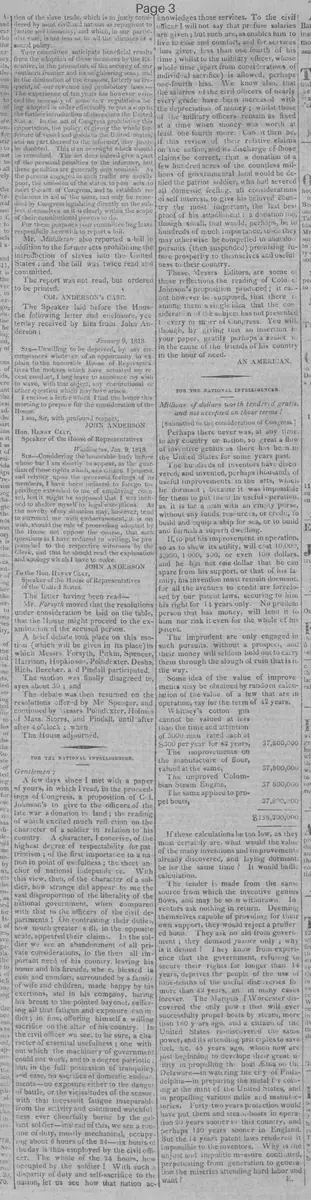
A few days since I met with a paper of yours, in which I read, in the proceedings of Congress, a proposition of Col. Johnson's to give to the officers of the late war a donation in land; the reading of which excited much reflection on the character of a soldier in relation to his country. A character, I conceive, of the highest degree of respectability for patriotism; of the first importance to a nation in point of usefulness; the sheet anchor of national independence. With this view, then, of the character of a soldier, how strange did appear to me the vast disproportion of the liberality of the national government, when compared with that to the officers of the civil departments! On contrasting their duties, how much greater still, in the opposite scale, appeared their claim. In the soldier we see an abandonment of all private considerations, to the then all important need of his country, leaving his home and his fireside, where, blessed in ease and comfort, surrounded by a family of wife and children, made happy by his exertions, and in his company, baring his breast to the pointed bayonet, suffering all that fatigue and exposure can inflict; in fine, offering himself a willing sacrifice on the altar of his country. In the civil officer we see, to be sure, a character of essential usefulness; one without which the machinery of government could not work, and to a degree patriotic; but, in the full possession of tranquility and ease, no sacrifice of domestic endearments—no exposure either to the danger of battle, or the vicissitudes of the season, with that incessant fatigue inseparable from the activity and continued watchfulness ever cheerfully borne by the gallant soldier—instead of this, we see a routine of duty, mostly mechanical, occupying about 6 hours of the 24—six hours of the day is thus employed by the civil officer. The whole of the 24 hours, how occupied by the soldier! With such a disparity of duty and self-sacrifice to the nation, let us see how that nation acknowledges those services. To the civil officer I will not say that profuse salaries are given; but such are, as enables him to live in ease and comfort, and for services thus given, less than one fourth of his time; whilst to the military officer, whose whole time (apart from considerations of individual sacrifice) is allowed, perhaps one-fourth less. We know also, that the salaries of the civil officers of nearly every grade have been increased with the depreciation of money; whilst those of the military officers remain as fixed at a time when money was worth at least one-fourth more. Can it then be, if this review of their relative claims on the nation, and its discharge of those claims be correct, that a donation of a few hundred acres of the countless millions of governmental land would be denied the patriot soldier, who had severed all domestic feeling, all considerations of self interest, to give his beloved country the most important, the last best proof of his attachment: a donation too, though small, that would, perhaps, be to hundreds of much importance, since they may otherwise be compelled to abandon pursuits (then suspended) promising future prosperity to themselves and usefulness to their country.
These, Messrs. Editors, are some of those reflections the reading of Col. Johnson's proposition produced; it cannot however be supposed, that there is among them a single idea that the consideration of the subject has not presented to every member of Congress. You will, though, by giving this an insertion in your paper, gratify perhaps a zealot in the cause of the friends of his country in the hour of need.
AN AMERICAN.
Gentlemen:
A few days since I met with a paper of yours, in which I read, in the proceedings of Congress, a proposition of Col. Johnson's to give to the officers of the late war a donation in land; the reading of which excited much reflection on the character of a soldier in relation to his country. A character, I conceive, of the highest degree of respectability for patriotism; of the first importance to a nation in point of usefulness; the sheet anchor of national independence. With this view, then, of the character of a soldier, how strange did appear to me the vast disproportion of the liberality of the national government, when compared with that to the officers of the civil departments! On contrasting their duties, how much greater still, in the opposite scale, appeared their claim. In the soldier we see an abandonment of all private considerations, to the then all important need of his country, leaving his home and his fireside, where, blessed in ease and comfort, surrounded by a family of wife and children, made happy by his exertions, and in his company, baring his breast to the pointed bayonet, suffering all that fatigue and exposure can inflict; in fine, offering himself a willing sacrifice on the altar of his country. In the civil officer we see, to be sure, a character of essential usefulness; one without which the machinery of government could not work, and to a degree patriotic; but, in the full possession of tranquility and ease, no sacrifice of domestic endearments—no exposure either to the danger of battle, or the vicissitudes of the season, with that incessant fatigue inseparable from the activity and continued watchfulness ever cheerfully borne by the gallant soldier—instead of this, we see a routine of duty, mostly mechanical, occupying about 6 hours of the 24—six hours of the day is thus employed by the civil officer. The whole of the 24 hours, how occupied by the soldier! With such a disparity of duty and self-sacrifice to the nation, let us see how that nation acknowledges those services. To the civil officer I will not say that profuse salaries are given; but such are, as enables him to live in ease and comfort, and for services thus given, less than one fourth of his time; whilst to the military officer, whose whole time (apart from considerations of individual sacrifice) is allowed, perhaps one-fourth less. We know also, that the salaries of the civil officers of nearly every grade have been increased with the depreciation of money; whilst those of the military officers remain as fixed at a time when money was worth at least one-fourth more. Can it then be, if this review of their relative claims on the nation, and its discharge of those claims be correct, that a donation of a few hundred acres of the countless millions of governmental land would be denied the patriot soldier, who had severed all domestic feeling, all considerations of self interest, to give his beloved country the most important, the last best proof of his attachment: a donation too, though small, that would, perhaps, be to hundreds of much importance, since they may otherwise be compelled to abandon pursuits (then suspended) promising future prosperity to themselves and usefulness to their country.
These, Messrs. Editors, are some of those reflections the reading of Col. Johnson's proposition produced; it cannot however be supposed, that there is among them a single idea that the consideration of the subject has not presented to every member of Congress. You will, though, by giving this an insertion in your paper, gratify perhaps a zealot in the cause of the friends of his country in the hour of need.
AN AMERICAN.
What sub-type of article is it?
Persuasive
Political
Ethical Moral
What themes does it cover?
Military War
Economic Policy
Politics
What keywords are associated?
Military Officers
Land Donation
Civil Officers
Patriotism
Congress Proposition
Salary Disparity
War Sacrifices
What entities or persons were involved?
An American.
Gentlemen
Letter to Editor Details
Author
An American.
Recipient
Gentlemen
Main Argument
officers of the late war deserve a land donation due to their greater sacrifices compared to civil officers, whose salaries are more generous and adjusted for inflation while military pay remains unchanged.
Notable Details
Contrasts Soldier's Full Time Sacrifice And Exposure To Battle With Civil Officer's Routine 6 Hour Duties In Comfort.
References Col. Johnson's Proposition In Congress.
Highlights Unadjusted Military Salaries Amid Money Depreciation.