Thank you for visiting SNEWPapers!
Sign up free
Alexandria Daily Advertiser
Alexandria, Virginia
What is this article about?
Editorial critiques President Jefferson's actions in 1802-1803 for favoring France over Britain, contrasting with scrupulous US conduct toward France in 1794. It highlights inviting Tom Paine and appointing James Monroe as minister to London, arguing these foster animosity rather than peace, against Jefferson's own principles.
Merged-components note: Merged continuation of the same editorial opinion piece across pages, as the text flows directly from one to the other; relabeled to editorial as it is an opinionated commentary.
Clippings
1 of 2
OCR Quality
Full Text
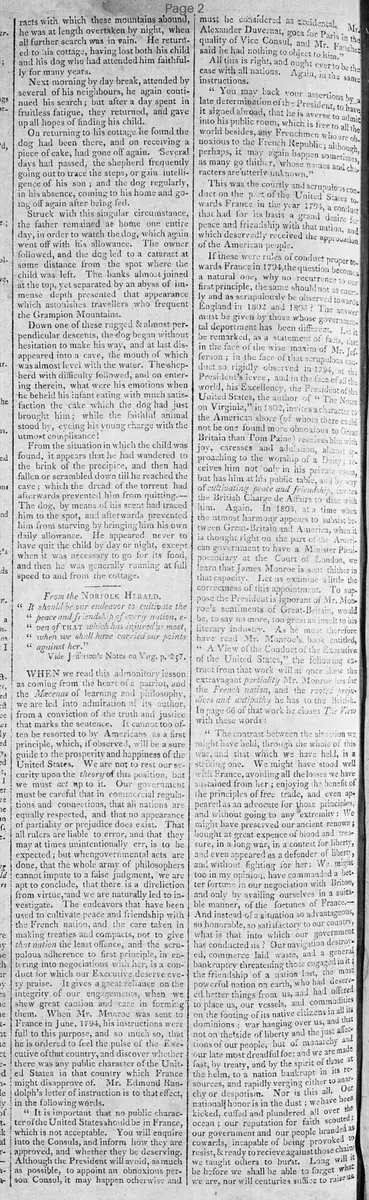
"It should be our endeavor to cultivate the peace and friendship of every nation, even of that which has injured us most, when we shall have carried our points against her."
Vide Jefferson's Notes on Virginia, p. 257.
WHEN we read this admonitory lesson as coming from the heart of a patriot, and the Maecenas of learning and philosophy, we are led into admiration of its author, from a conviction of the truth and justice that marks the sentence. It cannot too often be resorted to by Americans as a first principle, which, if observed, will be a sure guide to the prosperity and happiness of the United States. We are not to rest our security upon the theory of this position, but we must act up to it. Our government must be careful that in commercial regulations and connections, that all nations are equally respected, and that no appearance of partiality or prejudice does exist. That all rulers are liable to error, and that they may at times unintentionally err, is to be expected; but when governmental acts are done, that the whole army of philosophers cannot impute to a false judgment, we are apt to conclude, that there is a dereliction from virtue, and we are naturally led to investigate. The endeavors that have been used to cultivate peace and friendship with the French nation, and the care taken in making treaties and compacts, not to give that nation the least offence, and the scrupulous adherence to first principle, in entering into negotiations with her, is a conduct for which our Executive deserve every praise. It gives a great reliance on the integrity of our engagements, when we shew great caution and care in forming them. When Mr. Monroe was sent to France in June, 1794, his instructions were full to this purpose, and so much so, that he is ordered to feel the pulse of the Executive of that country, and discover whether there was any public character of the United States in that country which France might disapprove of. Mr. Edmund Randolph's letter of instruction is to that effect, in the following words.
"It is important that no public character of the United States should be in France, which is not acceptable. You will enquire into the Consuls, and inform how they are approved, and whether they be deserving. Although the President will avoid, as much as possible, to appoint an obnoxious person Consul, it may happen otherwise and must be considered as accidental. Alexander Duvernat, goes for Paris in the quality of Vice Consul, and Mr. Fauchet said he had nothing to object to him."
All this is right, and ought ever to be the case with all nations.
Again, in the same instructions.
"You may back your assertions by a late determination of the President, to have it signed abroad, that he is averse to admit into his public room, which is free to all the world besides, any Frenchmen who are obnoxious to the French Republic; although, perhaps, it may again happen sometimes, as many go thither, whose names and characters are utterly unknown."
This was the courtly and scrupulous conduct on the part of the United States towards France in the year 1794, a conduct that had for its basis a grand desire for peace and friendship with that nation, and which deservedly received the approbation of the American people.
If these were rules of conduct proper towards France in 1794, the question becomes a natural one, why no recurrence to our first principle, the same should not as courtly and as scrupulously be observed towards England in 1802 and 1803? The answer must be given by those whose governmental deportment has been different.
Let it be remarked, as a statement of facts, that in the face of the wise maxim of Mr. Jefferson; in the face of that scrupulous conduct so rigidly observed in 1794, at the President's levee, and in the face of all the world, his Excellency, the President of the United States, the author of "The Notes on Virginia," in 1802, invites a character to the American shore (of whom there could not be one found more obnoxious to Great Britain than Tom Paine) receives him with joy, caresses and adulation, almost approaching to the worship of a Deity; receives him not only in his private room, but has him at his public table, and by way of cultivating peace and friendship, invites the British Charge d'Affairs to dine with him.
Again. In 1803, at a time when the utmost harmony appears to subsist between Great-Britain and America, when it is thought right on the part of the American government to have a Minister Plenipotentiary at the Court of London, we learn that James Monroe is sent thither in that capacity. Let us examine a little the correctness of this appointment. To suppose the President is ignorant of Mr. Monroe's sentiments of Great-Britain, would be, to say no more, too great an insult to his literary industry. As he must therefore have read Mr. Monroe's book entitled, "A View of the Conduct of the Executive of the United States," the following extract from that work will at once shew the extravagant partiality Mr. Monroe has for the French nation, and the rooted prejudices and antipathy he has to the British.
In page 66 of that work he closes The View with these words:
"The contrast between the situation we might have held, through the whole of this war, and that which we have held, is a striking one. We might have stood well with France, avoiding all the losses we have sustained from her; enjoying the benefit of the principles of free trade, and even appeared as an advocate for those principles, and without going to any extremity: We might have preserved our ancient renown bought at great expense of blood and treasure, in a long war, in a contest for liberty, and even appeared as a defender of liberty, and without fighting for her: We might too in my opinion, have commanded a better fortune in our negotiation with Britain, and only by availing ourselves in a suitable manner, of the fortunes of France.- And instead of a situation so advantageous, so honorable, so satisfactory to our country, what is that into which our government has conducted us? Our navigation destroyed, commerce laid waste, and a general bankruptcy threatening those engaged in it; our government and our people branded as cowards, incapable of being provoked to resist, & ready to receive against those chains which we taught others to burst. Long will it be before we shall be able to forget what we are, nor will centuries suffice to raise us on the footing of its native citizens in all its dominions; war hanging over us, and that not on the side of liberty and the just affections of our people,- but of monarchy and our late most dreadful foe; and we are made fast, by treaty, and by the spirit of those at the helm, to a nation bankrupt in its resources, and rapidly verging either to anarchy or despotism. Nor is this all. We have been kicked, cuffed and plundered all over the ocean; our reputation for faith scouted; national honor is in the dust; we have lost, the most powerful nation on earth, who had deserved better things from us, and had offered to place us, our vessels, and commodities on the footing of its native citizens in all its dominions."
to the high ground from which we have fallen."
After perusing this extract, can any one doubt but that it was extremely easy to find a character in the United States as a nation, who would have been calculated for whose disposition towards Great Britain the meridian of London, who could have acted with more cordiality than it is possible for Mr. Monroe to do, with the administration of that country, and of course have served the purposes of the United States with better effect. If there is no such character to be found, then the American people have reason to lament their deficiency of merit, and the President's appointment is to be applauded, for so great an exertion to cultivate peace and friendship with Great-Britain. Nothing need be said about Mr. Monroe's condescension in accepting an appointment to a nation, in his opinion, "a deadly foe to this country."
"a bankrupt in its resources, and rapidly verging—either to anarchy or despotism."
He will be received with every respect to the United States, at St. James's, but he must not expect that the King of England will salute him FRATERNALLY, as the President of the Convention did at Paris, in August 1794. With this statement of facts, and these few observations, the American people will determine whether the conduct of the President in these particulars, is not more likely to create animosity rather than to cultivate peace and friendship, between the two nations.
SENEX.
What sub-type of article is it?
What keywords are associated?
What entities or persons were involved?
Editorial Details
Primary Topic
Critique Of Partiality In Us Diplomacy Towards Britain Versus France
Stance / Tone
Critical Of Presidential Bias Against Britain
Key Figures
Key Arguments