Thank you for visiting SNEWPapers!
Sign up free
The Daily Alaska Empire
Juneau, Juneau County, Alaska
What is this article about?
On the 50th anniversary of the Battle of San Juan Hill, the article commemorates the Rough Riders, the U.S. First Volunteer Cavalry led by Teddy Roosevelt, their recruitment from the Southwest, training, battles in Cuba in 1898, and lasting legacy in making Roosevelt president and influencing American nationalism.
Clipping
OCR Quality
Full Text
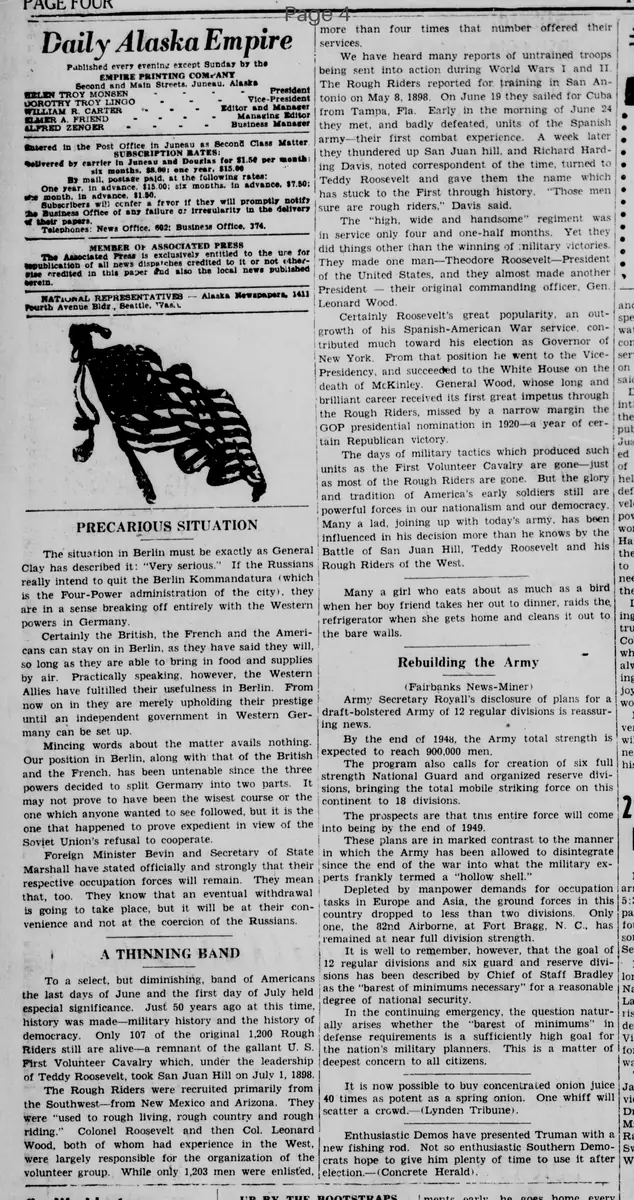
To a select, but diminishing, band of Americans the last days of June and the first day of July held especial significance. Just 50 years ago at this time, history was made—military history and the history of democracy. Only 107 of the original 1,200 Rough Riders still are alive—a remnant of the gallant U. S. First Volunteer Cavalry which, under the leadership of Teddy Roosevelt, took San Juan Hill on July 1, 1898.
The Rough Riders were recruited primarily from the Southwest—from New Mexico and Arizona. They were "used to rough living, rough country and rough riding." Colonel Roosevelt and then Col. Leonard Wood, both of whom had experience in the West, were largely responsible for the organization of the volunteer group. While only 1,203 men were enlisted, more than four times that number offered their services.
We have heard many reports of untrained troops being sent into action during World Wars I and II. The Rough Riders reported for training in San Antonio on May 8, 1898. On June 19 they sailed for Cuba from Tampa, Fla. Early in the morning of June 24 they met, and badly defeated, units of the Spanish army—their first combat experience. A week later they thundered up San Juan hill, and Richard Harding Davis, noted correspondent of the time, turned to Teddy Roosevelt and gave them the name which has stuck to the First through history. "Those men sure are rough riders," Davis said.
The "high, wide and handsome" regiment was in service only four and one-half months. Yet they did things other than the winning of military victories. They made one man—Theodore Roosevelt—President of the United States, and they almost made another President—their original commanding officer, Gen. Leonard Wood.
Certainly Roosevelt's great popularity, an outgrowth of his Spanish-American War service, contributed much toward his election as Governor of New York. From that position he went to the Vice-Presidency, and succeeded to the White House on the death of McKinley. General Wood, whose long and brilliant career received its first great impetus through the Rough Riders, missed by a narrow margin the GOP presidential nomination in 1920—a year of certain Republican victory.
The days of military tactics which produced such units as the First Volunteer Cavalry are gone—just as most of the Rough Riders are gone. But the glory and tradition of America's early soldiers still are powerful forces in our nationalism and our democracy. Many a lad, joining up with today's army, has been influenced in his decision more than he knows by the Battle of San Juan Hill, Teddy Roosevelt and his Rough Riders of the West.
What sub-type of article is it?
What themes does it cover?
What keywords are associated?
What entities or persons were involved?
Where did it happen?
Story Details
Key Persons
Location
San Juan Hill, Cuba
Event Date
July 1, 1898
Story Details
The Rough Riders, U.S. First Volunteer Cavalry led by Teddy Roosevelt, recruited from Southwest, trained in San Antonio, sailed to Cuba, defeated Spanish forces on June 24, 1898, and captured San Juan Hill on July 1, 1898; their service propelled Roosevelt to presidency and nearly Wood as well.