Thank you for visiting SNEWPapers!
Sign up free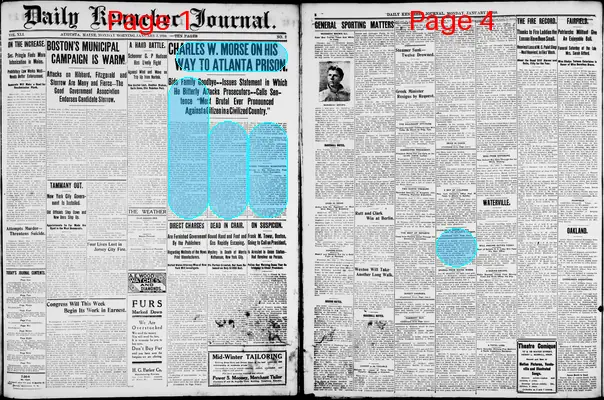
Daily Kennebec Journal
Augusta, Kennebec County, Maine
What is this article about?
Convicted banker Charles W. Morse leaves New York under guard for 15-year Atlanta prison term for banking law violations. He releases a statement decrying his innocence, trial flaws like jury drinking and detective oversight, and seeks public support for clemency. Wife to petition president. Passes stoically through Washington.
Merged-components note: Continuation of the Charles W. Morse story across pages.
Clippings
1 of 2
OCR Quality
Full Text
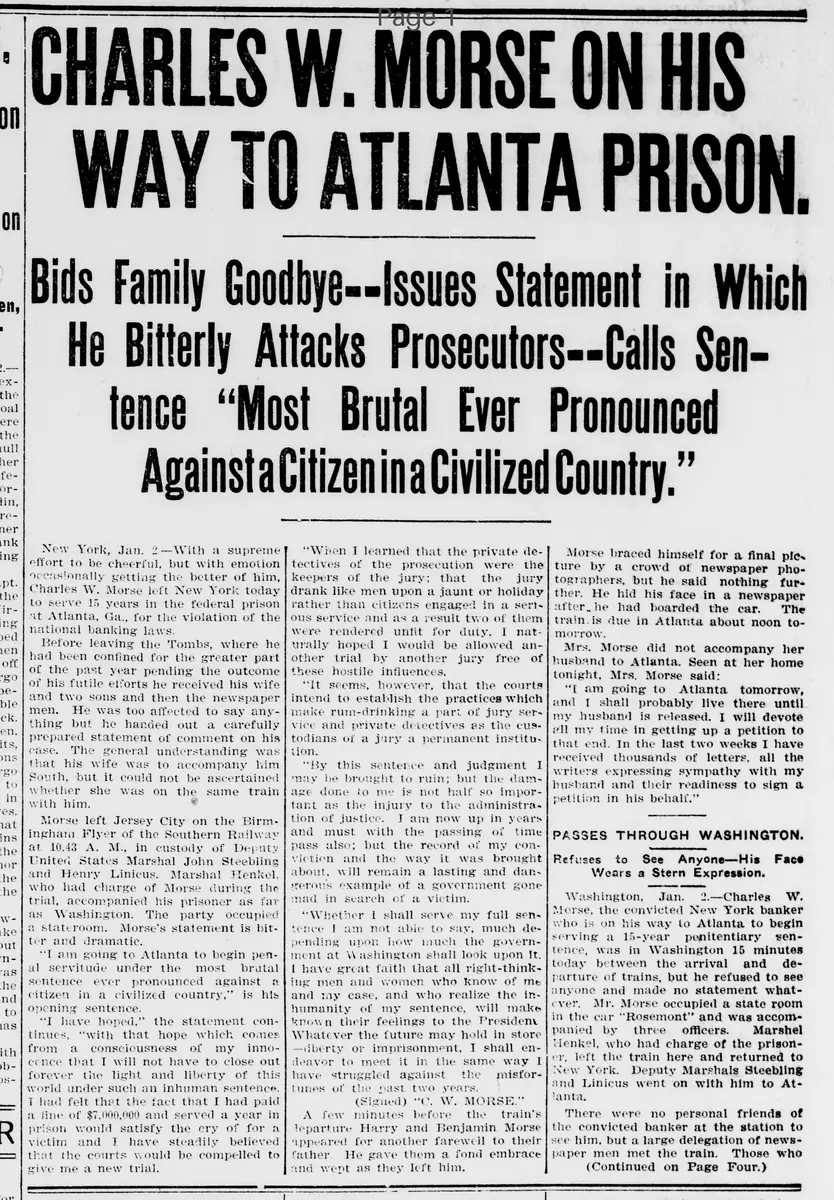
New York, Jan. 2.—With a supreme effort to be cheerful, but with emotion occasionally getting the better of him, Charles W. Morse left New York today to serve 15 years in the federal prison at Atlanta, Ga., for the violation of the national banking laws.
Before leaving the Tombs, where he had been confined for the greater part of the past year pending the outcome of his futile efforts he received his wife and two sons and then the newspaper men. He was too affected to say anything but he handed out a carefully prepared statement of comment on his case. The general understanding was that his wife was to accompany him South, but it could not be ascertained whether she was on the same train with him.
Morse left Jersey City on the Birmingham Flyer of the Southern Railway at 10:43 A. M., in custody of Deputy United States Marshal John Steeblins and Henry Linicus. Marshal Henkel, who had charge of Morse during the trial, accompanied his prisoner as far as Washington. The party occupied a stateroom. Morse's statement is bitter and dramatic.
"I am going to Atlanta to begin penal servitude under the most brutal sentence ever pronounced against a citizen in a civilized country," is his opening sentence.
"I have hoped," the statement continues, "with that hope which comes from a consciousness of my innocence that I will not have to close out forever the light and liberty of this world under such an inhuman sentence. I had felt that the fact that I had paid a fine of $7,000,000 and served a year in prison would satisfy the cry for a victim and I have steadily believed that the courts would be compelled to give me a new trial.
"When I learned that the private detectives of the prosecution were the keepers of the jury; that the jury drank like men upon a jaunt or holiday rather than citizens engaged in a serious service and as a result two of them were rendered unfit for duty. I naturally hoped I would be allowed another trial by another jury free of these hostile influences.
"It seems, however, that the courts intend to establish the practices which make rum-drinking a part of jury service and private detectives as the custodians of a jury a permanent institution.
"By this sentence and judgment I may be brought to ruin; but the damage done to me is not half so important as the injury to the administration of justice. I am now up in years and must with the passing of time pass also; but the record of my conviction and the way it was brought about, will remain a lasting and dangerous example of a government gone mad in search of a victim.
"Whether I shall serve my full sentence I am not able to say, much depending upon how much the government at Washington shall look upon it. I have great faith that all right-thinking men and women who know of me and my case, and who realize the inhumanity of my sentence, will make known their feelings to the President Whatever the future may hold in store—liberty or imprisonment. I shall endeavor to meet it in the same way I have struggled against the misfortunes of the past two years.
(Signed) "C. W. MORSE."
A few minutes before the train's departure Harry and Benjamin Morse appeared for another farewell to their father He gave them a fond embrace and went as they left him.
Morse braced himself for a final picture by a crowd of newspaper photographers, but he said nothing further. He hid his face in a newspaper after he had boarded the car.
The train is due in Atlanta about noon tomorrow.
Mrs. Morse did not accompany her husband to Atlanta. Seen at her home tonight, Mrs. Morse said:
"I am going to Atlanta tomorrow, and I shall probably live there until my husband is released. I will devote all my time in getting up a petition to that end. In the last two weeks I have received thousands of letters. all the writers expressing sympathy with my husband and their readiness to sign a petition in his behalf."
PASSES THROUGH WASHINGTON.
Refuses to See Anyone—His Face Wears a Stern Expression.
Washington, Jan. 2.—Charles W. Morse, the convicted New York banker who is on his way to Atlanta to begin serving a 15-year penitentiary sentence, was in Washington 15 minutes today between the arrival and departure of trains, but he refused to see anyone and made no statement whatever. Mr. Morse occupied a state room in the car "Rosemont" and was accompanied by three officers. Marshal Henkel, who had charge of the prisoner, left the train here and returned to New York. Deputy Marshals Steebling and Linicus went on with him to Atlanta.
There were no personal friends of the convicted banker at the station to see him, but a large delegation of newspaper men met the train. Those who
(Continued on Page Four.)
CHARLES W. MORSE ON HIS WAY TO ATLANTA PRISON.
(Continued From Page One.)
succeeded in finding which stateroom he was in were denied admittance by Deputy Steebling. Mr. Morse was seen for a moment from the outside as the blind of the window was raised. He glanced outside but apparently took no interest in anything he saw. His face wore a stern expression.
Passengers on the same car with Mr. Morse said that a son of the banker boarded the train with a friend at Baltimore and saw his father for a few minutes.
What sub-type of article is it?
What themes does it cover?
What keywords are associated?
What entities or persons were involved?
Where did it happen?
Story Details
Key Persons
Location
New York To Atlanta Via Washington And Jersey City
Event Date
Jan. 2
Story Details
Charles W. Morse departs New York for 15-year federal prison sentence in Atlanta for violating banking laws, issues bitter statement protesting innocence, trial irregularities including jury misconduct, and inhumanity of sentence; accompanied by marshals, refuses to see anyone in Washington; wife plans to petition for release.