Thank you for visiting SNEWPapers!
Sign up free
Gazette Of The United States, & Philadelphia Daily Advertiser
Philadelphia, Philadelphia County, Pennsylvania
What is this article about?
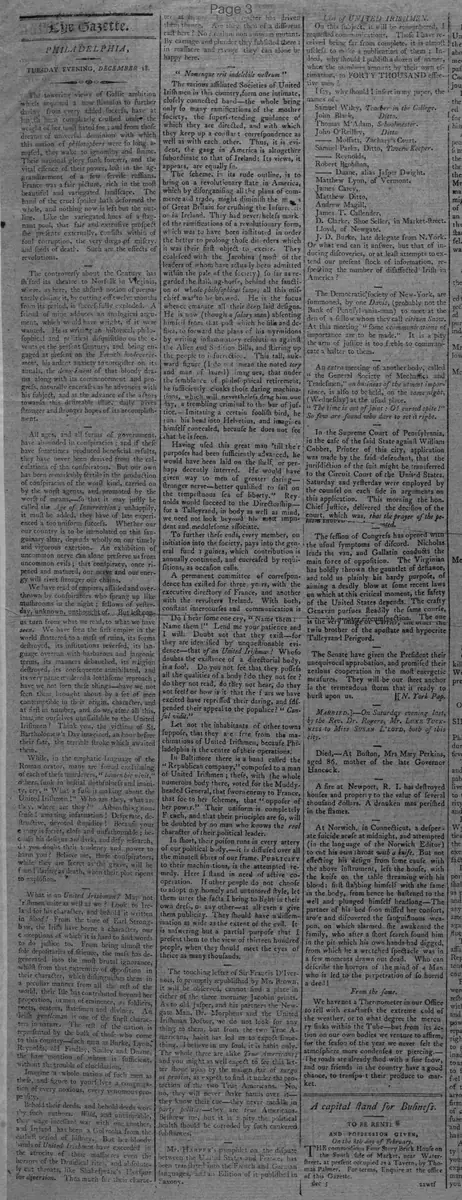
Editorial in Philadelphia Gazette laments France's revolutionary downfall and warns against United Irishmen conspiracies in America, linking them to Irish and French radicals aiming to incite revolution. Criticizes figures like Duane and Lyon, lists suspected members, notes Cobbett's court victory, and congressional tensions over laws like Alien and Sedition Acts.
Merged-components note: Merged sequential components forming a single extended editorial on French ambition, conspiracies, and United Irishmen.
Clipping
OCR Quality
Full Text
PHILADELPHIA
TUESDAY EVENING, DECEMBER 18.
The towering views of Gallic ambition which acquired a new stimulus to further daring from every added success, have at length been completely crushed under the weight of her most hated foe; and from those dreams of universal dominion with which this nation of philosophers were so long amused, they wake to ignominy and shame.
Their national glory sunk forever, and the vital essence of their power, lost in the aggrandizement of a few servile ruffians.
France was a fair picture, rich in the most beautiful and variegated landscape. The hand of the cruel spoiler hath deformed the whole, and nothing now is left but the outline. Like the variegated hues of a stagnant pool, that fair and extensive property presents externally, consists within of foul corruption, the very dregs of misery, and seeds of death. Such are the effects of revolutions.
The controversy about the Century has shifted its theatre to Norfolk in Virginia where, as here, the absurd notion of prematurely closing it, by cutting off twelve months from its period, is successfully exploded. A friend of mine adduces an analogical argument, which would have weight, if it were wanted. He is writing an historical, philosophical and political disquisition on the events of the present Century, and being engaged at present on the French bouleversement, his ardent anxiety to enregister on its annals, the denouement of that bloody drama along with its commencement and progress, naturally increases as he advances with his subject, and as the advance of the actors towards this desirable issue, daily gives stronger and stronger hopes of its accomplishment.
All ages, and all forms of government, have abounded in conspiracies; and if these have sometimes produced beneficial results, they have never been derived from the calculations of the conspirators. But our own has been remarkably fertile in the production of conspiracies of the worst kind, carried on by the worst agents, and promoted by the worst of means,—so that it may justly be called the Age of Insurrection; unhappily, it must be added, they have of late experienced a too uniform success. Whether our country is to be immolated on this sanguinary altar, depends wholly on our timely and vigorous exertion. An exhibition of uncommon nerve can alone preserve us from uncommon evils; that conspiracy, once ripened and matured, our nerve and our energy will rivet stronger our chains.
We have read of empires, assailed and overthrown by conspirators who sprang up like mushrooms in the night; fellows of yesterday, unknown, unthought of. But let us turn from what we read, to what we have seen. We have seen the first empire in the world shattered to a mass of ruins, its forms destroyed, its institutions revered, its language overrun with barbarous and jargonic terms, its manners debauched, its religion destroyed, its consequence annihilated, and its very name rendered a loathsome reproach; have we not seen these things—have we not seen them brought about by a set of men contemptible in their origin, character, and at first in number, and do we, after all this, imagine ourselves unassailable to the United Irishmen? Think you, the victims of St. Bartholomew's Day imagined, an hour before their fate, the terrible stroke which awaited them.
While, in the emphatic language of the Roman orator, many are found exclaiming of each of these murderers, "tamen hic vivit," others, sunk in bestial slothfulness and inactivity, cry, "What a fuss is making about the United Irishmen!" Who are they, what are they, where are they? Astonishing nonchalance! amazing infatuation! Desperate, destructive, devoted stupidity! Because your enemy is secret, close and unfathomable; because his designs are dark, and defy research, do you doubt their tendency and power to harm you? Believe me, these conspirators, while they are secret as the grave, will be found daring as death, when their plot ripens to explosion.
What is an United Irishman? May not Irishmen unite as well as we? Look to Ireland for his character, and behold it written in blood! From the time of Earl Strongbow, the Irish have borne a character, our conceptions of which it is hard to find words to do justice to. From being almost the sole depositaries of science, the mass has degenerated into the most brutal ignorance, whilst from that extremity of opposition in their character, which distinguishes them in a peculiar manner from all the rest of the world, their Isle has contributed beyond her proportion, in men of eminence, as soldiers, poets, orators, statesmen and divines. An Irish gentleman is one of the finest characters in nature. The rest of the nation is represented by the bulk of those who come to this country—such men as Burke, Lyon, Reynolds, old Findley, Smiley and Duane, the bare mention of whom is sufficient, without the trouble of elucidation.
Imagine a whole nation of such men as these, and figure to yourselves a congregation of every noxious, every venomous property.
Behold their deeds, and behold deeds worthy such authors. Wild, and untameable, they wage incessant war with one another, and Ireland has been a Golconda from the earliest period of history. But her bloody bands of United Irishmen have exceeded in the atrocity of their massacres even the horrors of the Druidical rites, and absolutely cut throats, like Shakespeare's Hotspur for diversion. Thus much for their character.
Terror at home. Hunger has driven them thence. Are they then of a different cast here? No: coelum non animum mutant.
By carnage and plunder they subsisted there: in massacre and ravage they can alone be happy here.
"Nomenque erit indelebile veltrum"
The various affiliated Societies of United Irishmen in this country, form one intimate, closely connected band—the whole being only so many ramifications of the mother society, the superintending guidance of which they are directed, and with which they keep up a constant correspondence as well as with each other. Thus, it is evident, the gang in America is altogether subordinate to that of Ireland: Its views, it appears, are equally so.
The scheme, in its rude outline, is to bring on a revolutionary state in America, which by disorganizing all the plans of commerce and trade, might diminish the means of Great Britain for crushing the insurgents on in Ireland. They had nevertheless marked the ramifications of a revolutionary form, which was to have been instituted in order the better to prolong those disorders which it was their first object to excite. They coalesced with the Jacobins (most of the leaders of whom have actually been admitted within the pale of the society) so far as regarded the talking-horse, behind the sanction of whose philosophical fame, all this mischief was to be brewed. He is the focus whence emanate all their deep laid designs. He is now (though a salary man) absenting himself from that post which he fills and defiles, to forward the plans of his myrmidons by writing inflammatory resolutions against the Alien and Sedition Bills, and Stirring up the people to insurrection. This tall, awkward figure (I do not mean the noted tory and man of laurel) imagines, that under the semblance of philosophical retirement, he sufficiently cloaks those daring machinations, which will nevertheless drag him one day, a trembling criminal to the bar of justice. - Imitating a certain foolish bird, he runs his head into Helvetius, and imagines himself concealed, because he does not see that he is seen.
Having used this great man till their purposes had been sufficiently advanced, he would have been laid on the shelf, or perhaps decently interred. He would have given way to men of greater daring—stronger nerve—better qualified to sail on the tempestuous sea of liberty." Reynolds would succeed to the Directorship—for a Talleyrand, in body as well as mind, we need not look beyond his most impudent and meddlesome associate.
To further these ends, every member, on initiation into the society, pays into the general fund 1 guinea, which contribution is annually continued, and increased by requisitions, as occasion calls.
A permanent committee of correspondence has existed for three years, with the executive directory of France, and another with the revolters Ireland. With both, constant intercourse and communication is
Do I hear some one cry, "Name them? Name them!" Lend me your patience and I will: Doubt not that they exist—for they are identified by unquestionable evidence—that of an United Irishman! Who doubts the existence of a directorial body, is a fool. Do you not see that they possess all the qualities of a body? do they not see? do they not read, do they not hear, do they not feel? or how is it that the fears we have excited have repressed their daring, and suspended their appeal to the populace? "Consul vidit."
Let not the inhabitants of other towns suppose, that they are free from the machinations of United Irishmen, because Philadelphia is the centre of their operations. In Baltimore there is a band called the "Republican company," composed to a man of United Irishmen; these, with the whole numerous body there, voted for the Muddy headed General, that sworn enemy to France, that foe to her schemes, that "opposer of her power." Their uniform is completely French, and that their principles are so, will be doubted by no man who knows the real character of their political leader.
In short, their poison runs in every artery of our political body,—it is diffused over all the minutest fibres of our frame. Publicity to their machinations, is the attempted remedy. Here I stand in need of active co-operation. If other people do not choose to adopt my homely and untutored style, let them utter the facts I bring to light in their own dress, or any other—at all events give them publicity. They should have a dissemination as wide as the extent of the evil. It is answering but a partial purpose that I present them to the view of thirteen hundred people, when they should meet the eyes of thrice as many thousands.
The touching letter of Sir Francis D'Ivernois, so promptly republished by Mr. Brown, it will be observed, cannot find a place in either of the three morning Jacobin prints. As to old Jasper, and his partners the Newgate Man, Dr. Morpheus and the United Irishman Doctor, we do not look for any thing to them, but from the two True Americans, habit has led us to expect something. I believe in my soul, it is habit only. The whole three are alike True Americans; and you might as well expect to see this letter shone upon by the malign star of surgo ut prosim, as expect to find it under the protection of the two True Americans. No, no, they will never shake hands over it they know their cue—they never meddle in party politics they are true Americans.
Beshrew me, but it is a pity the political health should be corroded by such cankered substances.
Mr. Harper's pamphlet on the dispute between the United States and France, has been translated into the French and German languages, and an Edition of it published in Saxony.
List of UNITED IRISHMEN.
On this subject, it will be remembered, I requested communications. Those I have received being far from complete, it is almost useless to make a publication of them: Indeed, why should I publish a dozen of names, when the members amount by their own estimation, to FORTY THOUSAND effective men?
I say, why should I insert in my paper, the names of
Samuel Wiley, Teacher in the College.
John Black, Ditto.
Thomas M'Adam, Schoolmaster.
John O'Reilley, Ditto
Moffatt, Zachary's Court.
Samuel Parks, Ditto, Tavern Keeper.
Reynolds,
Robert Robison,
Duane, alias Jasper Dwight
Matthew Lyon, of Vermont.
James Carey,
Matthew Ditto,
Andrew Magill,
James T. Callender,
D. Clarke, Shoe Seller, in Market-street
Lloyd, of Newgate.
J. D. Burke, late delegate from N.York.
Or what end can it answer, but that of inducing discoveries, or at least attempts to extend our present stock of information, respecting the number of disaffected Irish in America?
The Democratic society of New-York, are summoned, by one Davis, (probably not the Bank of Pennsylvania-man) to meet at the den of a fellow whom they call citizen Snors. At this meeting "some communications of importance are to be made." It is a pity the arm of justice is too feeble to communicate a halter to them.
An extra meeting of another body, called "the General Society of Mechanics and Tradesmen," on business of the utmost importance, is also to be held, on the same night, (Wednesday) at the usual place.
"The time is out of joint : O! cursed spite!"
So few are found who dare to set it right.
In the Supreme Court of Pennsylvania, in the case of the said State against William Cobbett, Printer of this city, application was made by the said defendant, that the jurisdiction of the suit might be transferred to the Circuit Court of the United States.
Saturday and yesterday were employed by the counsel on each side in arguments on this application. This morning the hon. Chief Justice, delivered the decision of the court. which was, that the prayer of the petition SHOULD be granted.
The Session of Congress has opened with the usual symptoms of discord. Nicholas leads the van, and Gallatin conducts the main force of opposition. The Virginian has boldly thrown the gauntlet of defiance, and told us plainly his hardy purpose, of aiming a deadly blow at some recent laws, on which at this critical moment, the safety of the United States depends. The crafty Genevan pursues steadily the same course, twin brother of the apostate and hypocrite Talleyrand Perigord.
The Senate have given the President their unequivocal approbation, and promised their zealous cooperation in the most energetic measures. They will be our sheet anchor in the tremendous storm that is ready to burst upon us.
N. York Pap.
MARRIED.—On Saturday evening last, by the Rev. Dr. Rogers, Mr. Luke Tuckness to Miss Susan L'Lord, both of this city.
Died, At Boston, Mrs Mary Perkins, aged 86, mother of the late Governor Hancock.
A fire at Newport, R. I. has destroyed houses and property to the value of several thousand dollars. A drunken man perished in the flames.
At Norwich, in Connecticut, a desperate suicide arose at midnight, and attempted (in the language of the Norwich Editor) to cut his own throat with a knife. But not effecting his design from some cause with the above instrument, left the house, with the knife on the table streaming with his blood: first stabbing himself with the same in the body, from whence he hastened to the well and plunged himself headlong—The partner of his bed soon missed her consort, arose and discovered the sanguiferous weapon, on which alarmed she awakened the family, who after a short search found him in the pit which his own hands had digged, from which he a wretched spectacle was in a few moments drawn out dead. Who can describe the horrors of the mind of a Man who is led to the perpetration of so horrid a deed!
From the same.
We have not a Thermometer in our Office to tell with exactness the extreme cold of the weather, or to what degree the mercury sinks within the Tube—but from its action on our own bodies we venture to affirm, for the season of the year we never felt the atmosphere more condensed or piercing.—The roads are already hid with a fine snow, and our friends in the country have a good chance, to transport their produce to market.
What sub-type of article is it?
What keywords are associated?
What entities or persons were involved?
Editorial Details
Primary Topic
Warning Against United Irishmen Conspiracies In America
Stance / Tone
Strongly Anti Revolutionary And Anti United Irishmen
Key Figures
Key Arguments