Thank you for visiting SNEWPapers!
Sign up free
Virginia Argus
Richmond, Virginia
What is this article about?
Oration by Harry Toulmin on July 4, 1804, in Frankfort, Kentucky, celebrating American independence and the Louisiana Purchase. It praises the acquisition's benefits for expansion, Mississippi navigation, and averting foreign colonization threats from France or Britain, while defending the Jefferson administration against Federalist critics and emphasizing federalism.
Merged-components note: This is a continuation of the same oration delivered by Harry Toulmin, spanning across pages 1 and 2. The content is an opinion piece on the acquisition of Louisiana and related political matters, fitting the editorial label better than literary.
Clippings
1 of 2
OCR Quality
Full Text
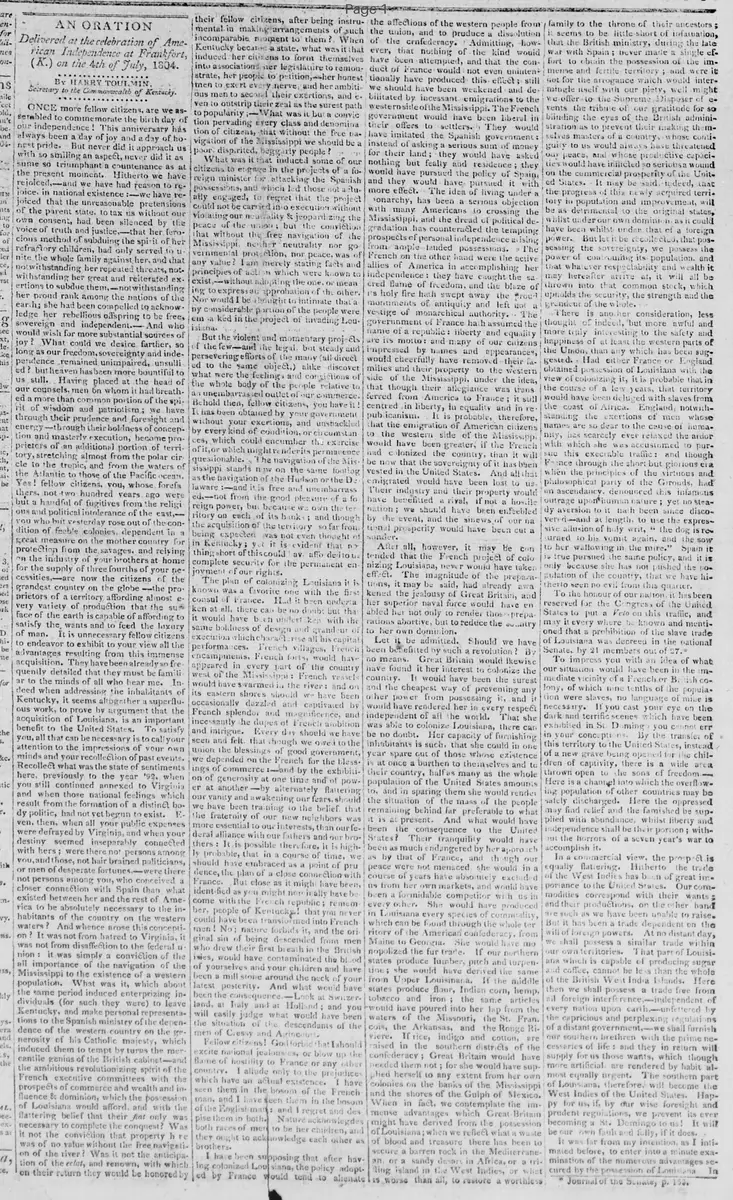
Delivered at the celebration of American Independence at Frankfort, (K.) on the 4th of July, 1804.
By HARRY TOULMIN.
Secretary to the Commonwealth of Kentucky
Once more fellow citizens, are we assembled to commemorate the birth day of our independence! This anniversary has always been a day of joy and a day of honest pride. But never did it approach us with so smiling an aspect, never did it assume so triumphant a countenance as at the present moment. Hitherto we have rejoiced,—and we have had reason to rejoice. in national existence:—we have rejoiced that the unreasonable pretensions of the parent state. to tax us without our own consent, had been silenced by the voice of truth and justice,—that her ferocious method of subduing the spirit of her refractory children, had only served to unite the whole family against her, and that notwithstanding her repeated threats, notwithstanding her great and reiterated exertions to subdue them,—notwithstanding her proud rank among the nations of the earth; she had been compelled to acknowledge her rebellious offspring to be free, sovereign and independent.—And who would wish for more substantial sources of joy? What could we desire farther, so long as our freedom, sovereignty and independence remained unimpaired, unsullied? but heaven has been more bountiful to us still. Having placed at the head of our counsels, men on whom it had breathed a more than common portion of the spirit of wisdom and patriotism; we have through their prudence and foresight and energy—through their boldness of conception and masterly execution, become proprietors of an additional portion of territory, stretching almost from the polar circle to the tropic, and from the waters of the Atlantic to those of the Pacific ocean.
Yes! fellow citizens. you, whose forefathers, not two hundred years ago were but a handful of fugitives from the religious and political intolerance of the east,— you who but yesterday rose out of the condition of feeble colonies, dependent in a great measure on the mother country for protection from the savages. and relying on the industry of your brothers at home for the supply of three-fourths of your necessities, are now the citizens of the grandest country on the globe—the proprietors of a territory affording almost every variety of production that the surface of the earth is capable of affording to satisfy the wants and to feed the luxury of man. It is unnecessary fellow citizens to endeavor to exhibit to your view all the advantages resulting from this immense acquisition. They have been already so frequently detailed that they must be familiar to the minds of all who hear me. Indeed when addressing the inhabitants of Kentucky, it seems altogether a superfluous work, to prove by argument that the acquisition of Louisiana, is an important benefit to the United States. To satisfy you, all that can be necessary is to call your attention to the impressions of your own minds and your recollection of past events. Recollect what was the state of sentiments here, previously to the year '92, when you still continued annexed to Virginia and when those national feelings which result from the formation of a distinct body politic, had not yet begun to exist. Even, then, when all your public expenses were defrayed by Virginia, and when your destiny seemed inseparably connected with hers; were there not persons among you, and those, not hair brained politicians, or men of desperate fortunes,—were there not persons among you, who conceived a closer connection with Spain than what existed between her and the rest of America to be absolutely necessary to the inhabitants of the country on the western waters? And whence arose this conception? It was not from hatred to Virginia, it was not from disaffection to the federal union: it was simply a conviction of the all importance of the navigation of the Mississippi to the existence of a western population. What was it, which about the same period induced enterprising individuals (for such they were) to leave Kentucky, and make personal representations to the Spanish ministry of the dependence of the western country on the generosity of his Catholic majesty, which induced them to tempt by turns the mercantile genius of the British cabinet—and the ambitious revolutionizing spirit of the French executive committees with the prospects of commerce and wealth and influence & dominion, which the possession of Louisiana would afford, and with the flattering belief that their fiat only was necessary to complete the conquest? Was it not the conviction that property here was of no value without the free navigation of the river? Was it not the anticipation of the eclat, and renown, with which on their return they would be honored by their fellow citizens, after being instrumental in making arrangements of such incomparable moment to them?. When Kentucky became a state, what was it that induced her citizens to form themselves into associations her legislature to remonstrate, her people to petition,—her honest men to exert every nerve, and her ambitious men to second their exertions, and even to outstrip their zeal as the surest path to popularity;— What was it but a conviction pervading every class and denomination of citizens,—that without the free navigation of the Mississippi we should be a poor. dispirited, beggarly people?
What was it that induced some of our citizens to engage in the projects of a foreign minister for attacking the Spanish possessions, and which led those not actually engaged, to regret that the project could not be carried into execution without violating our neutrality & jeopardizing the peace of the union: but the conviction that without the free navigation of the Mississippi, neither neutrality nor governmental protection, nor peace, was of any value? I am merely stating facts and principles of action which were known to exist,—without adopting the one, or meaning to express any approbation of the other. Nor would I be thought to intimate that any considerable portion of the people were embarked in the project of invading Louisiana. But the violent and momentary projects of the few—and the legal. but steady and persevering efforts of the many (all directed to the same object.) alike discover what were the feelings; and convictions of the whole body of the people relative to an unembarrassed outlet of our commerce. Behold then, fellow citizens, you have it! It has been obtained by your government without your exertions, and unshackled by every kind of condition, or circumstance, which could encumber the exercise of it, or which might render its permanence questionable. The navigation of the Mississippi stands now on the same footing as the navigation of the Hudson or the Delaware:—and it is free and unembarrassed,—not from the good pleasure of a foreign power, but because we own the territory on each of its banks; and though the acquisition of the territory so far from being expected was not even thought of in Kentucky; yet it is evident that no thing short of this could have afforded to us complete security for the permanent enjoyment of our rights.
The plan of colonizing Louisiana it is known was a favorite one with the first consul of France. Had it been undertaken at all, there can be no doubt; but that it would have been undertaken with the same boldness of design and grandeur of execution which characterize all his capital performances. French villages, French encampments, French forts, would have appeared in every part of the country west of the Mississippi: French vessels would have swarmed in the river: and on its eastern shores should we have been occasionally dazzled and captivated by French splendour and magnificence, and incessantly the dupes of French ambition and intrigue. Every day should we have seen and felt. that though we owed to the union the blessings of good government, we depended on the French for the blessings of commerce:—and by the exhibition of generosity at one time and of power at another—by alternately flattering our vanity and awakening our fears, should we have been training to the belief that the fraternity of our new neighbors was more essential to our interests, than our federal alliance with our fathers and our brothers: It is possible therefore, it is highly probable, that in a course of time, we should have embraced as a point of prudence, the plan of a close connection with France. But close as it might have been, identified as you might nominally have become with the French republic; remember, people of Kentucky! that you never could have been transformed into French men! No; nature forbids it, and the original sin of being descended from men who drew their first breath in the British isles, would have contaminated the blood of yourselves and your children and have been a mill stone around the neck of your latest posterity. And what would have been the consequence.—Look at Switzerland, at Italy and at Holland; and you will easily judge what would have been the situation of the descendants of the men of Cressy and Agincourt.
Fellow citizens! God forbid that I should excite national jealousies, or blow up the flame of hostility to France or any other country. I allude only to the prejudices which have an actual existence. I have seen them in the bosom of the French man, and I have seen them in the bosom of the Englishman: and I regret and despise them in both. Nature acknowledges both races of men to be her children, and they ought to acknowledge each other as brothers.
I have been supposing that after having colonized Louisiana, the policy adopted by France would tend to alienate the affections of the western people from the union, and to produce a dissolution of the confederacy. Admitting, however, that nothing of the kind would have been attempted, and that the conduct of France would not even unintentionally have produced this effect; still we should have been weakened and debilitated by incessant emigrations to the western side of the Mississippi. The French government would have been liberal in their offers to settlers. They would have imitated the Spanish government: instead of asking a serious sum of money for their land; they would have asked nothing but fealty and residence; they would have pursued the policy of Spain, and they would have pursued it with more effect. The idea of living under a monarchy, has been a serious objection with many Americans in crossing the Mississippi, and the dread of political degradation has counteracted the tempting prospects of personal independence arising from ample landed possessions. The French on the other hand were the active allies of America in accomplishing her independence: they have caught the sacred flame of freedom. and the blaze of its holy fire hath swept away the proud monuments of antiquity and left not a vestige of monarchical authority. The government of France hath assumed the name of a republic: liberty and equality are its motto: and many of our citizens impressed by names and appearances, would cheerfully have removed—their families and their property to the western side of the Mississippi, under the idea, that though their allegiance was transferred from America to France; it still centred, in liberty, in equality and in republicanism. It is probable, therefore, that the emigration of American citizens to the western side of the Mississippi, would have been greater, if the French had colonized the country, than it will be now that the sovereignty of it has been vested in the United States. And all that emigrated would have been lost to us. Their industry and their property would have benefited a rival, if not a hostile nation; we should have been enfeebled by the event, and the sinews of our national prosperity would have been cut asunder.
After all, however, it may be contended that the French project of colonizing Louisiana, never would have taken effect. The magnitude of the preparations, it may be said, had already awakened the jealousy of Great Britain, and her superior naval force would have enabled her not only to render those preparations abortive, but to reduce the country to her own dominion. Let it be admitted. Should we have been benefited by such a revolution? By no means. Great Britain would likewise have found her interest to Colonize the country. It would have been the surest and the cheapest way of preventing any other power from possessing it, and it would have rendered her in every respect independent of all the world. That she was able to colonize Louisiana, there can be no doubt. Her capacity of furnishing inhabitants is such, that she could in one year spare out of those whose existence is at once a burthen to themselves and to their country, half as many as the whole population of the United States amounts to, and in sparing them she would render the situation of the mass of the people remaining behind far preferable to what it is at present. And what would have been the consequence to the United States? Their tranquility would have been as much endangered by her approach as by that of France, and though our peace were not menaced she would in a course of years have absolutely excluded us from her own markets, and would have been a formidable competitor with us in every other. She would have produced in Louisiana every species of commodity, which can be found through the whole territory of the American confederacy, from Maine to Georgia. She would have monopolized the fur trade. If our northern states produce lumber, pitch and turpentine; she would have derived the same from Upper Louisiana. If the middle states produce flour, Indian corn, hemp, tobacco and iron; the same articles would have poured into her lap from the waters of the Missouri, the St. Francis, the Arkansas, and the Rouge River. If rice, indigo and cotton, are raised in the southern districts of the confederacy; Great Britain would have needed them not; for she would have supplied herself to any extent from her own colonies on the banks of the Mississippi and the shores of the Gulph of Mexico. When in fact, we contemplate the immense advantages which Great Britain might have derived from the possession of Louisiana; when we reflect what a waste of blood and treasure there has been to secure a barren rock in the Mediterranean. or a sandy desert in Africa, or a trifling island in the West Indies, or what is worse than all, to secure a worthless family to the throne of their ancestors; it seems to be little short of infatuation, that the British ministry, during the late war with Spain; never made a single effort to obtain the possession of the immense and fertile territory; and were it not for the arrogance which would inter mingle itself with our piety, well might we offer—to the Supreme Disposer of events the tribute of our gratitude for so blinding the eyes of the British administration as to prevent their making themselves masters of a country, whose contiguity to us would always have threatened our peace, and whose productive capacities would have inflicted so serious a wound on the commercial prosperity of the United States. - It may be said,—indeed, that the progress of this newly acquired territory in population and improvement, will be as detrimental to the original states, whilst under our own dominion. as it could have been whilst under that of a foreign power. But let it be recollected, that possessing the sovereignty, we possess the power of controlling its population. and that whatever respectability and wealth it may hereafter arrive at, it will all be thrown into that common stock, which upholds the security, the strength and the grandeur of the whole..
There is another consideration, less thought of indeed. but more awful and more truly interesting to the safety and happiness of at least the western parts of the Union, than any which has been suggested. Had either France or England obtained possession of Louisiana with the view of colonizing it, it is probable that in the course of a few years, that territory would have been deluged with slaves from the coast of Africa. England, notwithstanding the exertions of men whose names are so dear to the cause of humanity, has scarcely ever relaxed the ardor with which she was accustomed to pursue this execrable traffic: and though France through the short but glorious era when the principles of the virtuous and philosophical party of the Girondists, had an ascendancy. denounced this infamous outrage upon human nature; yet no steady aversion to it has been since discovered—and at length, to use the expressive allusion of holy writ, "the dog is returned to his vomit again, and the sow to her wallowing in the mire." Spain it is true pursued the same policy, and it is only because she has not pushed the population of the country, that we have hitherto seen no evil from this quarter. To the honour of our nation. it has been reserved for the Congress of the United States to put a Veto on this traffic, and may it every where be known and mentioned that a prohibition of the slave trade of Louisiana was decreed in the national Senate, by 21 members out of 27.*
To impress you with an idea of what our situation would have been in the immediate vicinity of a French or British colony, of which nine-tenths of the population were slaves, no language of mine is necessary. If you cast your eye on the dark and terrific scenes which have been exhibited in St. Domingo you cannot err in your conception. By the transfer of this territory to the United States, instead of a new grave being opened for the children of captivity, there is a wide area thrown open to the sons of freedom.— Here is a channel into which the overflowing population of other countries may be safely discharged. Here the oppressed may find relief and the famished be supplied with abundance, whilst liberty and independence shall be their portion; without the horrors of a seven years war to accomplish it.
In a commercial view, the prospect is equally flattering. Hitherto the trade of the West Indies has been of great importance to the United States. Our commodities correspond with their wants and their productions, on the other hand are such as we have been unable to raise. But it has been a trade dependent on the will of foreign powers. At no distant day, we shall possess a similar trade within our own territories. That part of Louisiana which is capable of producing sugar and coffee, cannot be less than the whole of the British West India Islands. Here then we shall possess a trade free from all foreign interference,—independent of every nation upon earth,—unfettered by the capricious and perplexing regulations of a distant government,—we shall furnish our southern brethren with the prime necessaries of life: and they in return will supply for us those wants, which though more artificial are rendered by habit almost equally urgent. The southern part of Louisiana, therefore, will become the West Indies of the United States. Happy for us, if. by our wise foresight and prudent regulations, we prevent its ever becoming a St. Domingo to us! It will be our own fault and folly, if it does..
It was far from my intention, as I intimated before, to enter into a minute examination of the numerous advantages secured by the possession of Louisiana
*Journal of the Senate, P. 158.
On the various occasions which the subject has undergone, your attention has been called into the ample provision which it makes for a population which doubles itself every 25 years; to the increase of strength derived to our confederacy by the addition of the inhabitants of Louisiana; to the new ties of trade which it creates between the United States and the most powerful nation in Europe; the danger which it averts of the unfriendly influence of foreign powers on the several Indian nations bordering on our frontiers; to the ability it affords us, by an exchange of territory advantageous to both parties, to remove them farther from our settlements, and to become the undisturbed possessors of the country East of the Mississippi,--and to the riches which may be obtained, by means of the precious metals which are said to abound in Louisiana. These considerations, as well as those perhaps, on which I have already dwelt are familiar to your minds. And you know how to appreciate them: and to engage in a detailed examination of the whole, would rather be trespassing on your patience, than enriching your stores of information. And what has been the price of these numerous and immense advantages? Have your young men been summoned from the plough to the field of battle? Have your fathers of families, been obliged to tear themselves from their little ones, and to abandon domestic duties? Have your towns been stormed, or your fields stained with human blood? Or have you been the instruments of vengeance on other countries, and desolated the fair works of God by fire and sword? Or, have you sunk your national character, and entered into obligations unworthy the dignity of an independent people? No: nothing of the kind has taken place. The whole country has been transferred to you for less than two millions and a half sterling. You have obtained it for about one half the sum which Great Britain a few years since squandered away on a dispute, whether the Turks or the Russians, should possess a single fortress in a desert. You have obtained it for about one half the sum, if my memory deceives me not, which the same power soon after this expended in a controversy with Spain, whether her subjects should enjoy the right of fishing on a coast belonging in fact to neither of them; and which was about eight or ten thousand miles distant from both.
Citizens of America! well may you be proud of your government! I dread to excite the feelings of self conceit, and national arrogance: but you may trace the long page of history, and mark the progress of other governments, whilst your eye will at one time and another alternately flash with indignation, and melt with pity, before you will find its parallel.
Yet has this government been calumniated! It has been calumniated, not by foreigners, not by rival nations. No: they respect it and are willing to bestow on it the tribute of admiration. It has been calumniated, ridiculed and abused, by native Americans!
The opponents of the government seem to be dissatisfied with this acquisition of Louisiana, because it was not previously fought for: as if no contracts could be valid between nations but such as are written in letters of blood. Whatever merit there may be, in having obtained the territory, it ought to be ascribed, they say, rather to Great Britain, than to the wisdom and energy of our own executive. It was her making war on France, before the fleet had sailed, which was destined to colonize Louisiana--it was the power of her navy, and the apprehension of the country's falling into her hands, that induced the First Consul to cede it to the United States.
Admitting, that a calculation of the chances of war had an influence on the mind of the First Consul; will it follow that no merit is due to the American government for the promptness with which they availed themselves of this circumstance, to promote the aggrandizement of their country, and the extension of the reign of liberty and reason? England, it is known, was in possession of the same naval superiority--was supported by the power of continental allies, and Louisiana was in the hands of her enemies, during the administration of Adams. How did it happen then, if the acquisition of it was so easy a matter under such circumstances, that Mr. Adams never obtained it; or at least so much of it as should have secured us the navigation of the Mississippi? It surely was not owing to a doubt of its importance, when the friends of that administration were disposed to plunge the nation into a war for the sake of its capital city merely. The reason is apparent: it was because there was nothing pacific, nothing conciliatory in the character of that administration. Their temper, their language and their deportment, were such as to preclude all idea of friendly intercourse. There was too much party spirit in their character--there was too evident a disposition to take a side in the politics and contentions of the rival nations--there was too evident a hatred of the principles of the French revolution, to justify them in expecting benefits from the republic, or to suffer them if possessing any delicacy of feeling or sense of personal dignity, even to propose a negociation which implied confidence in each others friendly or barely neutral dispositions.
The present administration, on the other hand, have been no partizans in European politics: they have railed at no foreign power: they have slandered none at the expense of the rest: their conduct in short, has been such, that without any violation of the principles of decorum, they could enter into a friendly negociation on any negociable subject with any power in Europe. As to the merits of their contract with France, they set up no pretensions to the power of working miracles on the mind of the First Consul, or of making him believe that it was his interest to sell Louisiana, when it was otherwise:--they affect no necromantic talent of conjuring the territory of other nations out of their possessions, how congenial soever it may be with the ideas of some men concerning acuteness of genius and diplomatic talents,--nor do they wish to persuade us, that they have tricked the First Consul out of a capital bargain,--nor do they call upon us to extol their skill at the expense of their honesty. Let it be admitted, that in other circumstances, the consideration given would have been regarded as no temptation to a sale. At that moment, it was no doubt considered as a genuine and valuable consideration. The merit of our government consisted in being ready to avail itself of that moment. Their being ready, implies that they anticipated it: it proves that in those general views which are taken by well informed and comprehensive minds, of the state of things actually existing and of the relations of foreign powers, to one another, the federal executive calculated on the possibility of a rupture between England and France, that he calculated the operation of such an event on the mind of the First Consul, and that notwithstanding the known solicitude of Bonaparte to establish a splendid colony: the President of the United States conceived the bold and original idea of proposing a purchase of Louisiana, at the critical instant, when the course of events should afford a probability that such a proposition would be received with attention.
Here then was an exhibition of genuine policy: here was a knowledge of the relations existing between different powers: here was a masterly calculation of the effect of these on future circumstances; here was a readiness to improve them to the aggrandizement of his country: here was that guarded conduct, that dignified reserve with respect to the misunderstandings between other nations, which opened the way to a free and confidential intercourse with either, as the interests of the people he presided over might render expedient. This is the policy, for which, fellow citizens, your government is so distinguished--which has been so eminently advantageous to the Union, and which so fully comports with the character of those at the helm of state, as honest and enlightened men. As to that kind of policy which consists, not in wisdom but in cunning; as to that kind of policy which consists not in open sincerity but in low intrigue; which consists not in studying the substantial interests of neighboring nations, and adapting your negociations to them, but in prying into the state of political factions, which consists not in respecting the authorities in power, but in blowing up the flame of internal discord,--not in truth, in prudence, in honesty, in fidelity--but in cabal, in flattery, in corruption, in treachery, and in assassination,--we make no pretensions to it--we grant the full monopoly of it to the kings & nobles, to the popes and prelates, to the ministers and envoys, of the eastern continent:--we leave it all to their Machiavels--their Richelieus--their Walpoles--their --, but I forbear, lest by coming too close on modern times, and alluding to recent events, I should in this public manner, though addressing you as a private individual, pass beyond that line of neutrality, which it is our duty to observe and invite you to intermingle with too much ardour, your minds in the politics of other countries.
It is time, fellow citizens, I should draw this long address to a conclusion. But let me previously congratulate you on having such an administration at the head of your affairs. Their conduct is daily acquiring new admirers, and extinguishing the remaining embers of faction. There is at this moment, probably, as large a proportion of the whole United States in favor of genuine republicanism, as there was of the State of Kentucky, above six years ago. At that time our principles insulated--as it were from the rest of the Union:--but the little leaven hath now leavened the whole lump. Fourteen States are decidedly republican; the other three are fast becoming so. We have nothing now to dread, but that our republicanism will degenerate. Some opposition to the will of the majority may be necessary: for the purpose of keeping them within the bounds of reason, of justice, and of consistency.--When parties become powerful, they are always joined by those who care nothing about their principles, and who form an alliance with them merely because they are composed of the majority. Many likewise who embark with good principles are very prone to forget them, when the occasion which first drew their attention to them ceases, and when contrary ones would better suit the circumstances of the party. Hence all parties have a tendency to degenerate; and not only governors themselves will sometimes forget the principles of the Constitution, and republican governors the principles of popular right; but a majority of the people themselves will go hand in hand with them, without perceiving that their attachment to liberty and equal justice is beginning to be swallowed up by their attachment to their faction.
An opposing faction, therefore, though originally having its basis on a repugnant system, may be the means of preventing a republican party from deviating from their own, and afford strong confirmation of the old adage, that it is right to receive instruction even from an enemy. That we shall not want such monitors, the history of our own times, and the history of human nature, affords pretty good security: and would they confine themselves within the bounds of decency, we should have no great reason to complain of them. The habit of opposition--an inveterate aversion to popular institutions, and the vexation attending disappointed ambition and neglected overtures for public employment, will at all times keep sufficiently full the phalanx of opposition: and whether those who compose it retain the name of federalists or assume the appellation of third party men, they will make but little impression on the republican band, so long as they keep within the entrenchments of justice and the constitution, to which they have strong admonitions, in the presence of a watchful adversary.
For my own part I feel full and unwavering confidence in the administration of the federal government; but no confidence is an apology for a want of vigilance; and it is our duty to watch with a scrutinizing eye, not only our governors but ourselves. Though three-fourths of the people of the United States are now probably of the same opinion; it is no assurance that genuine principles will uniformly predominate:--and so far should we be from placing confidence in the man who seriously makes it an article of his political creed, that the majority is always right--that this should be alone a sufficient reason to doubt, either the purity of his sentiments, or the soundness of his understanding: When the sentiments of a man are never disclosed, but on his joining with the popular cry on every popular occasion; it is an infallible indication, either that he wants firmness to declare his own convictions, or that he is too feeble minded to think for himself, and much more so to think and to act for others. Such a man will be the same sycophant when he associates with the great, as he is when mixing with the mass of the community.
Every human institution has its imperfections. We have abolished monarchy: we have reason to rejoice in it. But we have not in so doing abolished all the vices which attend a monarchical government. They appertain to human nature, and perplex and pervert the operations of every form of government. The sovereign prince has his courtiers, who instead of correcting his judgment, enlightening his understanding, and diluting, if I may be allowed the expression, the intoxicating cup of power; are ever foremost to inflame the passions--to sanction his conceits and to humor his caprices. The sovereign people likewise have their courtiers, who, instead of being confined to the precincts of a palace, distribute themselves over the whole territory of the republic, and are as often successful in obtaining popular favor, as the other are in obtaining the favor of the monarch.
Would you guard against the evil of their counsels? Pursue the same course that a patriotic prince would do. Think for yourselves--exercise your own judgments:--but listen to those who sometimes dare to controvert the infallibility of your opinion:--call into notice retired and unostentatious merit:--be not over anxious for personal attentions, but confer your confidence on men of sound wisdom and honest independence of character.
Citizens of America! if you are not wanting to yourselves, you have a fair prospect before you of permanent liberty and of increasing prosperity. It would be saying too little, to say that your form of government is the best that human wisdom ever produced. Human wisdom alone was never equal to the task. It has rather been the product of a most happy combination of circumstances and events, which the intellect of man has fortunately built upon and improved. The great outlines of your government may be said to have been drawn by nature. Colony after colony, each possessing its own local government, was formed in America, as circumstances dictated. They had both but a common original, a common language. External violence, superadded a common interest. This produced a confederacy for the common defence. The advantages of this were so evident, that a closer union, better contrived and better arranged was adopted. As to external defence--external commerce--external intercourse, your federal government possesses all the advantages of a government one and indivisible. As to local regulations adapted to the wants of particular districts, and to the habits of particular portions of the people, your state governments enjoy all the advantages of independent republics. Were the several members of the confederacy unconnected, perpetual jealousies would arise--foreign powers would be insinuating themselves into our councils; and would foment everlasting discords:--a respectable force would be considered as necessary in each, and local passions would often call it into action.--On the other hand, were the seventeen states consolidated into one, there would soon be an end to liberty and republicanism. That patronage which is now happily distributed among the executives of the several states, and which is probably too inconsiderable anywhere to threaten any serious evil would then be concentrated in the executive of the union--its magnitude would be irresistible, and it would portend the most fatal consequences to the cause of liberty.
In this single state there are at least two thousand five hundred persons, now in commission, including the militia officers. If they are proportionably numerous, in other states, there cannot be less than fifty thousand in the Union, besides the officers of the federal government. The possession of office, and a sense of obligation to the person who conferred it, will have an influence even on the most virtuous and independent minds. It may easily be conceived, therefore, what an accession the destruction of the state governments would make to the power of the federal executive. At the same time, the people who might be dissatisfied with the measures of administration, and might forebode the downfall of liberty, would have no established rallying point--all their associations would be voluntary and contingent at best--rapid strides to despotism might be made before their remonstrances became general and impressive, and finally a favorite maxim with some would seem to receive a confirmation, that republics cannot exist in a widely extended territory.
But under the federative plan now in operation, no great deviations can be made from the charter of our rights, which will not be noticed by at least some one of the legislatures of the seventeen states--Tho' they have no constitutional power to act; yet their mere protest and appeal to the people of the U. States, will have an instantaneous and forcible effect. This was seen in some respect during the unpopular measures of the late administration:--but it was seen more conspicuously at the commencement of the revolutionary war.
It has been generally and very truly observed, that the people of any country will long bear oppression before they will engage in a serious revolt. It was otherwise, however, with the American people:--and one reason of this undoubtedly was, that by means of the colonial assemblies, popular sentiment was brought into action more promptly and more systematically than it could possibly have been, if no such bodies had existed. These considerations clearly evince the necessity of a strict and tenacious adherence to our present political institutions. If the preservation of the federal union be necessary to maintain our security at home and our respectability abroad; the maintenance of the state sovereignties is equally necessary to the permanent enjoyment of personal and political liberty. Citizens! you are the guardians of your own rights: you are the ultimate depositories of your own liberties. Watch over them with a jealous circumspection. Cherish the federative principle. Be watchful that neither the state nor the federal government overstep the limits prescribed by their respective charters. No disposition to encroach upon the state authorities has been discovered by the present administration. They justly possess the confidence of the people. But in a series of years, it would be no more than what may be looked for from human frailty, that in some inconsiderable instances, the powers belonging to the individual states, may be assumed by the federal government, which though inoffensive in their immediate operation, may become plausible precedents for future administrations, less honestly disposed, to make more serious inroads on the rights of the several members of the confederacy.
God forbid that I should excite a spirit of needless jealousy of men in power! I feel it not: and I should be sorry to communicate it to others. If I have any jealousy; it is rather of man as such, than of any individuals, and it is rather of the weakness and inadvertence, than of the deliberate wickedness of man. Far, very far am I from adopting the detestable and debasing doctrine, that every man is to be regarded as a villain, and that every man in power has a propensity to serve himself and to become a despot. Have you not in a thousand instances seen self-interest swallowed up by the love of repose, by the love of pleasure, by the love of fame, by the fervor of enthusiasm, and by the genuine, all controuling principles of Religion? Why then should it be supposed, that self-interest can never bend to the love of one's country? Yes; It has done so, and it will do so again. When you see a man who from his early youth has been the firm and enlightened advocate of the cause of freedom--when you see a man who has passed with uniform consistency through almost every department of public life--a man who as a legislator, as a chief magistrate, as a diplomatic character, as a minister of state, has discharged his trust with the highest honor to himself, with the most ardent zeal for his country's good--a man who when retired to private life, has kept aloof from the struggles of faction, and a man who when called to the highest honors, and invested with the highest power, which a great and free nation is capable of bestowing--surrounded with calumniators and base assassins of character, without manifesting the smallest desire that they should be combated with any other weapons but those of reason and truth, doing homage with unabated devotion to the spirit of republicanism, and pursuing with vigor and with philosophic calmness the substantial welfare of the nation; surely we will place full confidence in the greatness of his soul and in the purity of his principles--surely we may say, "Behold the Patriot! Behold the friend of his country and of all mankind!"
What sub-type of article is it?
What keywords are associated?
What entities or persons were involved?
Editorial Details
Primary Topic
Benefits Of The Louisiana Purchase And Praise For The Republican Administration
Stance / Tone
Strongly Supportive Of The Louisiana Acquisition And Jefferson Administration, Critical Of Federalists
Key Figures
Key Arguments