Thank you for visiting SNEWPapers!
Sign up free
The Manchester Journal
Manchester, Bennington, Bennington County, Vermont
What is this article about?
Editorial critiques corporate influence on politics via campaign contributions and other means, urging Vermont to regulate public service corporations, ensure fair taxation, and prevent conflicted officials. References Governor Sulzer's campaign and Congressman Sibley as examples.
Merged-components note: These three sequential components with adjacent bounding boxes and continuous text form a single editorial on corporate influence in politics.
Clipping
OCR Quality
Full Text
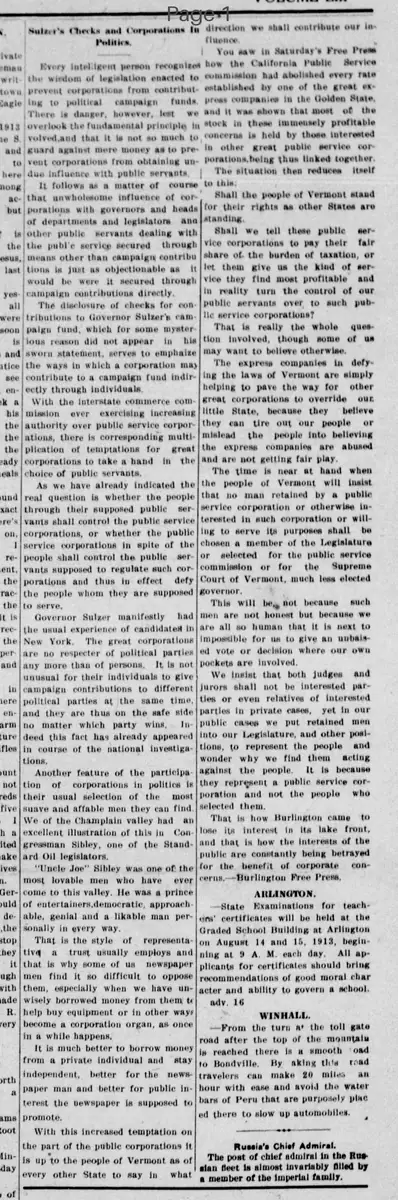
There is danger, however, lest we overlook the fundamental principle involved, and that it is not so much to guard against mere money as to prevent corporations from obtaining undue influence with public servants.
It follows as a matter of course that unwholesome influence of corporations with governors and heads of departments and legislators and other public servants dealing with the public's service secured through means other than campaign contributions is just as objectionable as it would be were it secured through campaign contributions directly.
The disclosure of checks for contributions to Governor Sulzer's campaign fund, which for some mysterious reason did not appear in his sworn statement, serves to emphasize the ways in which a corporation may contribute to a campaign fund indirectly through individuals.
With the interstate commerce commission ever exercising increasing authority over public service corporations, there is corresponding multiplication of temptations for great corporations to take a hand in the choice of public servants.
As we have already indicated the real question is whether the people through their supposed public servants shall control the public service corporations, or whether the public service corporations in spite of the people shall control the public servants supposed to regulate such corporations and thus in effect defy the people whom they are supposed to serve.
Governor Sulzer manifestly had the usual experience of candidates in New York. The great corporations are no respecter of political parties any more than of persons. It is not unusual for their individuals to give campaign contributions to different political parties at the same time, and they are thus on the safe side no matter which party wins. Indeed this fact has already appeared in course of the national investigations.
Another feature of the participation of corporations in politics is their usual selection of the most suave and affable men they can find. We of the Champlain valley had an excellent illustration of this in Congressman Sibley, one of the Standard Oil legislators.
"Uncle Joe" Sibley was one of the most lovable men who have ever come to this valley. He was a prince of entertainers, democratic, approachable, genial and a likable man personally in every way.
That is the style of representative a trust usually employs and that is why some of us newspaper men find it so difficult to oppose them, especially when we have unwisely borrowed money from them to help buy equipment or in other ways become a corporation organ, as once in a while happens.
It is much better to borrow money from a private individual and stay independent, better for the newspaper man and better for public interest the newspaper is supposed to promote.
With this increased temptation on the part of the public corporations it is up to the people of Vermont as of every other State to say in what direction we shall contribute our influence.
You saw in Saturday's Free Press how the California Public Service commission had abolished every rate established by one of the great express companies in the Golden State and it was shown that most of the stock in these immensely profitable concerns is held by those interested in other great public service corporations, being thus linked together.
The situation then reduces itself to this.
Shall the people of Vermont stand for their rights as other States are standing?
Shall we tell these public service corporations to pay their fair share of the burden of taxation, or let them give us the kind of service they find most profitable and in reality turn the control of our public servants over to such public service corporations?
That is really the whole question involved, though some of us may want to believe otherwise.
The express companies in defying the laws of Vermont are simply helping to pave the way for other great corporations to override our little State, because they believe they can tire out our people or mislead the people into believing the express companies are abused and are not getting fair play.
The time is near at hand when the people of Vermont will insist that no man retained by a public service corporation or otherwise interested in such corporation or willing to serve its purposes shall be chosen a member of the Legislature or selected for the public service commission or for the Supreme Court of Vermont, much less elected governor.
This will be, not because such men are not honest but because we are all so human that it is next to impossible for us to give an unbiased vote or decision where our own pockets are involved.
We insist that both judges and jurors shall not be interested parties or even relatives of interested parties in private cases, yet in our public cases we put retained men into our Legislature, and other positions, to represent the people and wonder why we find them acting against the people. It is because they represent a public service corporation and not the people who selected them.
That is how Burlington came to lose its interest in its lake front, and that is how the interests of the public are constantly being betrayed for the benefit of corporate concerns.—Burlington Free Press,
What sub-type of article is it?
What keywords are associated?
What entities or persons were involved?
Editorial Details
Primary Topic
Corporate Influence On Public Servants And Need For Regulation In Vermont
Stance / Tone
Strongly Against Corporate Political Influence, Advocating Public Control
Key Figures
Key Arguments