Thank you for visiting SNEWPapers!
Sign up free
The Elk Mountain Pilot (Irwin,
Crested Butte, Irwin, Ruby Camp, Gunnison County, Colorado
What is this article about?
At a Senate Committee on Immigration hearing on Saturday, New York attorney Walker Pollak, representing the American Civil Liberties Union, exposed a provision in the Administration's Immigration Bill that would shift the burden of proof to individuals, potentially enabling wholesale deportations of aliens and citizens, violating legal principles. A brief by Pollak and Albert DeSilver urged striking the words 'or remain' from Section 23.
Clipping
OCR Quality
Full Text
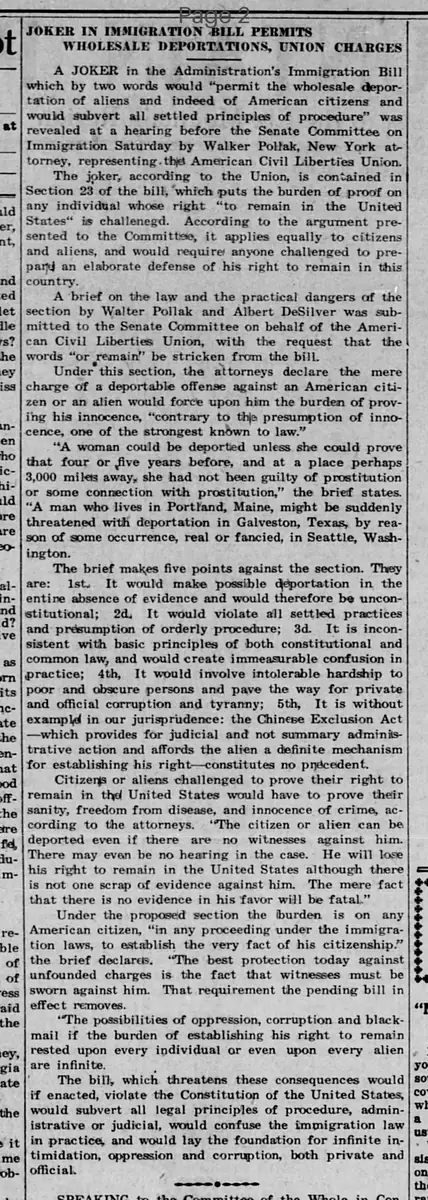
A JOKER in the Administration's Immigration Bill which by two words would "permit the wholesale deportation of aliens and indeed of American citizens and would subvert all settled principles of procedure" was revealed at a hearing before the Senate Committee on Immigration Saturday by Walker Pollak, New York attorney, representing the American Civil Liberties Union.
The joker, according to the Union, is contained in Section 23 of the bill, which puts the burden of proof on any individual whose right "to remain in the United States" is challenged. According to the argument presented to the Committee, it applies equally to citizens and aliens, and would require anyone challenged to prepare an elaborate defense of his right to remain in this country.
A brief on the law and the practical dangers of the section by Walter Pollak and Albert DeSilver was submitted to the Senate Committee on behalf of the American Civil Liberties Union, with the request that the words "or remain" be stricken from the bill.
Under this section, the attorneys declare the mere charge of a deportable offense against an American citizen or an alien would force upon him the burden of proving his innocence, "contrary to the presumption of innocence, one of the strongest known to law."
"A woman could be deported unless she could prove that four or five years before, and at a place perhaps 3,000 miles away, she had not been guilty of prostitution or some connection with prostitution," the brief states.
"A man who lives in Portland, Maine, might be suddenly threatened with deportation in Galveston, Texas, by reason of some occurrence, real or fancied, in Seattle, Washington."
The brief makes five points against the section. They are: 1st. It would make possible deportation in the entire absence of evidence and would therefore be unconstitutional: 2d. It would violate all settled practices and presumption of orderly procedure; 3d. It is inconsistent with basic principles of both constitutional and common law, and would create immeasurable confusion in practice; 4th, It would involve intolerable hardship to poor and obscure persons and pave the way for private and official corruption and tyranny; 5th, It is without example in our jurisprudence: the Chinese Exclusion Act -which provides for judicial and not summary administrative action and affords the alien a definite mechanism for establishing his right constitutes no precedent.
Citizens or aliens challenged to prove their right to remain in the United States would have to prove their sanity, freedom from disease, and innocence of crime, according to the attorneys. "The citizen or alien can be deported even if there are no witnesses against him. There may even be no hearing in the case. He will lose his right to remain in the United States although there is not one scrap of evidence against him. The mere fact that there is no evidence in his favor will be fatal."
Under the proposed section the burden is on any American citizen, "in any proceeding under the immigration laws, to establish the very fact of his citizenship." the brief declares. "The best protection today against unfounded charges is the fact that witnesses must be sworn against him. That requirement the pending bill in effect removes.
"The possibilities of oppression, corruption and blackmail if the burden of establishing his right to remain rested upon every individual or even upon every alien are infinite.
The bill, which threatens these consequences would if enacted, violate the Constitution of the United States, would subvert all legal principles of procedure, administrative or judicial, would confuse the immigration law in practice, and would lay the foundation for infinite intimidation, oppression and corruption, both private and official.
What sub-type of article is it?
What keywords are associated?
What entities or persons were involved?
Domestic News Details
Event Date
Saturday
Key Persons
Outcome
request to strike the words "or remain" from section 23 of the bill; potential for unconstitutional deportations, oppression, corruption, and violation of legal principles if enacted.
Event Details
Walker Pollak, representing the American Civil Liberties Union, revealed at a Senate Committee on Immigration hearing a provision in Section 23 of the Administration's Immigration Bill that shifts the burden of proof to individuals challenged on their right to remain in the United States, applying to both citizens and aliens, potentially allowing deportations without evidence and subverting legal procedures. A brief by Pollak and DeSilver outlined five points against the section and urged its amendment.