Thank you for visiting SNEWPapers!
Sign up free
Richmond Enquirer
Richmond, Richmond County, Virginia
What is this article about?
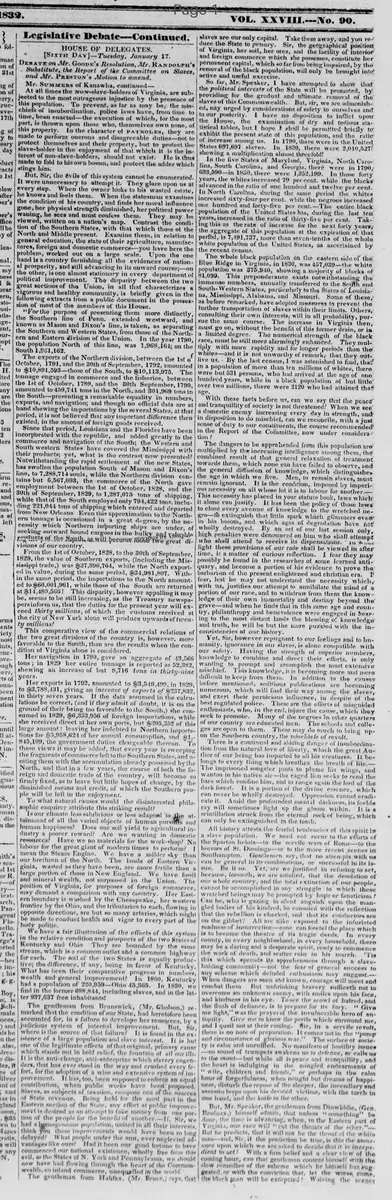
In the Virginia House of Delegates on January 17, Mr. Summers of Kanawha continues debate on resolutions concerning slavery, arguing its economic harms to non-slaveholders, comparative decline of Southern states, growing slave population risks, and need for gradual emancipation of future-born slaves for safety and moral reasons.
Merged-components note: These components form a single continuous legislative debate article spanning pages 1 and 2, with sequential reading orders and coherent topic flow on Virginia House of Delegates discussion of slavery.
Clippings
1 of 2
OCR Quality
Full Text
HOUSE OF DELEGATES.
[SIXTH DAY]—Tuesday, January 17.
Debate on Mr. Goode's Resolution, Mr. Randolph's Substitute, the Report of the Committee on Slaves, and Mr. Preston's Motion to amend.
Mr. SUMMERS of Kanawha, continued—
At all times the non-slave-holders of Virginia, are subjected to the most outrageous injustice by the presence of this population. To prevent, as far as may be, the mischiefs of insubordination, police laws have, from time to time, been enacted—the execution of which, for the most part, is thrown upon those who, themselves own none, of this property. In the character of PATROLES, they are made to perform onerous and disagreeable duties—not to protect themselves and their property, but to protect the slave-holder in the enjoyment of that which it is the interest of non-slave-holders, should not exist. He is thus made to fold to his own bosom, and protect the adder which stings him.
But, Sir, the evils of this system cannot be enumerated. It were unnecessary to attempt it. They glare upon us at every step. When the owner looks to his wasted estate, he knows and feels them. When the statesman examines the condition of his country, and finds her moral influence gone, her physical strength diminished, her political power waning, he sees and must confess them. They may be viewed, written on a nation's map. Contrast the condition of the Southern States, with that which those of the North and Middle present. Examine them, in relation to general education, the state of their agriculture, manufactures, foreign and domestic commerce—you have here the problem, worked out on a large scale. Upon the one hand is a country furnishing all the evidences of national prosperity, and still advancing in its onward course;—on the other, is one almost stationary in every department of political improvement. The disparity between the two great sections of the Union, in all that characterizes a vigorous and healthy community, is briefly given in the following extracts from a public document in the possession of most of the members of this House.
"For the purpose of presenting them more distinctly the Southern line of Penn. extended westward, and known as Mason and Dixon's line, is taken, as separating the Southern and Western States, from those of the Northern and Eastern division of the Union. In the year 1790, the population North of this line, was 1,968,161; on the South 1,961,162.
The exports of the Northern division, between the 1st of October, 1791, and the 30th of September, 1792, amounted to $10,891,593—those of the South, to $10,113,975. The tonnage engaged in commerce and the fisheries, between the 1st of October, 1789, and the 30th September, 1790, amounted to 459,741 tons in the North, and 301,969 tons in the South—presenting a remarkable equality in numbers. exports, and navigation; and though no official data are at hand shewing the importations by the several States, at that period, it is not believed that any important difference then existed, in the amount of foreign goods received.
Since that period, Louisiana and the Floridas have been incorporated with the republic, and added greatly to the commerce and navigation of the South; the Western and South western States have covered the Mississippi with their products; yet, what is the contrast now presented? Notwithstanding the rapid settlement of the new States, has swollen the population South of Mason and Dixon's line, to 7,288,714 souls, while the Northern division contains but 5,567,693, the commerce of the North gave employment between the 1st of October, 1828, and the 30th of September, 1829, to 1,287,075 tons of shipping, while that of the South employed only 794,422 tons, including 221,044 tons of shipping which entered and departed from New Orleans Even this approximation to the Northern tonnage is occasioned in a great degree, by the necessity which Northern importing ships are under, of seeking outward bound cargoes in the bulky and valuable products of the South. as will become slowly two great divisions of our country.
From the 1st of October, 1828, to the 30th of September, 1829, the value of Southern exports, (including the Mississippi trade,) was $37,396,764, while the North exported in value, during the same period, $34,981,807. Within the same period, the importations to the North amounted to $60,001,961, while those of the South are returned at $14,480,566! This disparity, however appalling it may be, seems to be still increasing, as the Treasury newspapers inform us, that the duties for the present year will exceed thirty millions, of which the customs received at the city of New York alone will produce upwards of twenty millions!
This comparative view of the commercial relations of the two great divisions of the country is, however, more favorable to the South, than are the results when the condition of Virginia alone is considered.
Her navigation in 1790, gave an aggregate of 43,566 tons; in 1829 her entire tonnage is reported as 52,382, shewing an increase of but 8,716 tons in thirty-nine years.
Her exports in 1792, amounted to $3,549,499, in 1829, to $3,785,431, giving an increase of exports of $237,832, in thirty seven years. If the data assumed in the calculations be correct, (and if they admit of doubt, it is on the ground of their being too favorable to the South,) she consumed in 1829, $6,353,956 of foreign importations, while she received direct at her own ports, but $395,352 of this large amount: leaving her indebted to Northern importations for $5,958,624 of her annual consumption, and $1,845,109, the government duties chargeable thereon. To these views it may be added, that every year is sweeping the fragments of commerce left to the Southern States, and uniting them with the accumulation already possessed by the North, and that in a few years, the course of both the foreign and domestic trade of the country, will become so firmly fixed, as to leave but little hopes of change. by the diminished means and credit, of which the Southern people will be left in the enjoyment.
To what natural causes would the disinterested philosophic enquirer attribute this striking result?
Is our climate less salubrious or less adapted 'to the attainment of all the varied objects of human pursuits and human happiness? Does our soil yield to agricultural industry a poorer reward? Are we wanting in domestic resources? Have we no materials for the work-shop? No labour for the great giant of modern times to perform? I mean the Steam Engine. We have a milder sky than our brethren of the North. The lands of Eastern Virginia, wasted as they have been, are more fertile than a large portion of those in New England. We have fossil and mineral wealth, not surpassed in the Union. The position of Virginia, for purposes of foreign commerce, may demand a comparison with any Country. Her Eastern boundary is washed by the Chesapeake, her western frontier by the Ohio, and the tributaries to each, flowing in opposite directions, are but so many arteries, which might be made to conduct health and vigor to every part of the body politic.
We have a fair illustration of the effects of this system in the relative condition and prospects of the two States of Kentucky and Ohio They are bounded by the same stream, which is a common outlet and a common highway for each. The soil of the two States is equally productive; the difference, if any, being in favor of Kentucky. What has been their comparative progress in numbers, wealth and general improvement? 'In 1800, Kentucky had a population of 220,959—Ohio 45,865. In 1830, we find in the former 688,844, including slaves, and in the latter 937,637 free inhabitants!
The gentleman from Brunswick, (Mr. Gholson,) remarked that the condition of our State, had heretofore been accounted for, in a failure to develope her resources, by a judicious system of internal improvement. But, Sir, where is the source of that failure? It is found in the existence of a large population and slave interest. It is but one of the legitimate effects of that original, primary cause which stands out in bold relief, the fountain of all our ills. It is the anti-change, anti-enterprize which slavery engenders, that has ever stood in the way and crushed every effort, for the adoption of a wise and extensive system of improvement. It has, too, been supposed to enforce an equal contribution, when public works have been proposed. Slaves, as subjects of taxation, compose one of the sources of State revenue. Being held for the most part in the Eastern section of the State, any effort at public improvement is desired as an attempt to take money from one portion of the people for the benefit of another.—If, Sir, we had a homogeneous population, united in all their interests. think you these improvements would have been so long delayed? What people under the sun, ever neglected advantages like ours? Had it been our good fortune to have commenced our national existence, wholly free from this evil, as the States of N. York and Pennsylvania, we should now have had flowing through the heart of the Commonwealth, an inland commerce, unequalled in the world. The gentleman from Halifax, (Mr. Bruce,) says.
VOL. XXVI.—No. 90.
slaves are our only capital. Take them away, and you reduce the State to penury. Sir, the geographical position of Virginia, her soil, her ores, and the facility of interior and foreign commerce which she possesses, constitute her permanent capital, which so far from being impaired, by the removal of the black population, will only be brought into active and useful exercise.
So far, Mr. Speaker, I have attempted to show that the political interests of the State will be promoted, by providing for the gradual and ultimate removal of the slaves of this Commonwealth. But, sir, we are admonished, nay urged by considerations of safety to ourselves and to our posterity. I have no disposition to inflict upon the House, the examination of dry and tedious statistical tables, but I hope I shall be permitted briefly to exhibit the present state of this population, and the ratio of increase among us. In 1790, there were in the United States 697,697 slaves. In 1830, there were 2,010,527 showing a multiplication almost threefold!
In the five States of Maryland, Virginia, North Carolina, South Carolina, and Georgia, there were in 1790, 633,590 in 1830, there were 1,352,199. In those forty years, the whites increased 79 per cent. while the blacks advanced in the ratio of one hundred and twelve per cent. In North Carolina, during the same period the whites increased sixty-four per cent. while the negroes increased one hundred and forty-five per cent.—The entire black population of the United States has, during the last ten years, increased in the ratio of thirty-five per cent. Taking this as the rate of increase for the next forty years, the aggregate of this population at the expiration of that period, is 7,491,737, more than seven-tenths of the whole white population of the United States, as ascertained by the recent census.
The whole black population on the eastern side of the Blue Ridge in Virginia, in 1830, was 457,039—the white population was 375,940, showing a majority of blacks of 81,099. This preponderance exists notwithstanding the immense numbers, annually transferred to the South and South-Western States, particularly to the States of Louisiana, Mississippi, Alabama, and Missouri. Some of these, as before remarked, have adopted measures to prevent the further transportation of slaves within their limits. Others, consulting their own interests, will in all probability, pursue the same course. The increase in Virginia then. must go on, without the benefit of this former drain, or in a limited degree. The numerical strength of the black race, must be still more alarmingly enhanced. They multiply with more rapidity and for longer periods than the whites—and it is not unworthy of remark, that they outlive us. · By the last census, I was astonished to find, that in a population of more than ten millions of whites, there were but 531 persons, who had arrived at the age of one hundred years, while in a black population of but little over two millions, there were 2120 who had attained that age.
With these facts before us, can we say that the peace and tranquillity of society is not threatened? When we see a domestic enemy increasing every day in strength, and in disposition to do mischief, can we reconcile, with a just sense of duty to our constituents, the course recommended in the Report of the Committee, now under consideration?
The dangers to be apprehended from this population are multiplied by the increasing intelligence among them, the combined result of that general relaxation of treatment towards them, which none can have failed to observe, and the general diffusion of knowledge, which distinguishes the age in which we live. Men, to remain slaves, must remain ignorant. It is the condition, imposed by imperious necessity on all whose lot it is to labour for another.— This necessity has placed in your statute book, laws which it alone can justify. It has been the policy of those laws to close every avenue of knowledge to the wretched negro—to extinguish that little spark which glimmers every in his bosom, and which ages of degradation have not wholly destroyed. By an act of our last session only, high penalties were denounced on him who shall attempt who shall attend to receive its dispensations. in nu light these provisions of our code shall be viewed in after time, is a matter of curious reflection. I fear they may possibly be found in the researches of some learned antiquary, and become a portion of his evidence to prove the barbarism of the present enlightened and christian era. I fear, lest he may not understand the necessity which, with us, justifies our attempt to annihilate the mind of a portion of our race, and to withdraw from them the knowledge of their own immortality and destiny beyond the grave—and when he finds that in this same age and country, philanthropy and benevolence were engaged in bearing to the most distant lands the blessing of knowledge and truth, he will be but the more puzzled with the inconsistencies of our history.
Yet, Sir, however repugnant to our feelings and to humanity, ignorance in our slaves, is alone compatible with our safety. Having the strength of superior numbers, knowledge to combine and direct their efforts, is only wanting to prompt and accomplish the most extensive mischief. This knowledge, it is becoming more and more difficult to keep from them. In addition to the causes before mentioned, seditious publications are becoming numerous, which will find their way among the slaves, and exert their pernicious influence, in despite of the best regulated police. These are the efforts of misguided enthusiasts, who, in the end, injure the cause, which they seek to promote. Many of the negroes in other quarters of our country are educated men. The schools and colleges are open to them. These may do much to bring upon the Southern country, the mischiefs of revolt.
There is a continual and abiding danger of insubordination from the natural love of liberty, which the great Author of our being has imparted to all his creatures. It belongs to every thing which breathes the breath of life.— The imprisoned songster pants to plume his wings, and wanton in his native air—the caged lion seeks to rend the bars which confine him, and to range again the lord of the dark forest. It is a portion of the divine essence, which can never be wholly destroyed. Oppression cannot eradicate it. Amid the profoundest mental darkness, its feeble ray will sometimes light up the gloom within. It is a scintillation struck from the eternal rock of being, which can only be extinguished in the tomb.
All history attests the fearful tendencies of this spirit in a slave population. We need not recur to the efforts of the Spartan helots—to the servile wars of Rome—to the horrors of St. Domingo—or to the more recent scenes in Southampton. Gentlemen say, that no attempts with us can be general in its combinations, or successful in its issue. Be it so. Yet, are we justified in refusing to act, because, forsooth, we are satisfied, that the desolation of our whole country, and the total extinction of our people, cannot be accomplished in any struggle to which these wretched beings may be prompted by hope or fanaticism?
Can he, who is gazing in silent anguish upon the mangled bodies of his kindred, be consoled with the reflection that the rebellion is checked, and that its conductors are on the gibbet? All are alike exposed to the infuriated madness of insurrection—none can foretel the place which is to become the theatre of its tragic deeds. In every county, in every neighborhood, in every household, there may be a daring and a desperate spirit, ready to commence the work of death, and scatter ruin in his march. 'Tis this which spreads its apprehensions through a slave-holding community—not the fear of general success to any scheme which deluded enthusiasm may suggest.— When dangers are seen and known, courage will meet and combat them But unshrinking bravery sufficeth not to overcome an unknown enemy, with smiles upon his face, and kindness in his eye. To see the scowl of hatred, and the flush of defiance, is to prepare for its fury. "Give me light," was the prayer of the invulnerable hero of antiquity. 'Give me to know the perils which surround me, and I quail not at their coming. Sir, in a servile revolt, there is no note of preparation. It comes not in the "pomp and circumstance of glorious war." The surface of society is calm and unruffled. No manifesto of hostility issues —no sound of trumpets awakens us to defence, or calls us to the onset—but while all is peace and tranquillity, and the heart is indulging in the mingled endearments of "wife, children and friends." or perhaps in the calm hour of forgetfulness, when nought but dreams of happiness, disturb the repose of the sleeper, the incendiary and assassin leaps upon his devoted victims, with the torch in one hand, and the knife in the other.
But, Mr. Speaker, the gentleman from Dinwiddie, (Gen. Brodnax.) himself admits, that unless "something" be done, the time is advancing, when, in the Eastern part of Virginia, one race will "cut the throats of the other."— But he predicts. that it will not be the throat of the white man—and, Sir, if the prediction be true, is this the assurance upon which we are asked to decide that it is inexpedient to act? With a firm belief and a clear view of the coming hour, can that gentleman content himself with the slow remedies of the scheme which he himself has suggested, or with the conviction that, let the worse come, the black man will be extirpated' Waiving the scenes
of blood, and the loss of lives to our own people which it would cost to effect that end, and with the certainty that it would be effected; upon what authority of natural or national law, does he deem the State warranted, in bringing about such a necessity by a failure to relieve now that she may, the cause which is to lead to it? Are we authorized to retain among us, a miserable degraded people, to be slaughtered and swept from existence, whenever fears for our own safety shall induce us to commence the work? To cut their throats, may be a money-saving scheme, but it is a species of economy which I hope we shall not be called upon to adopt. If the conflict for supremacy must occur in our time (which Heaven in its mercy forbid,) of its final issue I have not a solitary doubt. Even should the negroes triumph for a moment in the East, it would be but a fearful pause, before the coming of that mighty torrent from the mountains which would sweep them with the besom of destruction. But, sir, the gentleman should remember that the illustrious Jefferson, appropriately termed, by himself, the "Gamaliel of Virginia," in contemplation of such a crisis, "trembled to think that God was just," and averred that "Deity had no attribute which could take sides with us in such a contest." Mr. Speaker: we have been told, that the sense of public security no longer exists with a portion of our people. The late occurrences in Southampton have taught them that they may be sleeping near the verge of the slumbering volcano-that, though all is apparently tranquil,
Incendant per ignes
Suppositos, cineri doloso.
Sir, the gentleman from Brunswick, (Mr. Gholson,) says, that his people are "miserable and unhappy." Yes, sir, when in any community the sense of public security is lost, domestic happiness goes with it. It matters not whether the cause of apprehension be real or imaginary, the effect is the same; and as statesmen, charged with the promotion of the public weal, it behoves us to take such measures as shall restore tranquillity to the public mind. But gentlemen say, that this is not the proper time to begin the great work of gradual and final emancipation—that it is a subject of the utmost delicacy, and beset with innumerable difficulties—that we are not now able to accomplish the Herculean task. But will these gentlemen inform us, when it is to become less delicate, or attended with fewer difficulties, and at what period we shall be better enabled to meet them? Will it be when the number of our slaves shall have greatly increased beyond their present amount, and when the white population of the tide-water country shall have been still further diminished, by daily emigrations to other States? Will we be more adequate to the end proposed, after the resources of the State shall have been yet longer paralyzed by the withering, desolating influence of our present system? Sir, every year's delay but augments the difficulties of the great business before us, and weakens our ability to compass it. Like silly children, we endeavor to postpone the work which we know must be performed—we close our eyes, and attempt to forget it; we turn from it, as hopeless, without essaying to begin it. It is the frailty of our nature—it is the same spirit which said, "go thy way; at a more convenient season, I will call upon thee." But, sir, does it not become us, as men, and as patriots, to look this monster fearlessly in the face?—to approach it at once, with a steady nerve, and an undaunted ardor? It is due to posterity, that we should provide now for the removal of this evil.—What, sir, are the duties which one generation owes to that which is to succeed it? They are those which a father owes to his children. As the present tenants of the earth, we are bound, by a high moral obligation, to leave it in the best condition we may, for those who are to come after us. We are but tenants for life, with remainder over.—And what, sir, is the injustice which we do to posterity in failing to act in this matter, so momentous to their interests? We refuse to do that, upon which their happiness, their very existence, will depend, and tell them to achieve it themselves, when it will have become impossible. We, by our timely efforts, may effect "the consummation so devoutly to be wished for"—they never can. The stream may yet be managed; but if it is permitted to flow on, unchecked, its dark waters, swollen beyond control, will sweep before it all that may oppose its resistless current. But, sir, we are told that the end proposed, is utterly impracticable—that it is wild and visionary to think of it. We are seeking to bring about a state of things, desirable to all, but it is Utopian, vain, and worse than vain to attempt it.—It is argued, that to purchase the slave from their owners and remove them to another country, would exceed the resources of the Commonwealth, perhaps those of the Union, and that to liberate them, without remuneration, would be an invasion of individual right, secured and guaranteed by that clause of the Constitution, which provides that "private property, shall not be taken for public uses, without just compensation." As to the peculiar character of this property, and the right by which it is held, my friend from Montgomery, (Mr. Preston.) was correct in the position which he assumed yesterday—correct, sir, as I understood him, not as he has been understood by others. The slave is made property, not by any natural right in him who makes him such, nor by any inherent quality in the slave himself he belongs to another, not as the earth is apportioned out to the millions who inhabit and cultivate it—not as the beasts of the field, created for our use, become our own. To those gentlemen by the consent of all mankind. You have no statute making them property—they were always so by the common law, not of England, but of the world. Men are made slaves, and become property only by force: they are retained such, by force and necessity. The right to freedom, which is inherent, and which no man may alienate from his descendants, is surrendered by no voluntary act of the slave, but is yielded to superior might, or controlled by conventional agreements of the majority. Slaves are made property in Virginia, by statutory provision. The same authority permitted the Indians, the original owners of our soil, to be converted into slaves. But when our ancient House of Burgesses, enacted that the "heathens taken in battle," might be transported to the West Indies for sale—suppose the opposite had been the fact, and that good King Powhatan, with his royal and allied contemporaries, around the great council fire in Congress assembled, had solemnly decided that our adventurous ancestors, were intruders upon their domains, and that they should be made the slaves of their royal highnesses. Suppose them to have carried that ordinance into effect, and to have had the physical force to continue the system thus began—by what right would they now have held in bondage the descendants of Smith and Raleigh? And what would have been their property in those descendants? By precisely the same right in which we hold our slaves, the right of force; possessing in them the same property, a property founded in wrong. The question asked by my friend from Montgomery, was one of much force. It will not be denied that the slave, as a living man, has a right to assert and regain his liberty, if he can. Here, then, are two conflicting rights to the same thing. The master asserts an absolute, unqualified right to the slave, an authority to direct and control his every motion. The slave, at the same time, has a right to direct and control his own actions; a right never surrendered, never alienated, a right paramount to all conventional guarantees or civil compacts. Property in man, Mr. Speaker, is one sui generis. It cannot be treated or regulated, as other rights of property. By our own laws, the slave is in some respects, a person. Personal rights are secured to him. The master is bound to feed and clothe him, and to provide for him in old age. Not so with his horse. To kill him, is murder. He forms a portion of the population represented in the Federal Legislature. The Supreme Court of the United States, have decided that the liabilities of common carriers, do not attach to those, who may be employed in the transportation of slaves, from one place to another; that they are not bales and packages, but passengers and men. The Supreme Court of Massachusetts, in 1783, decided that slavery was abolished in that Commonwealth, by the Constitution. That instrument contains the general declaration "that all men are born free and equal." The Court was of opinion, that as men, slaves were included in the rights which these terms announced. I do not concur however, with my friend from Rockbridge, (Mr. Moore,) that the Bill of Rights of Virginia, employing the similar language, can only be interpreted correctly by being made to apply to our slave population. That instrument can only be understood, as purporting to declare the rights of those who composed the body politic at the time of its adoption. The promulgation of these great truths which it contains, was not intended to disturb the condition of the Virginia slave—he was to have no lot or part in the glorious achievements of the revolution—at its close, the fetters did not fall from his limbs, nor was the livery of servitude, exchanged for the robes of freedom. He was not a member of the community, which launched the vessel of their civil rights, on an untried sea—he reaped no advantages from its safe arrival upon a quiet shore. The natural equality of all men was proclaimed, long anterior to that period; yet the Roman maxim "Jure naturali, omnes homines ab initio, liberi nascebuntur," was the maxim of a slave-holding people. We have never maintained that in Virginia, slaves are not property. However, founded in original outrage and injustice, however subversive of the great fundamental principles of a free people, I do not controvert the right of the present owner, to hold the slave as his property—to hold him as such, so long as he may by force maintain his claim, and so long as he is permitted by the public good, and the public consent. Sir, all property is held subordinate to, and only as it promotes the general welfare of, the community in which it exists. Whenever it becomes subversive of that end, society may refuse to authorize its continuance, by the exercise of a great primary inherent right, belonging as well to all civil associations, as to individual man. the right of self-preservation. That "the safety of the people is the supreme law," is denied by no one. Who weighs property in one end of the balance, against the happiness, the lives of the citizens; against national glory, and national existence? When the vessel is tossed upon the billow, who enquires about property, its owner, or its value? Sir, it goes overboard. That "private property shall not be taken for public use, without just compensation," is one of the terms of our social covenant; but it is a stipulation, subject to this original, continuing right, in those who are parties to that covenant—nant. It cannot be lost or controlled. by written agreements or constitutions. But, Sir, if the representatives of the people, believing that the vital interests of the Commonwealth, require that the slaves be removed from among us, should adopt measures to secure that end, without providing remuneration to the owner, would it be a violation of the meaning and spirit of that clause of the Constitution so much relied upon by the other side? Does the citizen lose his property "without just compensation," when he surrenders it to the necessities of the community, of which he is a member, and when the happiness or continuance of that community depends upon the surrender? When the tax-gatherer takes from the pocket of the citizen, the revenue which is to support the operations of government, what is the "compensation," which he receives for his contribution? The general prosperity of that government, which enables it to protect him in the enjoyment of "life, liberty, and the pursuit of happiness." This, Sir, is his only compensation: It is a full and adequate one. But Mr. Speaker. gentlemen have discussed this proposition as if it were sought to liberate and remove the slaves now in being. We are told of the millions invested in this property, and of our total inability to purchase it. Sir, no one has dreamed of emancipating at once,the slaves now in this Commonwealth. The strong, the almost entire reliance placed upon the question of private right, has necessarily led the friends of gradual emancipation into an examination of the authority of the State, to demand the surrender of this property, if her interests require it. We say that if the necessity has arisen, the community has a perfect right, in the exercise of its legitimate powers, to remove this, as any other evil, dangerous to its safety and tranquillity. But, sir, no scheme for sudden action is proposed or defended. It is hoped that the necessity may be avoided, by the adoption now, of slow but certain means to prevent its occurrence. Should the motion to reverse the report of the Committee prevail, it is believed that a wise and efficient plan may be devised, providing for the liberation and removal of those hereafter to be born. The substitute of the gentleman from Albemarle, (Mr. Randolph,) proposes that all slaves born after the 4th of July, 1840, shall be free, the females at eighteen years of age, the males at twenty-one. That they shall then be hired out, until a sum be raised from such hire sufficient to transport them, to such country as may be provided for that purpose. This is the rash and precipitate scheme, condemned in terms so unqualified. It does not commence its operations for eight years. The further period of twenty-one years is to elapse, before the property of the master is to be relinquished; a period of service reimbursing him for the cost of rearing. And, sir, the period may be varied by the Committee or the House. They may make it thirty, instead of twenty-one, should it be deemed advisable. This project is objected to, as an invasion of private right, equally unwarranted with that which would take from the owner the slave in esse. It is said, that the property in the increase is as perfect as the property in the mother.— Mr. Speaker, if this be an invasion of private right, it is one sanctioned by the illustrious Jefferson—by him, who, above all others, delighted to defend and secure the rights of the people—by him, who, as much as any other man, aided in the organization of our Government, and the settlement of the terms upon which we became an associate community. Sir, the same right which makes a slave to be born in 1840 mine, would make those to be born one hundred years thereafter mine, and would authorize me to direct the distribution of all between those periods, and their multiplied progeny thereafter. The right to the increase of slaves, belongs to that class of rights which may at all times be changed, modified, or abridged, by legislative enactments. It is a right, not vested, but in expectancy. It is a contingent right, dependent on a known and existing one—and, admitting the inviolability of vested rights, to the fullest extent, has it ever been doubted, that rights springing out of them were under the control of legislation? Has the constitutionality or propriety of the laws abolishing entails, and the rights of primogeniture ever been questioned? These belong to the same class, and are fair illustrations of the authority now asserted. Mr. Speaker, by emancipating the post nati, the interests of the present owners are to be but little affected. The true question is, can we, by any act of ours, take from posterity that which would otherwise be property to them? Have we not a perfect moral and political right to do so? Has not the father a right, by emancipation, to deprive his offspring of the slaves, who would otherwise descend to them as property? We are collectively the fathers of the generation which is to succeed us.But, sir, when was it denied that any people had a right to abolish the form of their Government, or change their municipal regulations—to declare what things shall cease to be property. and what shall continue such? Is one generation authorized to fix upon the next a national debt? The opposite doctrine would relieve Great Britain of a debt of eight hundred millions of pounds sterling. But, Sir, the right to free the after-born is not one, now, for the first time, asserted. It has been acted upon in other countries, and may be considered an adjudicated question. This is the plan adopted, in relation to the Royal Islands. It was the plan acted upon by our sister States to the north of us. "They believed themselves authorized to take from posterity, what would have otherwise descended to them as property." And, Sir, will after ages complain of the deprivation?— Suppose the proposition made by Mr. Bland had prevailed; or that the bill reported by Mr. Jefferson, Mr. Wythe and Mr. Pendleton, and the amendments, proposed by the former, providing for emancipation, had been adopted, at that period, would we now regret the deed? But, Mr. Speaker, this is not the only plan which may be devised. The gentleman from Dinwiddie has endeavored to convince us, that emancipation is practicable by the scheme which he suggests. This ought to satisfy gentlemen that the work is not impracticable. Should the Committee be instructed to bring in a bill, other plans may yet be suggested. Sir, we should take encouragement, from the goodness of the cause in which we are engaged. It is one, on which Heaven will smile. We shall not be left unaided in our exertions. Slavery is a national calamity. Such it has been regarded, by those who are entirely free from the evil. Nine of the non-slave holding States, have generously offered to the South. the common treasury, for the removal of this common evil. Such, too, was the purport of the Resolutions, submitted to the Senate of the United States, by Rufus King, at the close of his long and useful public life. The gentleman from Albemarle, (Mr. Wood.) himself admits, that Congress may constitutionally, aid in the removal of our colored population, by appropriations from the public lands. If, Sir, we may lawfully receive assistance from this source, we may from the Treasury, or any other of the resources of the General Government. [Here Mr. Wood explained. He said there was, in his opinion, a wide difference. Congress had an express right to dispose of the public lands, but that it could only dispose of the monies in the Treasury, in the particular manner, and for the particular purposes, provided in the Constitution.] Mr. S. continued.—It is, Mr. Speaker, a distinction without a difference. The lands belonging to the Government, as much constitute a portion of the national fund, while they continue the public domain, as after they have been converted into money, and the proceeds placed in the treasury. The position is this, that Congress may legitimately give us a portion of the public lands, to be, by us sold and disposed of at pleasure; but that it is not competent for Congress to sell the same lands, and appropriate to us the amount of such sale. I could, too, remind the gentleman of another clause of the Constitution, which authorises Congress "to provide for the common defence and general welfare," but I suppose we should probably differ in our interpretation of that disputed text. If, sir, we should apply to this quarter for aid, we may go with the manly front and bearing of those who ask what they may justly claim. To the success of that fearful struggle, which ended in the independence and union of States, Virginia contributed no niggard's share. In the winter of our nation's fortune, she dispensed, with a generous hand, from her then ample treasure. She gave away eight States to the common cause. Sir, the resources of this country, are now adequate to any thing which the public good may require. Her riches are borne upon every wave, her flag floats in every breeze. Mr. Speaker, I cannot take my seat, without expressing my full and decided conviction that the effort now making to lay the foundation for the ultimate and total abolition of slavery, within this Commonwealth, will be crowned with triumphant success. It may encounter long and obstinate resistance, in the prejudices and interests of men, but it will finally prevail. Whatever may be the fate of the proposition now under consideration, the end is attained, in the fact that it is made, examined and discussed. For 50 years, no tongue has dared to speak the emotions of the heart, or the deliberate dictates of the judgment. The aspirations of the philanthropist have gone out in secret—the opinions of the statesman have died in the recesses of the mind which formed them.—The correspondence of Jefferson and Monroe, relating only to the removal of the free people of colour, was consigned to the hidden places of your archives. When we parted at the close of the last session, who would have predicted the events which have taken place here, within the past week? I had not hoped, that the opportunity would have been so soon furnished, to register by my vote in the Halls of my native State, the long cherished wishes of my mind. But silence is broken forever. Any attempt to restrain the freest enquiry now, were vain and idle—as well might you attempt to imprison the chainless winds. Sir, our present attitude is worthy of the Commonwealth, and of the age. It is proper that Virginia should lead the van in this splendid enterprise, so interesting to the happiness of our country and the human family. The gentleman from Brunswick, enquired of my friend from Rockbridge, where were the lights to which he had alluded. If that gentleman had turned his gaze, he might have seen the whole political horizon, radiant with the light of liberty. He might have looked to France, to Belgium, to unfortunate Poland. He would have seen the land of our ancestors, convulsed with the progress of free principles, and on the eve of reform or revolution. He would have seen, too, a ray streaming to the Antilles, and bearing its animating hopes even to the island slave. Sir, the question was decided here, when the House referred the petitions from Hanover to the Select Committee. This is the act to which after time will trace the origin of American abolition. And, Sir, I rejoice that it has been given to the good county of Hanover, distinguished in the annals of revolutionary patriotism, to have ushered in this new era. It is worthy of the land of Henry, of him who gave the first impulse to the ball of the Revolution. It is worthy, too, of his honoured descendant who presented the petition.*—He has contributed to set in motion another ball, which I trust will roll its accumulating blessings to distant ages and to other lands. I trust that upon the coast of Africa, some modern Carthage, will yet arise, to contend, not with imperial Rome for the mistress-ship of the world, but with us, in all that shall tend to secure the happiness and the liberties of mankind. Mr Roane, the member from Hanover; is the grandson of Patrick Henry.
What sub-type of article is it?
What themes does it cover?
What keywords are associated?
What entities or persons were involved?
Where did it happen?
Story Details
Key Persons
Location
House Of Delegates, Virginia
Event Date
Tuesday, January 17
Story Details
Mr. Summers argues in the Virginia legislature for gradual emancipation of slaves, highlighting economic disadvantages to the South, rapid slave population growth threatening safety, historical precedents, and moral imperatives, proposing freedom for slaves born after 1840 with provisions for removal.