Thank you for visiting SNEWPapers!
Sign up free
Literary
June 23, 1827
Phenix Gazette
Alexandria, Virginia
What is this article about?
Dramatic narrative of Tecumseh's origins: Shawnee warrior Onewequa, sent as hostage to Creeks after 1767 conflict, falls in love with Elohama, marries her, fathers Tecumseh. Returns to Muskingum, killed by treacherous whites in 1774; Elohama prophesies son's vengeful destiny.
Clipping
OCR Quality
95%
Excellent
Full Text
TECUMSEH.-
In the year 1767, the Shawanese Indians, then scattered along the waters of the Scioto and Muskingum, committed some depredations on the Creeks, who inhabited the interior of Georgia. This warlike and numerous nation threatened their immediate extermination, and would probably have accomplished their vengeful purpose, but for the timely interposition of the Delawares, who were warmly attached to the Shawanese, having, at a former period, lived with them as neighbors and allies, on the borders of the Susquehannah. A party of the Delawares, who inhabited New Jersey, had recently crossed the Alleghany mountains, and were seeking a settlement on the waters of the West, a suitable place for which they were immediately applied to, by their old friends, the unhappy Shawanese, who trembling beneath the expected vengeance of the Creeks, had no other hope but the influence of their former neighbors, whose character as peace makers had long been established; and this hope was eventually realised. The Delawares immediately stepped forward between them and their exasperated enemy, and a treaty was at length concluded, on condition that the Shawanese should yield up a certain number of their principal young men, as hostages for the future good conduct of their nation. Among these hostages was Onewequa; the father of Tecumseh: Tecumseh, the celebrated warrior, who moved a few years since like a stormy cloud, dark, terrible, and mysterious on the horizon of American prosperity.-
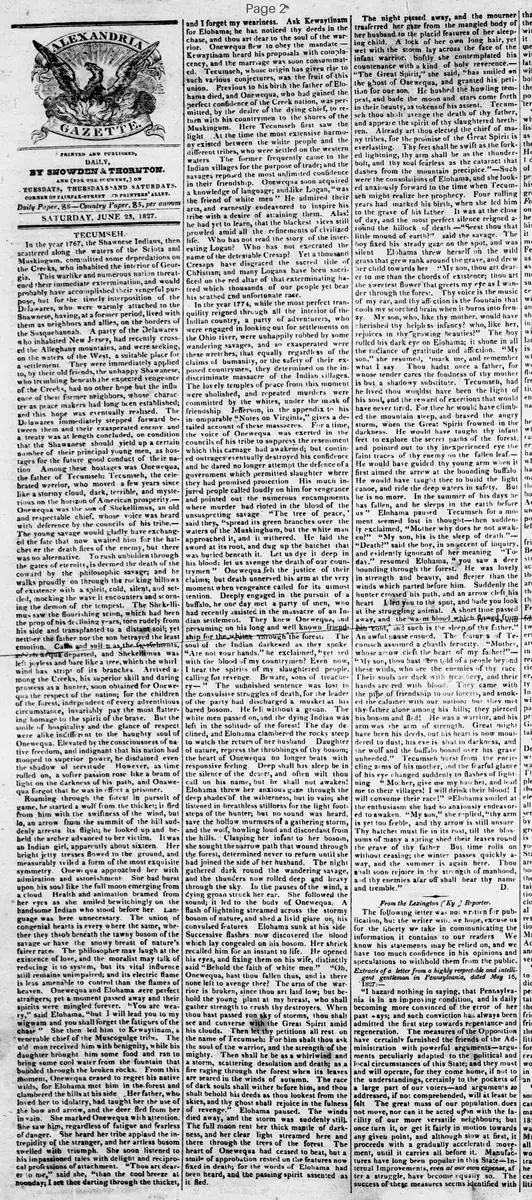
Onewequa was the son of Shekellimus, an old and respectable chief, whose voice was heard with deference by the councils of his tribe.- The young savage would gladly have exchanged the fate that now awaited him for the hatchet or the death fires of the enemy, but there was no alternative. To rush unbidden through the gates of eternity, is deemed the death of the coward by the philosophic savage; and he walks proudly on through the rocking billows of existence with a spirit, cold, silent, and settled, mocking the wave it encounters and scorning the demon of the tempest. The Shekellimus saw the flourishing scion, which had been the prop of his declining years, torn rudely from his side and transplanted to a distant soil; yet neither the father nor the son betrayed the least emotion. .. Calm and still as the firmaments, Onewequa departed, and Shekellimus was left joyless and bare like a tree, which the whirlwind has stripped of its branches. Arrived among the Creeks, his superior skill and daring prowess as a hunter, soon obtained for Onewequa the respect of the nation; for the children of the forest, independent of every adventitious circumstance, invariably pay the most flattering homage to the spirit of the brave. But the smile of hospitality and the glance of respect were alike indifferent to the haughty soul of Onewequa. Elevated by the consciousness of native freedom, and indignant that his nation had stooped to superior power, he disdained even the shadow of servitude However, as time rolled on, a softer passion rose like a beam of light on the darkness of his path, and Onewequa forgot that he was in effect a prisoner. Roaming through the forest in pursuit of game, he started a wolf from the thicket; it fled from him with the swiftness of the wind, but lo, an arrow from the summit of the hill suddenly arrests its flight; he looked up and beheld the archer advanced to her victim. It was an Indian girl, apparently about sixteen. Her bright jetty tresses flowed to the ground, and measurably veiled a form of the most exquisite symmetry. Onewequa approached her with admiration and astonishment She had burst upon his soul like the full moon emerging from a cloud. Health and animation beamed from her eyes as she smiled bewitchingly on the handsome Indian who stood before her Language was here unnecessary. The union of congenial hearts is every where the same, whether they throb beneath the tawny bosom of the savage or have the snowy breast of nature's fairer races The philosopher may laugh at the existence of love, and the moralist may talk of reducing it to system, but its vital influence still remains unimpaired; and its electric flame is less amenable to control than the flames of heaven. Onewequa and Elohama were perfect strangers; yet a moment passed away and their spirits were mingled forever. "You are weary," said Elohama, "but I will lead you to my wigwam and you shall forget the fatigues of the chase " She then led him to Kewaytinam, a venerable chief of the Muscogulge tribe. The old man received him with benignity, while his daughter brought him some food and ran to bring some cool water from the fountain that bubbled through the broken rocks. From this moment, Onewequa ceased to regret his native wilds, for Elohama met him in the forest and clambered the hills at his side Her father, who loved her to idolatry, had taught her the use of the bow and arrow, and the deer fled from her in vain. She marked Onewequa with attention. She saw him, regardless of fatigue and careless of danger. She heard her tribe applaud the intrepidity of the stranger, and her artless bosom swelled with triumph. She soon listened to his impassioned tales with delight and reciprocal professions of attachment. "Thou art dearer to me," said she, "than the cool breeze at noonday; I see thee darting through the thicket, and I forget my weariness. Ask Kewaytinam for Elohama; he has noticed thy deeds in the chase, and thou art dear to the soul of the warrior. Onewequa flew to obey the mandate - Kewaytinam heard his proposals with complacency, and the marriage was soon consummated.Tecumseh, whose origin has given rise to such various conjectures, was the fruit of this union. Previous to his birth the father of Elohama died, and Onewequa, who had gained the perfect confidence of the Creek nation, was permitted, by the desire of the dying chief, to return with his countrymen to the shores of the Muskingum. Here Tecumseh first saw the light At the time the most extensive harmony existed between the white people and the different tribes, who were settled on the western waters The former frequently came to the Indian villages for the purpose of trade; and the savages reposed the most unlimited confidence in their friendship. Onewequa soon acquired a knowledge of language; and like Logan, "was the friend of white men" He admired their arts, and earnestly endeavored to inspire his tribe with a desire of attaining them. Alas! he had yet to learn, that the blackest vices still prowled amid all the refinements of civilized life. Who has not read the story of the interesting Logan? Who has not execrated the name of the detestable Cresap? Yet a thousand Cresaps have disgraced the sacred title of Christian; and many Logans have been sacrificed on the red altar of that exterminating hatred which thousands of our people yet bear his scathed and unfortunate race. In the year 1774, while the most perfect tranquility reigned through all the interior of the Indian country, a party of adventurers, who were engaged in looking out for settlements on the Ohio river, were unhappily robbed by some wandering savages, and so exasperated were these wretches, that equally regardless of the claims of humanity, or the safety of their exposed countrymen, they determined on the indiscriminate massacre of the Indian villages. The lovely temples of peace from this moment were abolished, and repeated murders were committed by the whites, under the mask of friendship Jefferson, in the appendix to his incomparable "Notes on Virginia," gives a detailed account of these massacres. For a time, the voice of Onewequa was exerted in the councils of his tribe to suppress the resentment which this carnage had awakened; but continued outrages eventually destroyed his confidence and he dared no longer attempt the defence of a government which permitted slaughter where they had promised protection His much injured people called loudly on him for vengeance and pointed out the numerous encampments where murder had rioted in the blood of the unsuspecting savage "The tree of peace, ' said they,"spread its green branches over the waters of the Muskingum, but the white man approached it, and it withered. He laid the sword at its root, and dug up the hatchet that was buried beneath it. Let us dye it deep in his blood: let us avenge the death of our countrymen Onewequa felt the justice of their claims; but death unnerved his arm at the very moment when vengeance called for its utmost exertion. Deeply engaged in the pursuit of a buffalo, he one day met a party of men, who had recently assisted in the massacre of an Indian settlement. They knew Onewequa, and presuming on his long and well known friendship for the "white race through the forest: The soul of the Indian darkened as they spoke "Are not your hands." he exclaimed, "yet red with the blood of my countrymen? Even now, I hear the spirits of my slaughtered people. calling for revenge. Beware, sons of treachery- " The unfinished sentence was lost in the convulsive struggles of death, for the leader of the party had discharged a musket at his bared bosom. He fell without a groan. The white men passed on,and the dying Indian was left in the solitude of the forest! The day declined, and Elohama clambered the rocky steep to watch the return of her husband Daughter of nature, repress the throbbings of thy bosom; the heart of Onewequa no longer beats with responsive feeling. Deep shall his sleep be in the silence of the desert, and often wilt thou call on his name, but he shall not awaken! Elohama threw her anxious gaze through the deep shades'of the wilderness, but in vain; she listened in breathless stillness for the light footsteps of the hunter; but no sound was heard, save the hollow murmurs of a gathering storm, and the wolf, howling loud and discordant from the hills. ' Clasping her infant to her bosom, she sought the narrow path that wound through the forest, determined never to return until she had joined the side of her husband. The night gathered dark round the wandering savage, and the thunders now rolled deep and heavy through the sky. In the pauses of the wind, a dying groan struck her ear. She followed the sound; it led to the body of Onewequa. A flash of lightning streamed across the stormy bosom of nature, and shed a livid glare on, his convulsed features. Elohama sunk at his side Successive flashes now discovered the blood which lay congealed on his bosom. Her shriek recalled him for an instant to life. He opened his eyes, and fixing them on his wife, distinctly said "Behold the faith of white men." "Oh, Onewequa, hast thou fallen thus, and is there none left to avenge thee? The arm of the warrior is broken, since thou art laid low; but behold the young plant at my breast, who shall gather strength to crush thy destroyers. When thou hast passed yon sky of storms, thou shalt see and converse with the Great Spirit amid his clouds. Then let thy petitions all rest. on the name of Tecumseh: For him shalt thou ask the soul of the warrior, and the strength of the mighty. Then shall he be as a whirlwind and a storm, scattering desolation and death; as a fire raging through the forest when its leaves are seared in the winds of autumn. The race of dark souls shall wither before him, and thou shalt behold his deeds as thou lookest from the skies, and thy ghost shall rejoice in the fulness of revenge." Elohama paused. The winds died away, and the storm was suddenly still. The full moon rent her thick mantle of darkness, and her clear light streamed here and there through the trees of the forest The heart of Onewequa had ceased to beat, but a smile of approbation rested on the features now fixed in death; or the words of Elohama had been heard, and the passing spirit assented as it fled. The night passed away, and the mourner transferred her gaze from the mangled body of her husband to the placid features of her sleeping child. A lock of her own long hair, yet wet with the storm, lay across the face of the infant warrior. Sadly she contemplated his countenance with a kind of holy reverence.— "The Great Spirit," she said, "has smiled on the ghost of Onewequa, and granted his petition for our son, He hushed the howling tempest, and bade the moon and stars come forth in their beauty, as tokens of his assent. Tecumseh thou shalt avenge the death of thy father, and appease the spirit of thy slaughtered brethren. Already art thou elected the chief of many tribes, for the promise of The Great Spirit is everlasting. Thy feet shall be swift as the forked lightning, thy arm shall be as the thunderbolt, and thy soul fearless as the cataract that dashes from the mountain precipice." —Such were the consolations of Elohama, and she looked anxiously forward to the time when Tecumseh might realize her prophecy. Four rolling years had marked his birth, when she led him to the grave of his father It was at the close of day, and the most perfect silence reigned around the hillock of death -"Seest thou that little mound of earth?". said the savage. The boy fixed his steady gaze on the spot, and was silent Elohama threw herself on the wild grass that grew rank around the grave, and drew her child towards her "My son, thou art dearer to me than the chords of existence; thou art the sweetest flower that greets my eye as I wander through the forest. Thy voice is the music of my ear, and thy affection is the fountain that cools my scorched brain when it burns into frenzy. My son, who, like thy mother, would have cherished thy helpless infancy? who, like her, rejoices in thy growing beauties?" The boy rolled his dark eye on Elohama; it shone in all the radiance of gratitude and affection. "My son." she resumed, mark me, and remember what I say Thou hadst once a father, for whose tender cares the fondness of thy mother is but a shadowy substitute. Tecumseh, had he lived thou wouldst have been the light of his soul and he reward of exertions that would have never tired. For thee he would have climbed the mountain steep, and braved the angry storm, when the Great Spirit frowned in the darkness. He would have taught thy infant feet to explore the secret paths of the forest, and pointed out to thy inexperienced eye the faint traces of thy enemy on the fallen leaf.- He would have guided thy young arm when it first aimed the arrow at the bounding buffalo He would have taught thee to build the light canoe, and ride the deep waters in safety. But he is no more. In the summer of his days he has fallen, and he sleeps in the earth before us" Elohama paused Tecumseh for a moment seemed lost in thought then suddenly exclaimed, "Mother why does he not awaken?" "My son, his is the sleep of death." "Death?" said the boy, in an accent of inquiry, and evidently ignorant of her meaning "To- day," resumed Elohama, " you saw a deer bounding through the forest. He was lovely in strength and beauty, and fleeter than the winds which parted before him. Suddenly the hunter crossed his path, and an arrow cleft his heart I led you to the spot, and bade you look at the struggling animal. A short time passed away, and the warm blood which flowed from his heart told, and such is the sleep of thy father." An awful pause ensued. The features of Tecumseh assumed a ghastly ferocity. "Mother, whose arrow cleft the heart of my father?"- " My son, thou hast been told of a people beyond these woods, who are the enemies of thy race Their souls are dark with treachery, and their hands are red with blood." They came with the pipe of friendship to our forests, and smoked the calumet with our nation: but they met thy-father alone among his hills; they pierced his bosom and fled He was a warrior, and his arm was the arm of strength. Great might have been his deeds, but his heart is now mouldered to dust, his eye is shut in darkness, and the wolf and the buffalo bound over his grave unheeded." Tecumseh burst from the encircling arms of his mother, and the fearful glance of his eye changed suddenly to flashes of lightning " Mother, give me my hatchet, and lead me to their villages! I will drink their blood! I will consume their race!" Elohama smiled at the enthusiasm she had so anxiously endeavored to awaken."My son," she replied,"thy arm is yet too feeble, and thy arrow is still unsure Thy hatchet must lie in its rust, till the blossoms of many a spring shed their leaves round the grave of thy father But time rolls on without ceasing; the winter passes quickly away, and the summer is again here. Thou shalt soon rejoice in thy strength of manhood, and thy enemies afar off shall hear thy name and tremble." D.
In the year 1767, the Shawanese Indians, then scattered along the waters of the Scioto and Muskingum, committed some depredations on the Creeks, who inhabited the interior of Georgia. This warlike and numerous nation threatened their immediate extermination, and would probably have accomplished their vengeful purpose, but for the timely interposition of the Delawares, who were warmly attached to the Shawanese, having, at a former period, lived with them as neighbors and allies, on the borders of the Susquehannah. A party of the Delawares, who inhabited New Jersey, had recently crossed the Alleghany mountains, and were seeking a settlement on the waters of the West, a suitable place for which they were immediately applied to, by their old friends, the unhappy Shawanese, who trembling beneath the expected vengeance of the Creeks, had no other hope but the influence of their former neighbors, whose character as peace makers had long been established; and this hope was eventually realised. The Delawares immediately stepped forward between them and their exasperated enemy, and a treaty was at length concluded, on condition that the Shawanese should yield up a certain number of their principal young men, as hostages for the future good conduct of their nation. Among these hostages was Onewequa; the father of Tecumseh: Tecumseh, the celebrated warrior, who moved a few years since like a stormy cloud, dark, terrible, and mysterious on the horizon of American prosperity.-
Onewequa was the son of Shekellimus, an old and respectable chief, whose voice was heard with deference by the councils of his tribe.- The young savage would gladly have exchanged the fate that now awaited him for the hatchet or the death fires of the enemy, but there was no alternative. To rush unbidden through the gates of eternity, is deemed the death of the coward by the philosophic savage; and he walks proudly on through the rocking billows of existence with a spirit, cold, silent, and settled, mocking the wave it encounters and scorning the demon of the tempest. The Shekellimus saw the flourishing scion, which had been the prop of his declining years, torn rudely from his side and transplanted to a distant soil; yet neither the father nor the son betrayed the least emotion. .. Calm and still as the firmaments, Onewequa departed, and Shekellimus was left joyless and bare like a tree, which the whirlwind has stripped of its branches. Arrived among the Creeks, his superior skill and daring prowess as a hunter, soon obtained for Onewequa the respect of the nation; for the children of the forest, independent of every adventitious circumstance, invariably pay the most flattering homage to the spirit of the brave. But the smile of hospitality and the glance of respect were alike indifferent to the haughty soul of Onewequa. Elevated by the consciousness of native freedom, and indignant that his nation had stooped to superior power, he disdained even the shadow of servitude However, as time rolled on, a softer passion rose like a beam of light on the darkness of his path, and Onewequa forgot that he was in effect a prisoner. Roaming through the forest in pursuit of game, he started a wolf from the thicket; it fled from him with the swiftness of the wind, but lo, an arrow from the summit of the hill suddenly arrests its flight; he looked up and beheld the archer advanced to her victim. It was an Indian girl, apparently about sixteen. Her bright jetty tresses flowed to the ground, and measurably veiled a form of the most exquisite symmetry. Onewequa approached her with admiration and astonishment She had burst upon his soul like the full moon emerging from a cloud. Health and animation beamed from her eyes as she smiled bewitchingly on the handsome Indian who stood before her Language was here unnecessary. The union of congenial hearts is every where the same, whether they throb beneath the tawny bosom of the savage or have the snowy breast of nature's fairer races The philosopher may laugh at the existence of love, and the moralist may talk of reducing it to system, but its vital influence still remains unimpaired; and its electric flame is less amenable to control than the flames of heaven. Onewequa and Elohama were perfect strangers; yet a moment passed away and their spirits were mingled forever. "You are weary," said Elohama, "but I will lead you to my wigwam and you shall forget the fatigues of the chase " She then led him to Kewaytinam, a venerable chief of the Muscogulge tribe. The old man received him with benignity, while his daughter brought him some food and ran to bring some cool water from the fountain that bubbled through the broken rocks. From this moment, Onewequa ceased to regret his native wilds, for Elohama met him in the forest and clambered the hills at his side Her father, who loved her to idolatry, had taught her the use of the bow and arrow, and the deer fled from her in vain. She marked Onewequa with attention. She saw him, regardless of fatigue and careless of danger. She heard her tribe applaud the intrepidity of the stranger, and her artless bosom swelled with triumph. She soon listened to his impassioned tales with delight and reciprocal professions of attachment. "Thou art dearer to me," said she, "than the cool breeze at noonday; I see thee darting through the thicket, and I forget my weariness. Ask Kewaytinam for Elohama; he has noticed thy deeds in the chase, and thou art dear to the soul of the warrior. Onewequa flew to obey the mandate - Kewaytinam heard his proposals with complacency, and the marriage was soon consummated.Tecumseh, whose origin has given rise to such various conjectures, was the fruit of this union. Previous to his birth the father of Elohama died, and Onewequa, who had gained the perfect confidence of the Creek nation, was permitted, by the desire of the dying chief, to return with his countrymen to the shores of the Muskingum. Here Tecumseh first saw the light At the time the most extensive harmony existed between the white people and the different tribes, who were settled on the western waters The former frequently came to the Indian villages for the purpose of trade; and the savages reposed the most unlimited confidence in their friendship. Onewequa soon acquired a knowledge of language; and like Logan, "was the friend of white men" He admired their arts, and earnestly endeavored to inspire his tribe with a desire of attaining them. Alas! he had yet to learn, that the blackest vices still prowled amid all the refinements of civilized life. Who has not read the story of the interesting Logan? Who has not execrated the name of the detestable Cresap? Yet a thousand Cresaps have disgraced the sacred title of Christian; and many Logans have been sacrificed on the red altar of that exterminating hatred which thousands of our people yet bear his scathed and unfortunate race. In the year 1774, while the most perfect tranquility reigned through all the interior of the Indian country, a party of adventurers, who were engaged in looking out for settlements on the Ohio river, were unhappily robbed by some wandering savages, and so exasperated were these wretches, that equally regardless of the claims of humanity, or the safety of their exposed countrymen, they determined on the indiscriminate massacre of the Indian villages. The lovely temples of peace from this moment were abolished, and repeated murders were committed by the whites, under the mask of friendship Jefferson, in the appendix to his incomparable "Notes on Virginia," gives a detailed account of these massacres. For a time, the voice of Onewequa was exerted in the councils of his tribe to suppress the resentment which this carnage had awakened; but continued outrages eventually destroyed his confidence and he dared no longer attempt the defence of a government which permitted slaughter where they had promised protection His much injured people called loudly on him for vengeance and pointed out the numerous encampments where murder had rioted in the blood of the unsuspecting savage "The tree of peace, ' said they,"spread its green branches over the waters of the Muskingum, but the white man approached it, and it withered. He laid the sword at its root, and dug up the hatchet that was buried beneath it. Let us dye it deep in his blood: let us avenge the death of our countrymen Onewequa felt the justice of their claims; but death unnerved his arm at the very moment when vengeance called for its utmost exertion. Deeply engaged in the pursuit of a buffalo, he one day met a party of men, who had recently assisted in the massacre of an Indian settlement. They knew Onewequa, and presuming on his long and well known friendship for the "white race through the forest: The soul of the Indian darkened as they spoke "Are not your hands." he exclaimed, "yet red with the blood of my countrymen? Even now, I hear the spirits of my slaughtered people. calling for revenge. Beware, sons of treachery- " The unfinished sentence was lost in the convulsive struggles of death, for the leader of the party had discharged a musket at his bared bosom. He fell without a groan. The white men passed on,and the dying Indian was left in the solitude of the forest! The day declined, and Elohama clambered the rocky steep to watch the return of her husband Daughter of nature, repress the throbbings of thy bosom; the heart of Onewequa no longer beats with responsive feeling. Deep shall his sleep be in the silence of the desert, and often wilt thou call on his name, but he shall not awaken! Elohama threw her anxious gaze through the deep shades'of the wilderness, but in vain; she listened in breathless stillness for the light footsteps of the hunter; but no sound was heard, save the hollow murmurs of a gathering storm, and the wolf, howling loud and discordant from the hills. ' Clasping her infant to her bosom, she sought the narrow path that wound through the forest, determined never to return until she had joined the side of her husband. The night gathered dark round the wandering savage, and the thunders now rolled deep and heavy through the sky. In the pauses of the wind, a dying groan struck her ear. She followed the sound; it led to the body of Onewequa. A flash of lightning streamed across the stormy bosom of nature, and shed a livid glare on, his convulsed features. Elohama sunk at his side Successive flashes now discovered the blood which lay congealed on his bosom. Her shriek recalled him for an instant to life. He opened his eyes, and fixing them on his wife, distinctly said "Behold the faith of white men." "Oh, Onewequa, hast thou fallen thus, and is there none left to avenge thee? The arm of the warrior is broken, since thou art laid low; but behold the young plant at my breast, who shall gather strength to crush thy destroyers. When thou hast passed yon sky of storms, thou shalt see and converse with the Great Spirit amid his clouds. Then let thy petitions all rest. on the name of Tecumseh: For him shalt thou ask the soul of the warrior, and the strength of the mighty. Then shall he be as a whirlwind and a storm, scattering desolation and death; as a fire raging through the forest when its leaves are seared in the winds of autumn. The race of dark souls shall wither before him, and thou shalt behold his deeds as thou lookest from the skies, and thy ghost shall rejoice in the fulness of revenge." Elohama paused. The winds died away, and the storm was suddenly still. The full moon rent her thick mantle of darkness, and her clear light streamed here and there through the trees of the forest The heart of Onewequa had ceased to beat, but a smile of approbation rested on the features now fixed in death; or the words of Elohama had been heard, and the passing spirit assented as it fled. The night passed away, and the mourner transferred her gaze from the mangled body of her husband to the placid features of her sleeping child. A lock of her own long hair, yet wet with the storm, lay across the face of the infant warrior. Sadly she contemplated his countenance with a kind of holy reverence.— "The Great Spirit," she said, "has smiled on the ghost of Onewequa, and granted his petition for our son, He hushed the howling tempest, and bade the moon and stars come forth in their beauty, as tokens of his assent. Tecumseh thou shalt avenge the death of thy father, and appease the spirit of thy slaughtered brethren. Already art thou elected the chief of many tribes, for the promise of The Great Spirit is everlasting. Thy feet shall be swift as the forked lightning, thy arm shall be as the thunderbolt, and thy soul fearless as the cataract that dashes from the mountain precipice." —Such were the consolations of Elohama, and she looked anxiously forward to the time when Tecumseh might realize her prophecy. Four rolling years had marked his birth, when she led him to the grave of his father It was at the close of day, and the most perfect silence reigned around the hillock of death -"Seest thou that little mound of earth?". said the savage. The boy fixed his steady gaze on the spot, and was silent Elohama threw herself on the wild grass that grew rank around the grave, and drew her child towards her "My son, thou art dearer to me than the chords of existence; thou art the sweetest flower that greets my eye as I wander through the forest. Thy voice is the music of my ear, and thy affection is the fountain that cools my scorched brain when it burns into frenzy. My son, who, like thy mother, would have cherished thy helpless infancy? who, like her, rejoices in thy growing beauties?" The boy rolled his dark eye on Elohama; it shone in all the radiance of gratitude and affection. "My son." she resumed, mark me, and remember what I say Thou hadst once a father, for whose tender cares the fondness of thy mother is but a shadowy substitute. Tecumseh, had he lived thou wouldst have been the light of his soul and he reward of exertions that would have never tired. For thee he would have climbed the mountain steep, and braved the angry storm, when the Great Spirit frowned in the darkness. He would have taught thy infant feet to explore the secret paths of the forest, and pointed out to thy inexperienced eye the faint traces of thy enemy on the fallen leaf.- He would have guided thy young arm when it first aimed the arrow at the bounding buffalo He would have taught thee to build the light canoe, and ride the deep waters in safety. But he is no more. In the summer of his days he has fallen, and he sleeps in the earth before us" Elohama paused Tecumseh for a moment seemed lost in thought then suddenly exclaimed, "Mother why does he not awaken?" "My son, his is the sleep of death." "Death?" said the boy, in an accent of inquiry, and evidently ignorant of her meaning "To- day," resumed Elohama, " you saw a deer bounding through the forest. He was lovely in strength and beauty, and fleeter than the winds which parted before him. Suddenly the hunter crossed his path, and an arrow cleft his heart I led you to the spot, and bade you look at the struggling animal. A short time passed away, and the warm blood which flowed from his heart told, and such is the sleep of thy father." An awful pause ensued. The features of Tecumseh assumed a ghastly ferocity. "Mother, whose arrow cleft the heart of my father?"- " My son, thou hast been told of a people beyond these woods, who are the enemies of thy race Their souls are dark with treachery, and their hands are red with blood." They came with the pipe of friendship to our forests, and smoked the calumet with our nation: but they met thy-father alone among his hills; they pierced his bosom and fled He was a warrior, and his arm was the arm of strength. Great might have been his deeds, but his heart is now mouldered to dust, his eye is shut in darkness, and the wolf and the buffalo bound over his grave unheeded." Tecumseh burst from the encircling arms of his mother, and the fearful glance of his eye changed suddenly to flashes of lightning " Mother, give me my hatchet, and lead me to their villages! I will drink their blood! I will consume their race!" Elohama smiled at the enthusiasm she had so anxiously endeavored to awaken."My son," she replied,"thy arm is yet too feeble, and thy arrow is still unsure Thy hatchet must lie in its rust, till the blossoms of many a spring shed their leaves round the grave of thy father But time rolls on without ceasing; the winter passes quickly away, and the summer is again here. Thou shalt soon rejoice in thy strength of manhood, and thy enemies afar off shall hear thy name and tremble." D.
What sub-type of article is it?
Prose Fiction
What themes does it cover?
War Peace
Political
Death Mortality
What keywords are associated?
Tecumseh
Shawnee
Creeks
Onewequa
Elohama
Native American
Massacre
Vengeance
Prophecy
Treaty
What entities or persons were involved?
D.
Literary Details
Title
Tecumseh.
Author
D.
Form / Style
Historical Narrative In Prose
Key Lines
"Behold The Faith Of White Men."
"Tecumseh Thou Shalt Avenge The Death Of Thy Father, And Appease The Spirit Of Thy Slaughtered Brethren."
"Mother, Give Me My Hatchet, And Lead Me To Their Villages! I Will Drink Their Blood! I Will Consume Their Race!"