Thank you for visiting SNEWPapers!
Sign up free
Letter to Editor
July 30, 1846
Vermont Phœnix
Brattleboro, Bellows Falls, Ludlow, Windham County, Windsor County, Vermont
What is this article about?
A 'Whig of the North' rebuts 'Many Whigs'' criticisms of a county convention, claiming the nine towns had a clear majority (at least 89 members out of 171), all candidates were from their section, and no injustice occurred. He defends broad Whig participation rights and denies accusations of unfairness.
Clipping
OCR Quality
98%
Excellent
Full Text
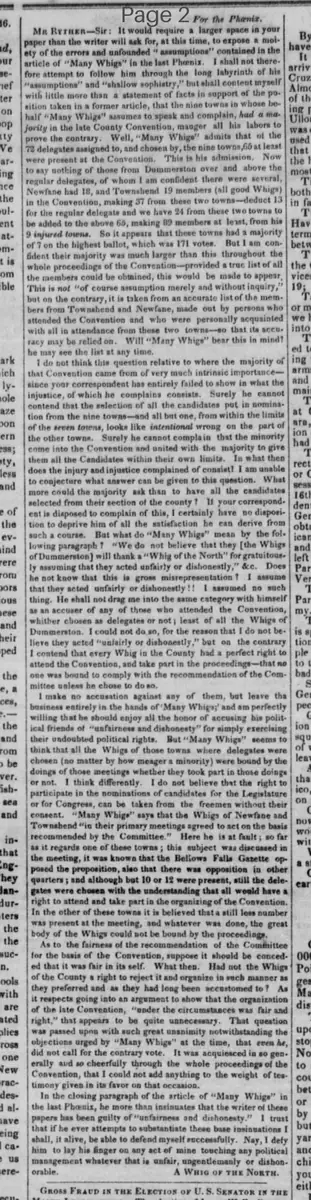
Mr. R.—Sir: It would require a larger space in your paper than the writer will ask for, at this time, to expose a moiety of the errors and unfounded "assumptions" contained in the article of "Many Whigs" in the last Phoenix. I shall not therefore attempt to follow him through the long labyrinth of his "assumptions" and "shallow sophistry," but shall content myself with little more than a statement of facts in support of the position taken in a former article, that the nine towns in whose behalf "Many Whigs" assumes to speak and complain, had a majority in the late County Convention, maugre all his labors to prove the contrary. Well, "Many Whigs" admits that of the 72 delegates assigned to, and chosen by, the nine towns, 65 at least were present at the Convention. This is his admission. Now to say nothing of those from Dummerston over and above the regular delegates, of whom I am confident there were several, Newfane had 18, and Townshend 19 members (all good Whigs) in the Convention, making 37 from these two towns—deduct 13 for the regular delegates and we have 24 from these two towns to be added to the above 65, making 89 members at least, from his 9 injured towns. So it appears that these towns had a majority of 7 on the highest ballot, which was 171 votes. But I am confident their majority was much larger than this throughout the whole proceedings of the Convention—provided a true list of all the members could be obtained, this would be made to appear.
This is not "of course assumption merely and without inquiry," but on the contrary, it is taken from an accurate list of the members from Townshend and Newfane, made out by persons who attended the Convention and who were personally acquainted with all in attendance from these two towns—so that its accuracy may be relied on. Will "Many Whigs" bear this in mind? he may see the list at any time.
I do not think this question relative to where the majority of that Convention came from of very much intrinsic importance—since your correspondent has entirely failed to show in what the injustice, of which he complains, consists. Surely he cannot contend that the selection of all the candidates put in nomination from the nine towns—and all but one, from within the limits of the seven towns, looks like intentional wrong on the part of the other towns. Surely he cannot complain that the minority come into the Convention and united with the majority to give them all the Candidates within their own limits. In what then does the injury and injustice complained of consist? I am unable to conjecture what answer can be given to this question. What more could the majority ask than to have all the candidates selected from their section of the county? If your correspondent is disposed to complain of this, I certainly have no disposition to deprive him of all the satisfaction he can derive from such a course. But what do "Many Whigs" mean by the following paragraph? "We do not believe that they [the Whigs of Dummerston] will thank a "Whig of the North" for gratuitously assuming that they acted unfairly or dishonestly," &c. Does he not know that this is gross misrepresentation? I assume that they acted unfairly or dishonestly!! I assumed no such thing. He shall not drag me into the same category with himself as an accuser of any of those who attended the Convention, whether chosen as delegates or not; least of all the Whigs of Dummerston. I could not do so, for the reason that I do not believe they acted "unfairly or dishonestly," but on the contrary I contend that every Whig in the County had a perfect right to attend the Convention, and take part in the proceedings—that no one was bound to comply with the recommendation of the Committee unless he chose to do so.
I make no accusation against any of them, but leave that business entirely in the hands of 'Many Whigs;' and am perfectly willing that he should enjoy all the honor of accusing his political friends of "unfairness and dishonesty" for simply exercising their undoubted political rights. But "Many Whigs" seems to think that all the Whigs of those towns where delegates were chosen (no matter by how meager a minority) were bound by the doings of those meetings whether they took part in those doings or not. I think differently. I do not believe that the right to participate in the nominations of candidates for the Legislature or for Congress, can be taken from the freemen without their consent. "Many Whigs" says that the Whigs of Newfane and Townshend "in their primary meetings agreed to act on the basis recommended by the Committee." Here he is at fault; so far as it regards one of these towns; this subject was discussed in the meeting, it was known that the Bellows Falls Gazette opposed the proposition, also that there was opposition in other quarters; and although but 10 or 12 were present, still the delegates were chosen with the understanding that all would have a right to attend and take part in the organizing of the Convention.
In the other of these towns it is believed that a still less number was present at the meeting, and whatever was done, the great body of the Whigs could not be bound by the proceedings.
As to the fairness of the recommendation of the Committee for the basis of the Convention, suppose it should be conceded that it was fair in itself. What then. Had not the Whigs of the County a right to reject it and organize in such manner as they preferred and as they had long been accustomed to? As it respects going into an argument to show that the organization of the late Convention, "under the circumstances was fair and right," that appears to be quite unnecessary. That question was passed upon with such great unanimity notwithstanding the objections urged by "Many Whigs" at the time, that even he, did not call for the contrary vote. It was acquiesced in so generally and so cheerfully through the whole proceedings of the Convention, that I could not add anything to the weight of testimony given in its favor on that occasion.
In the closing paragraph of the article of "Many Whigs" in the last Phoenix, he more than insinuates that the writer of these papers has been guilty of "unfairness and dishonesty." I trust that if he ever attempts to substantiate these base insinuations I shall, if alive, be able to defend myself successfully. Nay, I defy him to lay his finger on any act of mine touching any political management whatever that is unfair, ungentlemanly or dishonorable.
A Whig of the North.
This is not "of course assumption merely and without inquiry," but on the contrary, it is taken from an accurate list of the members from Townshend and Newfane, made out by persons who attended the Convention and who were personally acquainted with all in attendance from these two towns—so that its accuracy may be relied on. Will "Many Whigs" bear this in mind? he may see the list at any time.
I do not think this question relative to where the majority of that Convention came from of very much intrinsic importance—since your correspondent has entirely failed to show in what the injustice, of which he complains, consists. Surely he cannot contend that the selection of all the candidates put in nomination from the nine towns—and all but one, from within the limits of the seven towns, looks like intentional wrong on the part of the other towns. Surely he cannot complain that the minority come into the Convention and united with the majority to give them all the Candidates within their own limits. In what then does the injury and injustice complained of consist? I am unable to conjecture what answer can be given to this question. What more could the majority ask than to have all the candidates selected from their section of the county? If your correspondent is disposed to complain of this, I certainly have no disposition to deprive him of all the satisfaction he can derive from such a course. But what do "Many Whigs" mean by the following paragraph? "We do not believe that they [the Whigs of Dummerston] will thank a "Whig of the North" for gratuitously assuming that they acted unfairly or dishonestly," &c. Does he not know that this is gross misrepresentation? I assume that they acted unfairly or dishonestly!! I assumed no such thing. He shall not drag me into the same category with himself as an accuser of any of those who attended the Convention, whether chosen as delegates or not; least of all the Whigs of Dummerston. I could not do so, for the reason that I do not believe they acted "unfairly or dishonestly," but on the contrary I contend that every Whig in the County had a perfect right to attend the Convention, and take part in the proceedings—that no one was bound to comply with the recommendation of the Committee unless he chose to do so.
I make no accusation against any of them, but leave that business entirely in the hands of 'Many Whigs;' and am perfectly willing that he should enjoy all the honor of accusing his political friends of "unfairness and dishonesty" for simply exercising their undoubted political rights. But "Many Whigs" seems to think that all the Whigs of those towns where delegates were chosen (no matter by how meager a minority) were bound by the doings of those meetings whether they took part in those doings or not. I think differently. I do not believe that the right to participate in the nominations of candidates for the Legislature or for Congress, can be taken from the freemen without their consent. "Many Whigs" says that the Whigs of Newfane and Townshend "in their primary meetings agreed to act on the basis recommended by the Committee." Here he is at fault; so far as it regards one of these towns; this subject was discussed in the meeting, it was known that the Bellows Falls Gazette opposed the proposition, also that there was opposition in other quarters; and although but 10 or 12 were present, still the delegates were chosen with the understanding that all would have a right to attend and take part in the organizing of the Convention.
In the other of these towns it is believed that a still less number was present at the meeting, and whatever was done, the great body of the Whigs could not be bound by the proceedings.
As to the fairness of the recommendation of the Committee for the basis of the Convention, suppose it should be conceded that it was fair in itself. What then. Had not the Whigs of the County a right to reject it and organize in such manner as they preferred and as they had long been accustomed to? As it respects going into an argument to show that the organization of the late Convention, "under the circumstances was fair and right," that appears to be quite unnecessary. That question was passed upon with such great unanimity notwithstanding the objections urged by "Many Whigs" at the time, that even he, did not call for the contrary vote. It was acquiesced in so generally and so cheerfully through the whole proceedings of the Convention, that I could not add anything to the weight of testimony given in its favor on that occasion.
In the closing paragraph of the article of "Many Whigs" in the last Phoenix, he more than insinuates that the writer of these papers has been guilty of "unfairness and dishonesty." I trust that if he ever attempts to substantiate these base insinuations I shall, if alive, be able to defend myself successfully. Nay, I defy him to lay his finger on any act of mine touching any political management whatever that is unfair, ungentlemanly or dishonorable.
A Whig of the North.
What sub-type of article is it?
Persuasive
Political
Investigative
What themes does it cover?
Politics
Constitutional Rights
What keywords are associated?
County Convention
Whig Party
Delegates
Political Rights
Candidate Selection
Townshend
Newfane
Dummerston
What entities or persons were involved?
A Whig Of The North
Mr. R.
Letter to Editor Details
Author
A Whig Of The North
Recipient
Mr. R.
Main Argument
the nine towns had a majority in the county convention with at least 89 members present, all candidates were selected from their section, and there was no injustice; every whig had the right to participate regardless of delegate selection.
Notable Details
Admission By 'Many Whigs' Of 65 Delegates Present
Newfane: 18 Members, Townshend: 19 Members
Total Votes On Highest Ballot: 171
Reference To Accurate List Of Members Available
Denial Of Assuming Unfairness By Dummerston Whigs
Criticism Of Primary Meetings With Low Attendance Binding All Whigs