Thank you for visiting SNEWPapers!
Sign up free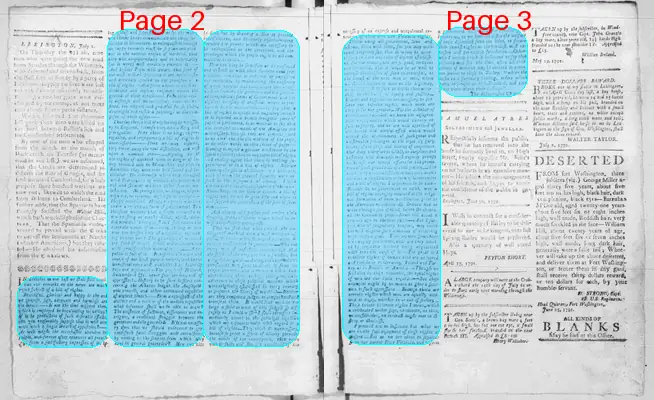
The Kentucky Gazette
Lexington, Fayette County, Kentucky
What is this article about?
This letter continues advocacy for including a bill of rights in the U.S. Constitution, refuting opponents who argue it's unnecessary in a republic without a king or prerogative. It stresses explicit protections to prevent tyranny, secure liberties for posterity, and draws historical parallels to monarchies and ancient republics.
Merged-components note: This is a continuation of the essay on the bill of rights across pages 2 and 3, ending with the signature 'The disinterested Citizen,' which indicates it is a letter to the editor rather than a standard editorial.
Clippings
1 of 2
OCR Quality
Full Text
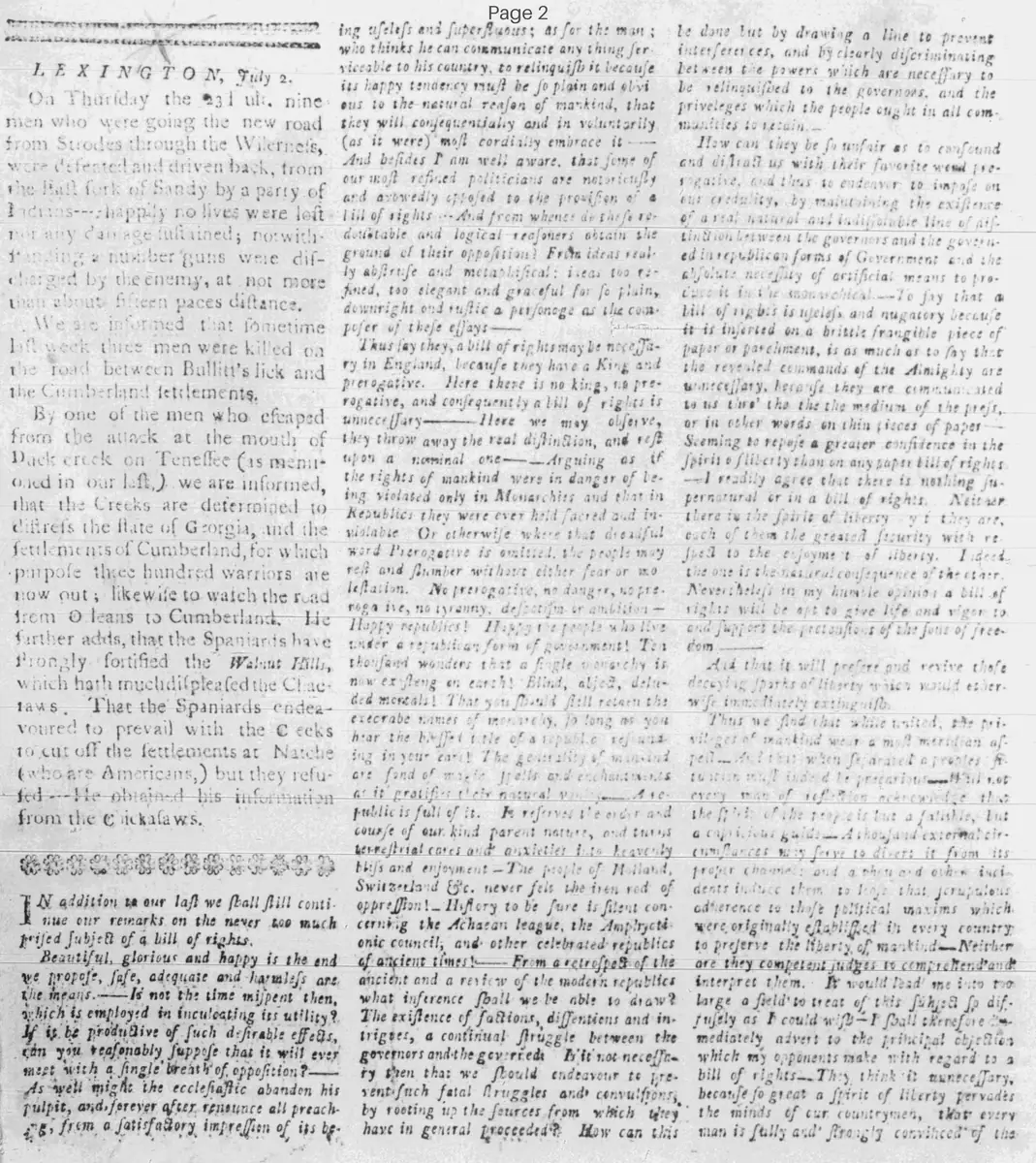
Beautiful, glorious and happy is the land we propose, adequate and harmless are the means. Is not the time misspent then, which is employed in inculcating its utility? If it be productive of such desirable effects, can you reasonably suppose that it will ever meet with a single breath of opposition?— As well might the ecclesiastic abandon his pulpit, and forever after renounce all preaching from a satisfactory impression of its being useless and superfluous; as for the man who thinks he can communicate any thing serviceable to his country, to relinquish it because its happy tendency must be so plain and obvious to the natural reason of mankind, that they will consequently and involuntarily (as it were) most cordially embrace it — And besides I am well aware, that some of our most refined politicians are notoriously and absurdly opposed to the provision of a bill of rights --And from whence do these redoubtable and logical reasoners obtain the ground of their opposition? From ideas very abstract and metaphysical: ideas too refined, too elegant and graceful for so plain, downright old rustic a personage as the composer of these essays Thus say they, a bill of rights may be necessary in England, because they have a King and prerogative. Here there is no king, no prerogative, and consequently a bill of rights is unnecessary--Here we may observe, they throw away the real distinction, and rest upon a nominal one---arguing as if the rights of mankind were in danger of being violated only in Monarchies and that in Republics they were ever held sacred and inviolable Or otherwise where that dreadful word Prerogative is omitted, the people may rest and slumber without either fear or motivation. No prerogative, no danger, no prerogative, no tyranny. Democracy and ambition- Happy republics! Happy the people who live under a republican form of government! Ten thousand wonders that a single monarchy is now on earth! Blind, idle, deluded mortals! That you should still retain the execrable names of your vicinity. so long as you hear the blest title of a republic trembling in your ear! The selfish would find are fond of magic spells and enchantments as it gratifies their natural vanity. publications full of it. I reverence the order and course of our kind parent nature, and this terrestrial state and another its heavenly bliss and enjoyment -The people of Holland, Switzerland &c. never felt the iron rod of oppression! History to be sure is silent concerning the Achaean league, the Amphictyonic council; and other celebrated republics of ancient times!-From a perusal of the ancient and a review of the modern republics what inference shall we be able to draw? The existence of factions, dissensions and intrigues, a continual struggle between the governors and the governed But not necessarily then that we should endeavour to prevent such fatal struggles and convulsions, by rooting up the sources from which they have in general proceeded' How can this be done but by drawing a line to prevent interferences, and by clearly discriminating between the powers which are necessary to be relinquished to the governors. and the privileges which the people ought in all communities to retain.-
How can they be so unfair as to confound and dazzle us with their favorite word prerogative, and thus to endeavour to impose on our credulity, by maintaining the existence of a natural, natural and inviolable line of demarcation between the governors and the governed in republican forms of Government and the absolute necessity of artificial means to protect it in the monarchical --to say that a bill of rights is useless and nugatory because it is inserted on a brittle fragile piece of paper or parchment, is as much as to say that the revealed commands of the Almighty are unnecessary, because they are communicated to us through the medium of the press. or in other words on thin pieces of paper- Seeming to repose a greater confidence in the spirit of liberty than on any paper bill of rights --I readily agree that there is nothing supernatural or in a bill of rights. Neither there in the spirit of liberty yet they are, each of them the greatest security with respect to the enjoyment of liberty. Indeed the one is the natural consequence of the other. Nevertheless in my humble opinion a bill. of rights will be apt to give life and vigor to and support the pretensions of the sons of freedom— did that it will therefore and revive those decaying parts o liberty which time et der. w tnnliiehy ex:hgufb Thus we find that the stated. the noi. vil eero ma:tind we a mo? meridan af reddit: win faactapoes A tu inod.rianot cery ran of of.gion orca!e th the fi dthe roeis te a faahle, lnt acpiib.Kiili-dshosjundeaterna.cir. cumPa ces ws faaye to di-er: it fgm its fropr cnama: a.d a rh,ycd othn inci dents i.dn c them to loe that jerupulons odherence to thofe tollrical mavims which. were originally elablifled in every country to preferve the liberiy of mankind--Neirber ore they competent judres lo cemirehendand. interpret them. Ir would lead' me into too large a teld' to treat of this fihjed o dif- rufely as F could wify-I fall cherefore d mediately advert to the jritcipal cbjeflion which my opponents mate mrith regard to a bill of rights- Th:y think it aunecefJary, becanfe fo gieat a tirit of lileriy pervades the minds of cur countrymnen, tkat every man is fully and' Rrangly corvihced'of the
Intent on the preservation of their dear and valuable rights.
Throw away all government, laws and systems, down with them, for you may with equal propriety say, that it would be unnecessary to have any rules of decent established. for our country men are good, virtuous and liberal, such it would be as well to ruin the decision of such controversies, to the breast of the next man or men, whom we first happen to meet on the highway, as this would be free to decide them according to the rules of equity and justice.
If laws and regulations are necessary to preserve our inferior rights, much more are they so for our greater. Was the doctrine of inheritance deduced, we know the dreadful consequences which would thereby result to society, and we are well apprised of the horrors and direful effects which would attend the abandonment of such great and inestimable privileges as the trial by jury, liberty of the press and liberty of conscience.
Our duty therefore to GOD, to ourselves and posterity will doubtless most eagerly prompt us to use our utmost efforts for the promotion of such grandeur of civil society. The question you ask our right Bill of Rights hath been drawn between a constitution or form of Government and a bill of rights I apprehend to be this.
Because in no government on earth, was a bill of rights expressly retained at the original formation of their constitution prior to the American revolution. Great Britain had to wade through seas of blood before she obtained the invaluable pri[viliges]. Never till about a century ago in the year 1688 and I suppose men of sanguinary tempers, may think the most eligible such a method of attaining so important a goal. Thus men sometimes led away by precedents, thus are they blinded by prejudice without being acquainted with either the cause of it. The great and indelible rights of human kind are as sacred and inviolable in Germany, Poland and Turkey, as in Britain or America. Though we feel that in those countries, the equal rights of men are but little regarded. But these examples ought by no means to give a sanction to such oppression. Because there are certain rights which men are equally entitled to enjoy, whether in or out of society.
Those innate inherent rights I mean which a celebrated writer says, no climate, no time, no constitution, no contract aughts ever to destroy or diminish, or pretend to encroach upon them we are in the full enjoyment of these rights at present. But as we are about to separate from our parent State Virginia, and to form a government calculated for durability, it becomes us, as we love and desire the welfare of those descended from our loins, to secure their dearest rights on the broadest, most extensive and permanent foundation. Otherwise I cannot think it ludicrous to say that posterity may see the time, when all civil actions of moment may be decided in a manner similar to those in Turkey, where the basha on a summary hearing, orders which party he pleases to be bastinadoed, and then sends them about their business.
The disinterested Citizen.
What sub-type of article is it?
What themes does it cover?
What keywords are associated?
What entities or persons were involved?
Letter to Editor Details
Author
The Disinterested Citizen.
Main Argument
a bill of rights is essential in the new republican government to explicitly protect inherent liberties, prevent tyranny, and secure rights for posterity, contrary to claims that it is unnecessary without a monarchy or prerogative.
Notable Details