Thank you for visiting SNEWPapers!
Sign up free
Portland Gazette, And Maine Advertiser
Portland, Cumberland County, Maine
What is this article about?
Commentary on Napoleon's 29th Bulletin describing the destruction and suffering in Moscow after his invasion, critiquing his character as embodying pure wickedness without redeeming qualities, contrasting him with historical figures and noting his admirers despite atrocities in Russia, Spain, and Portugal.
Clipping
OCR Quality
Full Text
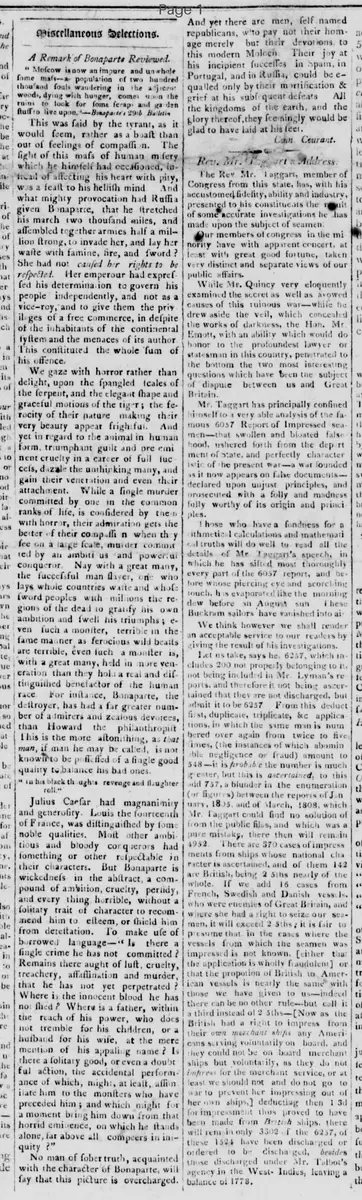
A Remark of Bonaparte Reviewed.
"Moscow is now an impure and unwholesome mass—a population of two hundred thousand souls wandering in the adjacent woods, dying with hunger, comes upon the ruins to look for some scraps and garden stuff to live upon."—Bonaparte's 29th Bulletin.
This was said by the tyrant, as it would seem, rather as a boast than out of feelings of compassion. The sight of this mass of human misery which he himself had occasioned, instead of affecting his heart with pity, was a feast to his hellish mind. And what mighty provocation had Russia given Bonaparte, that he stretched his march two thousand miles, and assembled together armies half a million strong, to invade her, and lay her waste with famine, fire, and sword?
She had not caused her rights to be respected. Her emperor had expressed his determination to govern his people independently, and not as a vice-roy, and to give them the privilege of a free Commerce, in despite of the inhabitants of the continental system and the menaces of its author. This constituted the whole sum of his offence.
We gaze with horror rather than delight, upon the spangled scales of the serpent, and the elegant Shape and graceful motions of the tiger; the ferocity of their nature making their very beauty appear frightful. And yet in regard to the animal in human form, triumphant guilt and pre-eminent cruelty in a career of full success, dazzle the unthinking many, and gain their veneration and even their attachment. While a single murder committed by one in the common ranks of life, is considered by the mass with horror, their admiration gets the better of their compassion when they see on a large scale, murder committed by an ambitious and powerful conqueror. Nay with a great many, the successful man slaver, one who lays whole countries waste and whose word peoples with millions the regions of the dead to gratify his own ambition and swell his triumphs; even such a monster, terrible in the same manner as ferocious wild beasts are terrible, even such a monster is, with a great many, held in more veneration than they hold a real and distinguished benefactor of the human race. For instance, Bonaparte, the destroyer, has had a far greater number of admirers and zealous devotees, than Howard the philanthropist.
This is the more astonishing, as that man, if man he may be called, is not known to be possessed of a single good quality to balance his bad ones.
"In his black thoughts revenge and slaughter roll."
Julius Caesar had magnanimity and generosity. Louis the fourteenth of France, was distinguished by some noble qualities. Most other ambitious and bloody conquerors had something or other respectable in their characters. But Bonaparte is wickedness in the abstract, a compound of ambition, cruelty, perfidy, and every thing horrible, without a solitary trait of character to recommend him to esteem, or shield him from detestation. To make use of borrowed language—"Is there a single crime he has not committed? Remains there aught of lust, cruelty, treachery, alienation and murder, that he has not yet perpetrated? Where is the innocent blood he has not shed? Where is a father, within the reach of his power, who does not tremble for his children, or a husband for his wife, at the mere mention of his appalling name? Is there a solitary good, or even a doubtful action, the accidental performance of which, might, at least, assimilate him to the monsters who have preceded him; and which might for a moment bring him down from that horrid eminence, on which he stands alone, far above all compeers in iniquity?"
No man of sober truth, acquainted with the character of Bonaparte, will say that this picture is overcharged.
And yet there are men, self named republicans, who pay not their homage merely but their devotions, to this modern Moloch. Their joy at his incipient success in Spain, in Portugal, and in Russia, could be equalled only by their mortification & grief at his subsequent defeats. All the kingdoms of the earth, and the glory thereof, they seemingly would be glad to have laid at his feet.
Con. Courant.
What sub-type of article is it?
What keywords are associated?
What entities or persons were involved?
Where did it happen?
Foreign News Details
Primary Location
Moscow
Event Date
Bonaparte's 29th Bulletin
Key Persons
Outcome
population of two hundred thousand souls wandering in the adjacent woods, dying with hunger; armies half a million strong; lays whole countries waste and whose word peoples with millions the regions of the dead
Event Details
Bonaparte's remark on Moscow as an impure and unwholesome mass after invasion, with population scavenging ruins; critique of his invasion of Russia over free commerce and independence, portraying him as embodiment of ambition, cruelty, perfidy without redeeming qualities, contrasted with historical figures; mentions successes and defeats in Spain, Portugal, Russia.