Thank you for visiting SNEWPapers!
Sign up free
Literary
March 6, 1802
The Recorder, Or, Lady's And Gentleman's Miscellany
Richmond, Virginia
What is this article about?
Continuation of the novel where Mrs. Jakeman questions Mr. Tyrrel about forcing Emily Melville to marry Grimes. Emily rejects Grimes but is coerced by Tyrrel's sternness. She attempts to soften Tyrrel through music and plea, but he remains resolute.
Clipping
OCR Quality
85%
Good
Full Text
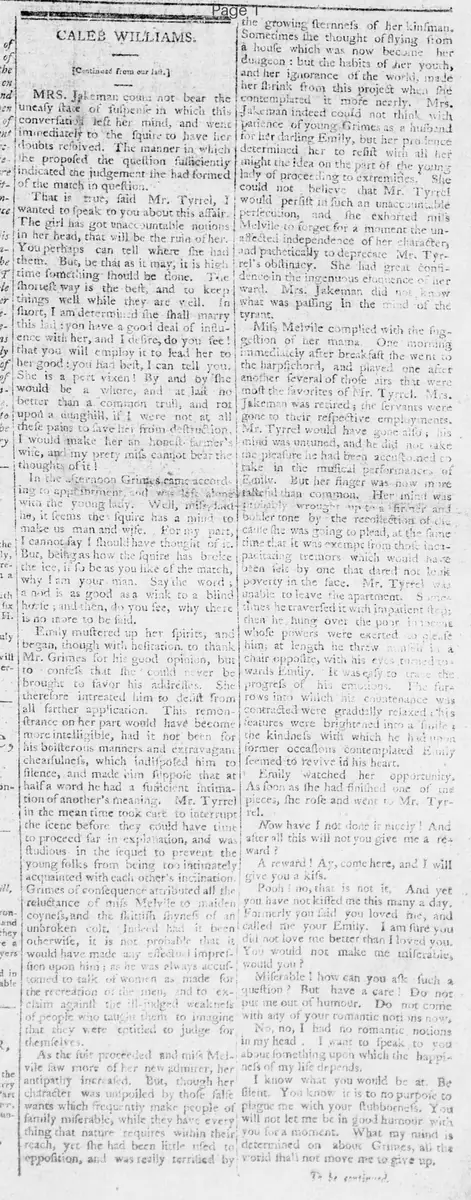
CALEB WILLIAMS.
[Continued from our last.]
Mrs. Jakeman could not bear the uneasy state of suspense in which this conversation left her mind, and went immediately to the squire to have her doubts resolved. The manner in which she proposed the question sufficiently indicated the judgement she had formed of the match in question.
"That is true," said Mr. Tyrrel, "I wanted to speak to you about this affair. The girl has got unaccountable notions in her head, that will be the ruin of her. You perhaps can tell where she had them. But, be that as it may, it is high time something should be done. The shortest way is the best, and to keep things well while they are well. In short, I am determined she shall marry this lad: you have a good deal of influence with her, and I desire, do you see, that you will employ it to lead her to her good: you had best, I can tell you. She is a pert vixen! By and by she would be a whore, and at last no better than a common trull, and rot upon a dunghill, if I were not at all these pains to save her from destruction. I would make her an honest farmer's wife, and my pretty miss cannot bear the thoughts of it!"
In the afternoon Grimes came according to appointment, and was left alone with the young lady. "Well, missy," said he, "it seems the squire has a mind to make us man and wife. For my part, I cannot say I should have thought of it. But, seeing as how the squire has broke the ice, if so be as you like of the match, why I am your man. Say the word; a nod is as good as a wink to a blind horse; and then, do you see, why there is no more to be said."
Emily mustered up her spirits, and began, though with hesitation, to thank Mr. Grimes for his good opinion, but to confess that she could never be brought to favor his addresses. She therefore intreated him to desist from all farther application. This remonstrance on her part would have become more intelligible, had it not been for his boisterous manners and extravagant cheerfulness, which indisposed him to silence, and made him suppose that at half a word he had a sufficient intimation of another's meaning. Mr. Tyrrel in the mean time took care to interrupt the scene before they could have time to proceed far in explanation, and was studious in the sequel to prevent the young folks from being too intimately acquainted with each other's inclination. Grimes of consequence attributed all the reluctance of miss Melville to maiden coyness, and the sluttish shyness of an unbroken colt. Indeed had it been otherwise, it is not probable that it would have made any effectual impression upon him; as he was always accustomed to talk of women as made for the recreation of the men, and to exclaim against the ill-judged weakness of people who taught them to imagine that they were entitled to judge for themselves.
As the suit proceeded and miss Melville saw more of her new admirer, her antipathy increased. But, though her character was unspoiled by those false wants which frequently make people of family miserable, while they have every thing that nature requires within their reach, yet she had been little used to opposition, and was really terrified by the growing sternness of her kinsman.
Sometimes she thought of flying from a house which was now become her dungeon: but the habits of her youth, and her ignorance of the world, made her shrink from this project when she contemplated it more nearly. Mrs. Jakeman indeed could not think with patience of young Grimes as a husband for her darling Emily, but her prudence determined her to resist with all her might the idea on the part of the young lady of proceeding to extremities. She could not believe that Mr. Tyrrel would persist in such an unaccountable persecution, and she exhorted miss Melville to forget for a moment the unaffected independence of her character and pathetically to deprecate Mr. Tyrrel's obstinacy. She had great confidence in the ingenuous eloquence of her ward. Mrs. Jakeman did not know what was passing in the mind of the tyrant.
Miss Melville complied with the suggestion of her mama. One morning immediately after breakfast she went to the harpsichord, and played one after another several of those airs that were most the favorites of Mr. Tyrrel. Mrs. Jakeman was retired; the servants were gone to their respective employments. Mr. Tyrrel would have gone also; his mind was out of tune, and he did not take the pleasure he had been accustomed to take in the musical performances of Emily. But her finger was now more tasteful than common. Her mind was pitiably wrought up to a firmer and holier tone by the recollection of the cause she was going to plead, at the same time that it was exempt from those captivating tremors which would have been felt by one that dared not look poverty in the face. Mr. Tyrrel was unable to leave the apartment. Sometimes he traversed it with impatient step; then he hung over the poor girl whose powers were exerted to ensnare him, at length he threw himself in a chair opposite, with his eyes turned towards Emily. It was easy to trace the progress of his emotions. The furrows into which his countenance was constructed were gradually relaxed: his features were brightened into a smile: the kindness with which he had on former occasions contemplated Emily seemed to revive in his heart.
Emily watched her opportunity. As soon as she had finished one of her pieces, she rose and went to Mr. Tyrrel.
"Now have I not done it neatly! And after all this will not you give me a reward?"
"A reward! Ay, come here, and I will give you a kiss."
"Pooh no, that is not it. And yet you have not kissed me this many a day. Formerly you said you loved me, and called me your Emily. I am sure you did not love me better than I loved you. You would not make me miserable, would you?"
"Miserable! how can you ask such a question? But have a care! Do not put me out of humour. Do not come with any of your romantic notions now."
"No, no, I had no romantic notions in my head. I want to speak to you about something upon which the happiness of my life depends."
"I know what you would be at. Be silent. You know it is to no purpose to plague me with your stubbornness. You will not let me be in good humour with you for a moment. What my mind is determined on about Grimes, all the world shall not move me to give up."
To be continued,
[Continued from our last.]
Mrs. Jakeman could not bear the uneasy state of suspense in which this conversation left her mind, and went immediately to the squire to have her doubts resolved. The manner in which she proposed the question sufficiently indicated the judgement she had formed of the match in question.
"That is true," said Mr. Tyrrel, "I wanted to speak to you about this affair. The girl has got unaccountable notions in her head, that will be the ruin of her. You perhaps can tell where she had them. But, be that as it may, it is high time something should be done. The shortest way is the best, and to keep things well while they are well. In short, I am determined she shall marry this lad: you have a good deal of influence with her, and I desire, do you see, that you will employ it to lead her to her good: you had best, I can tell you. She is a pert vixen! By and by she would be a whore, and at last no better than a common trull, and rot upon a dunghill, if I were not at all these pains to save her from destruction. I would make her an honest farmer's wife, and my pretty miss cannot bear the thoughts of it!"
In the afternoon Grimes came according to appointment, and was left alone with the young lady. "Well, missy," said he, "it seems the squire has a mind to make us man and wife. For my part, I cannot say I should have thought of it. But, seeing as how the squire has broke the ice, if so be as you like of the match, why I am your man. Say the word; a nod is as good as a wink to a blind horse; and then, do you see, why there is no more to be said."
Emily mustered up her spirits, and began, though with hesitation, to thank Mr. Grimes for his good opinion, but to confess that she could never be brought to favor his addresses. She therefore intreated him to desist from all farther application. This remonstrance on her part would have become more intelligible, had it not been for his boisterous manners and extravagant cheerfulness, which indisposed him to silence, and made him suppose that at half a word he had a sufficient intimation of another's meaning. Mr. Tyrrel in the mean time took care to interrupt the scene before they could have time to proceed far in explanation, and was studious in the sequel to prevent the young folks from being too intimately acquainted with each other's inclination. Grimes of consequence attributed all the reluctance of miss Melville to maiden coyness, and the sluttish shyness of an unbroken colt. Indeed had it been otherwise, it is not probable that it would have made any effectual impression upon him; as he was always accustomed to talk of women as made for the recreation of the men, and to exclaim against the ill-judged weakness of people who taught them to imagine that they were entitled to judge for themselves.
As the suit proceeded and miss Melville saw more of her new admirer, her antipathy increased. But, though her character was unspoiled by those false wants which frequently make people of family miserable, while they have every thing that nature requires within their reach, yet she had been little used to opposition, and was really terrified by the growing sternness of her kinsman.
Sometimes she thought of flying from a house which was now become her dungeon: but the habits of her youth, and her ignorance of the world, made her shrink from this project when she contemplated it more nearly. Mrs. Jakeman indeed could not think with patience of young Grimes as a husband for her darling Emily, but her prudence determined her to resist with all her might the idea on the part of the young lady of proceeding to extremities. She could not believe that Mr. Tyrrel would persist in such an unaccountable persecution, and she exhorted miss Melville to forget for a moment the unaffected independence of her character and pathetically to deprecate Mr. Tyrrel's obstinacy. She had great confidence in the ingenuous eloquence of her ward. Mrs. Jakeman did not know what was passing in the mind of the tyrant.
Miss Melville complied with the suggestion of her mama. One morning immediately after breakfast she went to the harpsichord, and played one after another several of those airs that were most the favorites of Mr. Tyrrel. Mrs. Jakeman was retired; the servants were gone to their respective employments. Mr. Tyrrel would have gone also; his mind was out of tune, and he did not take the pleasure he had been accustomed to take in the musical performances of Emily. But her finger was now more tasteful than common. Her mind was pitiably wrought up to a firmer and holier tone by the recollection of the cause she was going to plead, at the same time that it was exempt from those captivating tremors which would have been felt by one that dared not look poverty in the face. Mr. Tyrrel was unable to leave the apartment. Sometimes he traversed it with impatient step; then he hung over the poor girl whose powers were exerted to ensnare him, at length he threw himself in a chair opposite, with his eyes turned towards Emily. It was easy to trace the progress of his emotions. The furrows into which his countenance was constructed were gradually relaxed: his features were brightened into a smile: the kindness with which he had on former occasions contemplated Emily seemed to revive in his heart.
Emily watched her opportunity. As soon as she had finished one of her pieces, she rose and went to Mr. Tyrrel.
"Now have I not done it neatly! And after all this will not you give me a reward?"
"A reward! Ay, come here, and I will give you a kiss."
"Pooh no, that is not it. And yet you have not kissed me this many a day. Formerly you said you loved me, and called me your Emily. I am sure you did not love me better than I loved you. You would not make me miserable, would you?"
"Miserable! how can you ask such a question? But have a care! Do not put me out of humour. Do not come with any of your romantic notions now."
"No, no, I had no romantic notions in my head. I want to speak to you about something upon which the happiness of my life depends."
"I know what you would be at. Be silent. You know it is to no purpose to plague me with your stubbornness. You will not let me be in good humour with you for a moment. What my mind is determined on about Grimes, all the world shall not move me to give up."
To be continued,
What sub-type of article is it?
Prose Fiction
What themes does it cover?
Liberty Freedom
Social Manners
What keywords are associated?
Caleb Williams
Forced Marriage
Emily Melville
Mr Tyrrel
Grimes
Independence
Tyranny
Literary Details
Title
Caleb Williams.
Subject
Forced Marriage Of Emily Melville To Grimes
Form / Style
Narrative Prose Excerpt
Key Lines
"She Is A Pert Vixen! By And By She Would Be A Whore, And At Last No Better Than A Common Trull, And Rot Upon A Dunghill, If I Were Not At All These Pains To Save Her From Destruction."
"Well, Missy," Said He, "It Seems The Squire Has A Mind To Make Us Man And Wife."
"You Would Not Make Me Miserable, Would You?"
"What My Mind Is Determined On About Grimes, All The World Shall Not Move Me To Give Up."