Thank you for visiting SNEWPapers!
Sign up free
Story
June 5, 1889
Great Falls Tribune
Great Falls, Cascade County, Montana
What is this article about?
John G. Williams exhibits a new 'port-electric' transportation system in Boston, using sequential coil magnets to propel a steel car at high speeds for mail delivery, potentially covering New York to Boston in one hour at 200 mph.
Clipping
OCR Quality
98%
Excellent
Full Text
A TREMENDOUS RATE OF SPEED.
Extraordinary Claims Made for a New Invention to Utilize Electricity.
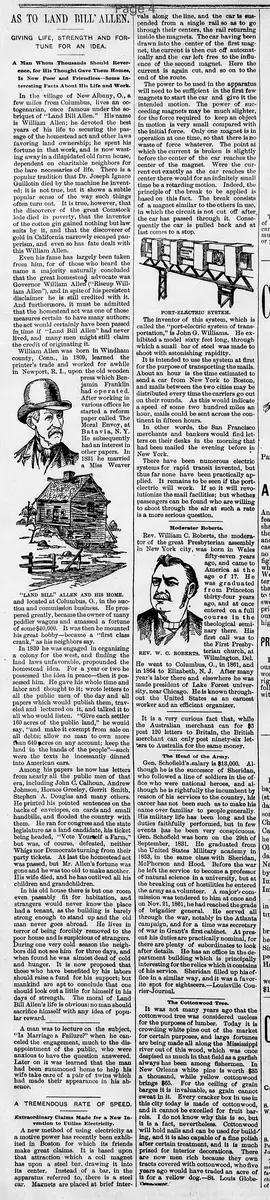
A new method of using electricity as a motive power has recently been exhibited in Boston for which its friends make great claims. It is based upon that attraction which a coil magnet has upon a steel bar, drawing it into its center. Instead of a bar, in the apparatus referred to, there is a steel car. Magnets are placed at brief intervals along the line, and the car is suspended from a single rail so as to go through their centers, the rail returning inside the magnets. The car having been drawn into the center of the first magnet, the current is then cut off automatically and the car left free to the influence of the second magnet. Here the current is again cut, and so on to the end of the route.
The power to be used in the apparatus will need to be sufficient in the first few magnets to start the car and give it the intended motion. The power of succeeding magnets may be much slighter, for the force required to keep an object in motion is very small compared with the initial force. Only one magnet is in operation at one time, so that there is no waste of force whatever. The point at which the current is broken is slightly before the center of the car reaches the center of the magnet. Were the current cut exactly as the car reaches the center there would for an infinitely small time be a retarding motion. Indeed, the principle of the break to be applied is based on this fact. The break consists of a magnet similar to the others in use, in which the circuit is not cut off after the car has passed through it. Consequently the car is pulled back and at last comes to a stop.
PORT-ELECTRIC SYSTEM.
The inventor of this system, which is called the "port-electric system of transportation," is John G. Williams. He exhibited a model sixty feet long, through which a small bar of steel was made to shoot with astonishing rapidity.
It is intended to use the system at first for the purpose of transporting the mails. About an hour is the time estimated to send a car from New York to Boston, and mails between the two cities may be distributed every time the carriers go out on their rounds. As this would indicate a speed of some two hundred miles an hour, mails could be sent across the continent in fifteen hours.
In other words, the San Francisco merchants and bankers would find letters on their desks in the morning that had been mailed the evening before in New York.
There have been numerous electric systems for rapid transit invented, but thus far none have been practically applied. It remains to be seen if the port-electric will work. If so it will revolutionize the mail facilities; but whether passengers can be found who are willing to shoot through the air at such a rate is a more serious question.
Extraordinary Claims Made for a New Invention to Utilize Electricity.
A new method of using electricity as a motive power has recently been exhibited in Boston for which its friends make great claims. It is based upon that attraction which a coil magnet has upon a steel bar, drawing it into its center. Instead of a bar, in the apparatus referred to, there is a steel car. Magnets are placed at brief intervals along the line, and the car is suspended from a single rail so as to go through their centers, the rail returning inside the magnets. The car having been drawn into the center of the first magnet, the current is then cut off automatically and the car left free to the influence of the second magnet. Here the current is again cut, and so on to the end of the route.
The power to be used in the apparatus will need to be sufficient in the first few magnets to start the car and give it the intended motion. The power of succeeding magnets may be much slighter, for the force required to keep an object in motion is very small compared with the initial force. Only one magnet is in operation at one time, so that there is no waste of force whatever. The point at which the current is broken is slightly before the center of the car reaches the center of the magnet. Were the current cut exactly as the car reaches the center there would for an infinitely small time be a retarding motion. Indeed, the principle of the break to be applied is based on this fact. The break consists of a magnet similar to the others in use, in which the circuit is not cut off after the car has passed through it. Consequently the car is pulled back and at last comes to a stop.
PORT-ELECTRIC SYSTEM.
The inventor of this system, which is called the "port-electric system of transportation," is John G. Williams. He exhibited a model sixty feet long, through which a small bar of steel was made to shoot with astonishing rapidity.
It is intended to use the system at first for the purpose of transporting the mails. About an hour is the time estimated to send a car from New York to Boston, and mails between the two cities may be distributed every time the carriers go out on their rounds. As this would indicate a speed of some two hundred miles an hour, mails could be sent across the continent in fifteen hours.
In other words, the San Francisco merchants and bankers would find letters on their desks in the morning that had been mailed the evening before in New York.
There have been numerous electric systems for rapid transit invented, but thus far none have been practically applied. It remains to be seen if the port-electric will work. If so it will revolutionize the mail facilities; but whether passengers can be found who are willing to shoot through the air at such a rate is a more serious question.
What sub-type of article is it?
Curiosity
Extraordinary Event
What themes does it cover?
Triumph
Exploration
What keywords are associated?
Electric Invention
Magnetic Propulsion
High Speed Transport
Mail Delivery
Port Electric System
John G Williams
Boston Exhibition
What entities or persons were involved?
John G. Williams
Where did it happen?
Boston
Story Details
Key Persons
John G. Williams
Location
Boston
Event Date
Recently
Story Details
John G. Williams exhibits a model of the port-electric system in Boston, a magnetic propulsion method for high-speed mail transport using sequential electromagnets to draw a steel car along a rail at up to 200 mph, potentially revolutionizing cross-country mail delivery.