Thank you for visiting SNEWPapers!
Sign up free
The New Hampshire Gazette And General Advertiser
Portsmouth, Exeter, Rockingham County, New Hampshire
What is this article about?
A letter to the author signing as 'a Member of Convention' in the New-Hampshire Gazette challenges their defense of an alternative constitution plan, questioning their evidence, consistency, and motives, while defending the original plan's separation of powers and accusing the author of anti-revolutionary sympathies.
Clipping
OCR Quality
Full Text
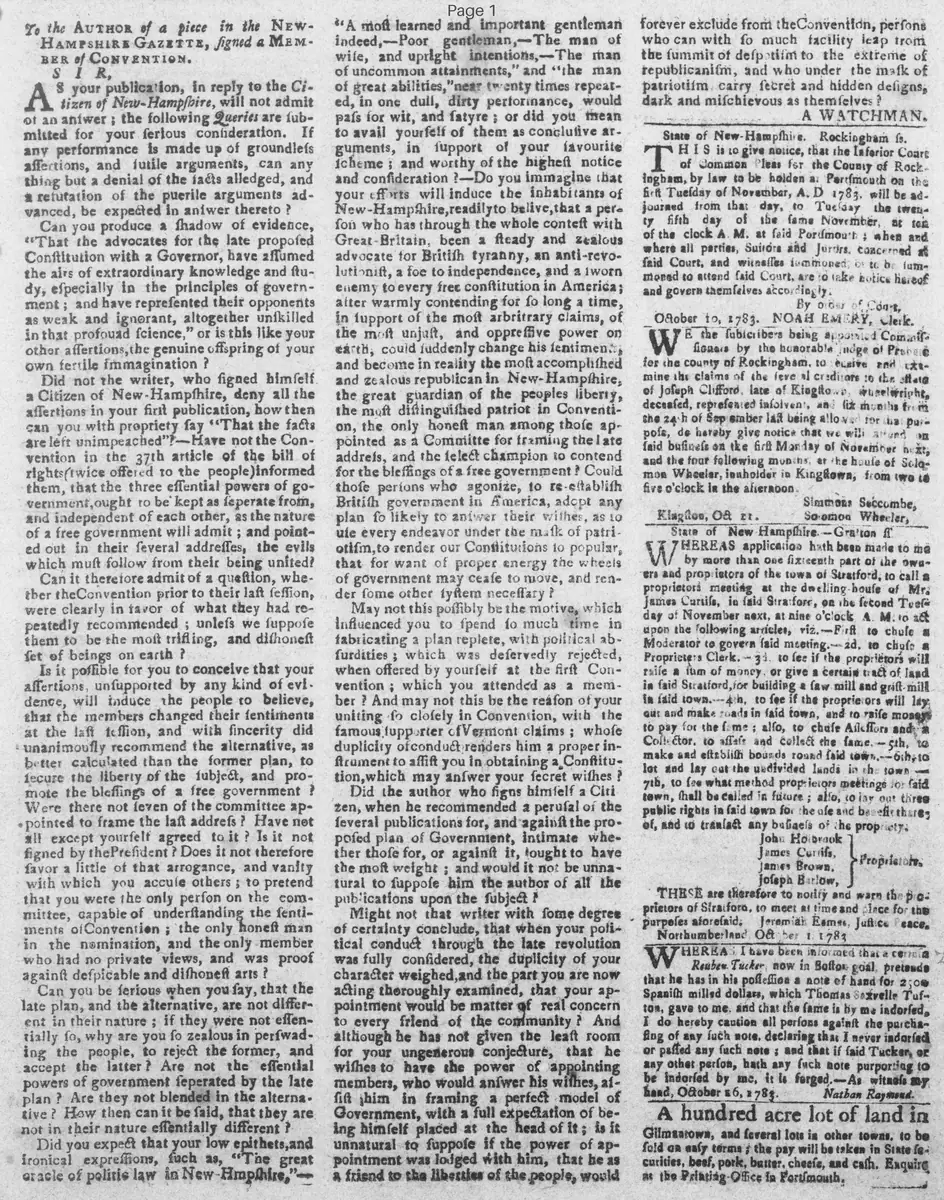
SIR,
As your publication, in reply to the Citizen of New-Hampshire, will not admit of an answer: the following queries are submitted for your serious consideration. If any performance is made up of groundless assertions, and futile arguments, can any thing but a denial of the facts alleged, and a refutation of the puerile arguments advanced, be expected in answer thereto?
Can you produce a shadow of evidence, that the advocates for the late proposed Constitution with a Governor, have assumed the airs of extraordinary knowledge and study, especially in the principles of government; and have represented their opponents as weak and ignorant, altogether unskilled in that profound science, or is this like your other assertions, the genuine offspring of your own fertile imagination?
Did not the writer, who signed himself a Citizen of New-Hampshire, deny all the assertions in your first publication, how then can you with propriety say "That the facts are left unimpeached"? Have not the Convention in the 37th article of the bill of rights (twice offered to the people) informed them, that the three essential powers of government, ought to be kept as separate from, and independent of each other, as the nature of a free government will admit; and pointed out in their several addresses, the evils which must follow from their being united?
Can it therefore admit of a question, whether the Convention prior to their last session, were clearly in favor of what they had repeatedly recommended; unless we suppose them to be the most trifling, and dishonest set of beings on earth?
Is it possible for you to conceive that your assertions, unsupported by any kind of evidence, will induce the people to believe, that the members changed their sentiments at the last session, and with sincerity did unanimously recommend the alternative, as better calculated than the former plan, to secure the liberty of the subject, and promote the blessings of a free government?
Were there not seven of the committee appointed to frame the last address? Have not all except yourself agreed to it? Is it not signed by the President? Does it not therefore savor a little of that arrogance, and vanity with which you accuse others; to pretend that you were the only person on the committee, capable of understanding the sentiments of Convention: the only honest man in the nomination, and the only member who had no private views, and was proof against despicable and dishonest arts?
Can you be serious when you say, that the late plan, and the alternative, are not different in their nature; if they were not essentially so, why are you so zealous in persuading the people, to reject the former, and accept the latter? Are not the essential powers of government separated by the late plan? Are they not blended in the alternative? How then can it be said, that they are not in their nature essentially different.
Did you expect that your low epithets, and ironical expressions, such as, "The great oracle of politic law in New-Hampshire,"
"A most learned and important gentleman indeed,--Poor gentleman,--The man of wisdom and upright intentions,--The man of uncommon attainments." and "the man of great abilities." near twenty times repeated, in one dull, dirty performance, would pass for wit, and satire; or did you mean to avail yourself of them as conclusive arguments, in support of your favourite scheme; and worthy of the highest notice and consideration?--Do you imagine that your efforts will induce the inhabitants of New-Hampshire, readily to believe, that a person who has through the whole contest with Great-Britain, been a steady and zealous advocate for British tyranny, an anti-revolutionist, a foe to independence, and a sworn enemy to every free constitution in America;
after warmly contending for so long a time, in support of the most arbitrary claims, of the most unjust, and oppressive power on earth, could suddenly change his sentiments: and become in reality the most accomplished and zealous republican in New-Hampshire, the great guardian of the peoples liberty, the most distinguished patriot in Convention, the only honest man among those appointed as a Committee for framing the last address, and the select champion to contend for the blessings of a free government? Could those persons who agonize, to re-establish British government in America, adopt any plan so likely to answer their wishes, as to use every endeavor under the mask of patriotism, to render our Constitutions so popular, that for want of proper energy the wheels of government may cease to move, and render some other system necessary?
May not this possibly be the motive, which influenced you to spend so much time in fabricating a plan replete, with political absurdities: which was deservedly rejected, when offered by yourself at the first Convention: which you attended as a member? And may not this be the reason of your uniting so closely in Convention, with the famous supporter of Vermont claims: whose duplicity of conduct renders him a proper instrument to assist you in obtaining a Constitution, which may answer your secret wishes?
Did the author who signs himself a Citizen, when he recommended a perusal of the several publications for, and against the proposed plan of Government, intimate whether those for, or against it, ought to have the most weight: and would it not be unnatural to suppose him the author of all the publications upon the subject?
Might not that writer with some degree of certainty conclude, that when your political conduct through the late revolution was fully considered, the duplicity of your character weighed, and the part you are now acting thoroughly examined, that your appointment would be matter of real concern to every friend of the community? And although he has not given the least room for your ungenerous conjecture, that he wishes to have the power of appointing members, who would answer his wishes, assist him in framing a perfect model of Government, with a full expectation of being himself placed at the head of it: is it unnatural to suppose if the power of appointment was lodged with him, that he as a friend to the liberties of the people, would forever exclude from the Convention, persons who can with so much facility leap from the summit of despotism to the extreme of republicanism, and who under the mask of patriotism, carry secret and hidden designs, dark and mischievous as themselves?
A WATCHMAN.
What sub-type of article is it?
What themes does it cover?
What keywords are associated?
What entities or persons were involved?
Letter to Editor Details
Author
A Watchman.
Recipient
To The Author Of A Piece In The New Hampshire Gazette, Signed A Member Of Convention.
Main Argument
the letter poses a series of queries challenging the credibility and motives of 'a member of convention,' denying their claims about the proposed constitution, defending the separation of governmental powers in the original plan, and accusing the author of duplicity and anti-revolutionary sympathies.
Notable Details