Thank you for visiting SNEWPapers!
Sign up free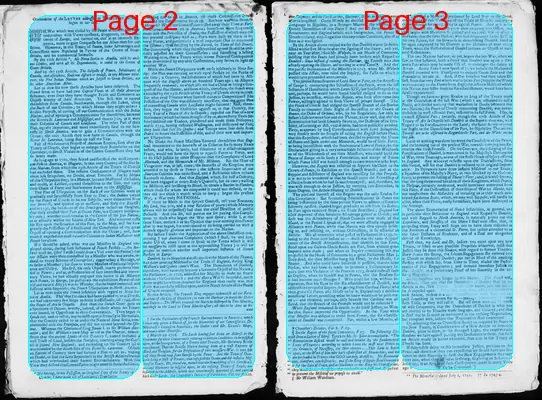
The New Hampshire Gazette
Portsmouth, Rockingham County, New Hampshire
What is this article about?
Continuation of a letter critiquing French violations of the Treaty of Utrecht, including encroachments in North America (Nova Scotia, Niagara, Ohio) and failure to demolish Dunkirk. Urges British negotiators to demand immediate justice on these issues before new peace talks, highlighting past ministerial negligence.
Merged-components note: Merging the continuation of the editorial letter addressed to Two Great Men across pages 2 and 3, as indicated by the explicit 'Continuation' and seamless topic flow on French perfidy and treaties.
Clippings
1 of 2
OCR Quality
Full Text
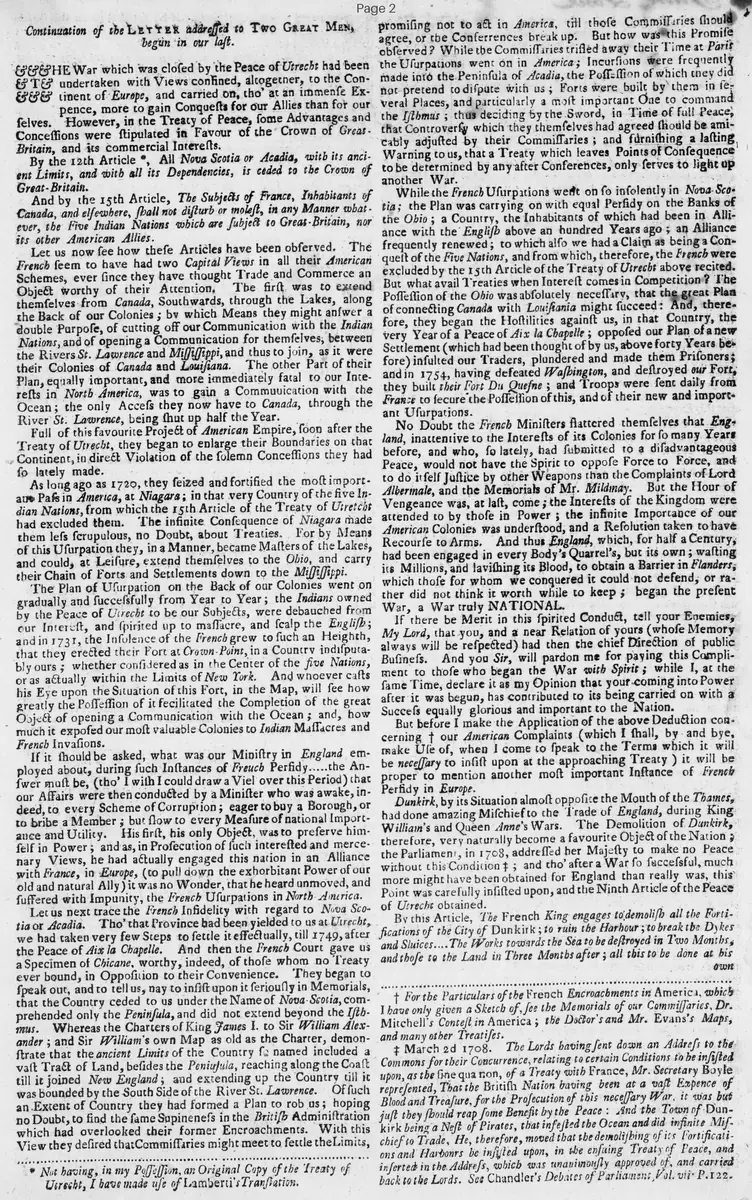
The late War which was closed by the Peace of Utrecht had been undertaken with Views confined, altogether, to the Continent of Europe, and carried on, tho' at an immense Expence, more to gain Conquests for our Allies than for our Selves. However, in the Treaty of Peace, some Advantages and Concessions were stipulated in Favour of the Crown of Great Britain, and its commercial Interests.
By the 12th Article *. All Nova Scotia or Acadia, with its ancient Limits, and with all its Dependencies, is ceded to the Crown of Great-Britain.
And by the 15th Article, The Subjects of France, Inhabitants of Canada, and elsewhere, shall not disturb or molest, in any Manner whatever, the Five Indian Nations which are subject to Great-Britain, nor its other American Allies.
Let us now see how these Articles have been observed. The French seem to have had two Capital Views in all their American Schemes, ever since they have thought Trade and Commerce an Object worthy of their Attention. The first was to extend themselves from Canada, Southwards, through the Lakes, along the Back of our Colonies; by which Means they might answer a double Purpose, of cutting off our Communication with the Indian Nations, and of opening a Communication for themselves: between the Rivers St. Lawrence and Mississippi, and thus to join, as it were their Colonies of Canada and Louisiana. The other Part of their Plan, equally important, and more immediately fatal to our Interests in North America, was to gain a Communication with the Ocean; the only Access they now have to Canada, through the River St. Lawrence, being shut up half the Year.
Full of this favourite Project of American Empire, soon after the Treaty of Utrecht, they began to enlarge their Boundaries on that Continent, in direct Violation of the solemn Concessions they had so lately made.
As long ago as 1720, they seized and fortified the most important Pass in America, at Niagara; in that very Country of the five Indian Nations, from which the 15th Article of the Treaty of Utrecht had excluded them. The infinite Consequence of Niagara made them less scrupulous, no Doubt, about Treaties. For by Means of this Usurpation they, in a Manner, became Masters of the Lakes, and could, at Leisure, extend themselves to the Ohio, and carry their Chain of Forts and Settlements down to the Mississippi.
The Plan of Usurpation on the Back of our Colonies went on gradually and successfully from Year to Year; the Indians owned by the Peace of Utrecht to be our Subjects, were debauched from our Interest, and spirited up to massacre, and scalp the English: and in 1731, the Insolence of the French grew to such an Height, that they erected their Fort at Crown-Point, in a Country indisputably ours; whether considered as in the Center of the five Nations, or as actually within the Limits of New York. And whoever casts his Eye upon the Situation of this Fort. in the Map, will see how greatly the Possession of it facilitated the Completion of the great Object of opening a Communication with the Ocean: and, how much it exposed our most valuable Colonies to Indian Massacres and French Invasions.
If it should be asked, what was our Ministry in England employed about, during such Instances of French Perfidy.....the Answer must be, (tho' I wish I could draw a Veil over this Period) that our Affairs were then conducted by a Minister who was awake, indeed, to every Scheme of Corruption; eager to buy a Borough, or to bribe a Member; but slow to every Measure of national Importance and Utility. His first, his only Object, was to preserve himself in Power; and as, in Prosecution of such interested and mercenary Views, he had actually engaged this nation in an Alliance with France, in Europe, (to pull down the exorbitant Power of our old and natural Ally) it was no Wonder, that he heard unmoved, and suffered with Impunity, the French Usurpations in North America.
Let us next trace the French Infidelity with regard to Nova Scotia or Acadia. Tho' that Province had been yielded to us at Utrecht, we had taken very few Steps to settle it effectually, till 1749, after the Peace of Aix la Chapelle. And then the French Court gave us a Specimen of Chicane, worthy, indeed, of those whom no Treaty ever bound, in Opposition to their Convenience. They began to speak out, and to tell us, nay to insist upon it seriously in Memorials, that the Country ceded to us under the Name of Nova-Scotia, comprehended only the Peninsula, and did not extend beyond the Isthmus.
Whereas the Charters of King James I. to Sir William Alexander; and Sir William's own Map as old as the Charter, demonstrate that the ancient Limits of the Country so named included a vast Tract of Land, besides the Peninsula, reaching along the Coast till it joined New England; and extending up the Country till it was bounded by the South Side of the River St. Lawrence. Of such an Extent of Country they had formed a Plan to rob us; hoping no Doubt, to find the same Supineness in the British Administration which had overlooked their former Encroachments. With this View they desired that Commissaries might meet to settle the Limits,
Not having, in my Possession, an Original Copy of the Treaty of Utrecht. I have made use of Lambert's Translation. promising not to act in America, till those Commissaries should agree, or the Conferences break up. But how was this Promise observed? While the Commissaries trifled away their Time at Paris the Usurpations went on in America: Incursions were frequently made into the Peninsula of Acadia. the Possession of which they did not pretend to dispute with us: Forts were built by them in several Places, and particularly a most important One to command the Isthmus; thus deciding by the Sword, in Time of full Peace, that Controversy which they themselves had agreed should be amicably adjusted by their Commissaries; and furnishing a lasting Warning to us, that a Treaty which leaves Points of Consequence to be determined by any after Conferences, only serves to light up another War.
While the French Usurpations went on so insolently in Nova-Scotia; the Plan was carrying on with equal Perfidy on the Banks of the Ohio; a Country, the Inhabitants of which had been in Alliance with the English above an hundred Years ago; an Alliance frequently renewed; to which also we had a Claim as being a Conquest of the Five Nations, and from which, therefore, the French were excluded by the 15th Article of the Treaty of Utrecht above recited.
But what avail Treaties when Interest comes in Competition? The Possession of the Ohio was absolutely necessary, that the great Plan of connecting Canada with Louisiana might succeed: And, therefore, they began the Hostilities against us, in that Country, the very Year of a Peace of Aix la Chapelle; opposed our Plan of a new Settlement (which had been thought of by us, above forty Years before) insulted our Traders, plundered and made them Prisoners; and in 1754, having defeated Washington, and destroyed our Fort. they built their Fort Du Quesne; and Troops were sent daily from France to secure the Possession of this, and of their new and important Usurpations.
No Doubt the French Ministers flattered themselves that England, inattentive to the Interests of its Colonies for so many Years before, and who. so lately, had submitted to a disadvantageous Peace, would not have the Spirit to oppose Force to Force, and to do itself Justice by other Weapons than the Complaints of Lord Albermarle, and the Memorials of Mr. Mildmay. But the Hour of Vengeance was, at last, come; the Interests of the Kingdom were attended to by those in Power; the infinite Importance of our American Colonies was understood, and a Resolution taken to have Recourse to Arms. And thus England, which, for half a Century. had been engaged in every Body's Quarrels, but its own; wasting its Millions, and lavishing its Blood, to obtain a Barrier in Flanders; which those for whom we conquered it could not defend; or rather did not think it worth while to keep; began the present War, a War truly NATIONAL.
If there be Merit in this spirited Conduct, tell your Enemies, My Lord, that you, and a near Relation of yours (whose Memory always will be respected) had then the chief Direction of public Business. And you Sir, will pardon me for paying this Compliment to those who began the War with Spirit; while I, at the Same Time, declare it as my Opinion that your coming into Power after it was begun, has contributed to its being carried on with a Success equally glorious and important to the Nation.
But before I make the Application of the above Deduction concerning our American Complaints (which I shall, by and by, make Use of, when I come to speak to the Terms which it will be necessary to insist upon at the approaching Treaty) it will be proper to mention another most important Instance of French Perfidy in Europe.
Dunkirk, by its Situation almost opposite the Mouth of the Thames. had done amazing Mischief to the Trade of England, during King William's and Queen Anne's Wars. The Demolition of Dunkirk, therefore, very naturally became a favourite Object of the Nation: the Parliament, in 1708, addressed her Majesty to make no Peace without this Condition ‡; and tho' after a War so successful, much more might have been obtained for England than really was, this Point was carefully insisted upon, and the Ninth Article of the Peace of Utrecht obtained.
By this Article, The French King engages to demolish all the Fortifications of the City of Dunkirk; to ruin the Harbour; to break the Dykes and Sluices...The Works towards the Sea to be destroyed in Two Months, and those to the Land in Three Months after; all this to be done at his own
Footnotes:
† For the Particulars of the French Encroachments in America, which I have only given a Sketch of, see the Memorials of our Commissaries, Dr. Mitchell's Contest in America; the Doctor's and Mr. Evans's Maps, and many other Treatises.
‡ March 2d 1708. The Lords having sent down an Address to the Commons for their Concurrence, relating to certain Conditions to be insisted upon, as the sine qua non, of a Treaty with France, Mr. Secretary Boyle represented, That the British Nation having been at a vast Expence of Blood and Treasure, for the Prosecution of this necessary War, it was but just they should reap some Benefit by the Peace: And the Town of Dunkirk being a Nest of Pirates, that infested the Ocean and did infinite Mischief to Trade. He, therefore, moved that the demolishing of its Fortifications and Harbours be insisted upon, in the ensuing Treaty of Peace, and inserted in the Address, which was unanimously approved of, and carried back to the Lords. See Chandler's Debates of Parliament Vol. vii P.122.
own Expense: and the Fortifications, Harbours, Dykes and Sluices, never after to be restored. Could words be devised in all the extent of language to stimulate, in a stronger manner, the effectual and speedy demolition of this place? And yet all Europe saw with amazement, and England beheld with indignation, the Peace of Utrecht violated, with regard to this important condition, almost as soon as it was signed.
By the article above-recited we see that Dunkirk was to be demolished within five months after the signing of the Peace; and yet, near a year after, I find Mr. Walpole, in our House of Commons, insisting that the Peace had already been broken with regard to Dunkirk: Since instead of ruining the harbour, the French were then actually repairing the sluices, and working on a new canal. And tho' the pacific inclinations of the ministry in 1713, when Mr. Walpole pushed this affair, overruled the inquiry, the facts on which it would have proceeded were certain.
The spirited remonstrances of Lord Stair at Paris, on the accession of George I, concerning this infraction of the Peace, were the last instances of humiliation which Lewis XIV saw himself exposed to; and, perhaps, he would have found himself obliged to do us that justice, by necessity, which the Regent, who soon after came into power, willingly agreed to from views of private interest. Tho' the Peace of Utrecht had obliged the Spanish branch of the Bourbon family to renounce their right of succession to the crown of France, the Duke of Orleans, who, by his calculation, saw only an infant's life between him and the throne, knew well, that tho' the renunciation had been solemnly sworn to, the doctrine of its invalidity, of its being an act void ab initio, had been publicly avowed. Torcy, as appears by his correspondence with Lord Bolingbroke, very frankly made no scruple of telling the English beforehand, that this expedient, which had been devised to prevent the union of France and Spain under one monarch, would be of little force, as being inconsistent with the fundamental laws of France; by this declaration giving us a very remarkable instance of the weakness or of the wickedness of our then ministers, who could build the peace of Europe on so sandy a foundation, and accept of terms which France itself was honest enough to own were not to be kept.
However, the Regent was resolved to support his claim to the crown of France, in exclusion to the Spanish branch; and as the support and assistance of England was necessary for this purpose, it is not to be wondered at that he should court the friendship of a nation from whom he had so much to expect; and, therefore, he was wise enough to do us justice, by carrying into execution, in some degree, the article relating to Dunkirk.
The personal interest of the Regent was the only reason for this compliance: But succeeding administrations in France not being influenced by the same private views to adhere to treaties solemnly ratified, Dunkirk began gradually to rise from its ruins; its port again received ships; its trade flourished; England saw itself deprived of this favourite advantage gained at Utrecht; and such was the ascendency of French councils over those of this island, at the period I speak of, that we were actually engaged in alliances with France, while that nation was thus openly insulting us, and molesting us, without obstruction, in so essential an article. We all remember what passed in Parliament in 1733, relating to the point now before us. Such was the tame acquiescence of the British administration, that Dunkirk, by this time, stood upon our custom-house books as a port, from whence great imports were made; and when an inquiry concerning this was proposed in the House of Commons by a great parliament man (since dead), the then minister hung his head, in the House, for shame. And who could have believed it possible, that the same person, who had been so ready to promote a parliamentary inquiry into this violation of the Peace in 1713, should obstruct such an inquiry, when he himself was in power, tho' the reasons for it had become much stronger? Who could see him, without indignation, shut his eyes to the re-establishment of Dunkirk, and obstruct the proposed inquiry, by getting from Cardinal Fleury (who then governed France, and blush to say it, England too) a delusive ministerial letter, promising what he knew would not be performed—and obtained, perhaps, only because the Cardinal was assured, that the breach of the promise would not be resented?
While England remained so averse to do itself justice, no wonder that France improved the opportunity. At the time when that minister was obliged to retire from power, the re-establishment of Dunkirk was completed. For, within a few months, after—
Chandler's Debates; Vol. 8. P. 69.
See the Report of the Secret Committee, P. 72. The following extract from a letter of Mons. Torcy to Mr. St. John is remarkable. "The laws of France; according to which laws the most near Prince to the crown upon, as the work of him who hath established all monarchies, and we are persuaded in France that God can only abolish it. No renunciation, therefore, can destroy it; and if the King of Spain should renounce it for the sake of peace, and in obedience to the King his grandfather, his children would deceive themselves that received it as a sufficient expedient."
After this, we find a memorial presented by Lord Stair to the Dutch, complaining of this violation of the Peace of Utrecht, and urging this as a reason for their joining us against France. And as it is for the honour of the administration then entering into office, that they began with measures so spirited and national, it is equally remarkable, that the same person, who had threatened Lewis XIV in his own palace for his slowness in demolishing Dunkirk, lived to be again employed by his country at the distance of near thirty years, when the restoration of Dunkirk became an object of national resentment.
The two nations had not, as yet, begun the late war, when we saw, in one instance, both a proof that Dunkirk was again a port, and a port which may be made use of to endanger the safety of Britain. At the time I now speak of it, we beheld the harbour of Dunkirk crowded with transports to embark Count Saxe and the Pretender to invade us. And, if that invasion had then taken effect, from that very port which was to be no port (happily the winds were contrary to the fleets from Brest), the infinite mischief which this nation may suffer from its re-establishment, would have been fatally experienced.
Though we have no great reason to brag of the treaty made at the conclusion of the last war (which I am ashamed to call a peace, as it settled nothing that was before in doubt between the two nations), the Peace of Utrecht concerning Dunkirk, was nevertheless in its most essential part, restored to its full force. I say, in its most essential part; because, though the 17th article of the treaty of Aix la Chapelle left Dunkirk in the state it then was, with regard to its fortifications to the land; the same article revived our right to the demolition of its port, by stipulating that ancient treaties are to be observed in regard to the port, and the works on the sea side.
Little or nothing was done between the conclusion of the peace and the breaking out of the present war, towards carrying into execution this fresh promise. On the contrary, the enlarging of the fortifications of Dunkirk, is mentioned in his majesty's declaration of war, three years ago, as one of the fresh heads of injury offered to England. And whoever reflects upon the transactions, since that period, will see that Dunkirk is restored to its original importance. Its privateers have done infinite mischief to our trade; a squadron of his majesty's navy, in vain blocked up its harbour lately, to prevent the sailing of Thurot's fleet; and, it is well known, that the long threatened invasion of these kingdoms, which France, in despair, certainly meditated, would have been attempted from this place, if the destruction of their ships of war by Hawke, had not taught them the absurdity of invading us in their much celebrated flat bottom boats, which, we may well suppose, will hardly be tried, when their fleets, really formidable, have been destroyed in the attempt.
The above enumeration of French infidelities, in general, and in particular their behaviour to England with regard to Dunkirk, and with regard to North America, so naturally points out the expediency, and necessity of the hints I shall now offer, that, in proposing them, I may well hope not to have them ridiculed as the reveries of a chimerical St. Pierre, but rather attended to as the sober dictates of prudence, and of a zeal not altogether devoid of knowledge.
First then, my Lord, and Sir, before you enter upon any new treaty, or listen to any plausible proposals whatever, insist that justice may be done this nation, with regard to former treaties. Show France the strong, the solemn engagement he entered into at Utrecht to demolish Dunkirk; put her in mind of the amazing perfidy with which he, from time to time, eluded the performance of that engagement; and demand immediate justice on that article, as a preliminary proof of her sincerity in the ensuing negotiation.
Be not deceived any longer in this matter. The French will, no doubt, assure you that the demolition of Dunkirk shall be an article in the new treaty. But let them know, you are not to be so imposed upon. They will, to be sure, when this becomes a new article, reckon it a new concession on their side, and expect something in return for it—perhaps Guadaloupe, or some such trifle, as they will call it. But tell them with the firmness of wise conquerors, that the demolition of Dunkirk is what you are entitled to by treaties made long ago, and violated; and that it shall not be so much as mentioned in the ensuing negotiation, but complied with, before that negotiation shall commence.
Or, admitting that no concession should be required by France in the new treaty, in consideration of a new article to demolish Dunkirk, place to them, in the strongest light, the unanswerable reasons we have against putting any confidence in them, that such an article would be better executed, than that in the treaty of Utrecht has been.
If they refuse doing us this immediate justice, previous to the peace; ask them how they can expect that we should have any reliance on their sincerity to fulfil the new engagements they may enter into, when they afford us so strong, so glaring an instance of infidelity, in an article of such consequence, made so many years ago.
[To be Continued.]
What sub-type of article is it?
What keywords are associated?
What entities or persons were involved?
Editorial Details
Primary Topic
French Violations Of Treaty Of Utrecht In North America And Dunkirk
Stance / Tone
Critical Of French Perfidy And Past British Negligence, Urging Firm Demands In Peace Negotiations
Key Figures
Key Arguments