Thank you for visiting SNEWPapers!
Sign up free
Alexandria Daily Gazette, Commercial & Political
Alexandria, Virginia
What is this article about?
In a King's Bench case (Buckers v. Ainslie), the court ruled that Russian residents in Riga were not alien enemies under a British license, preserving neutrality despite hostile acts like the Tagus fleet seizure. Verdict favors plaintiffs, safeguarding Baltic trade.
Clipping
OCR Quality
Full Text
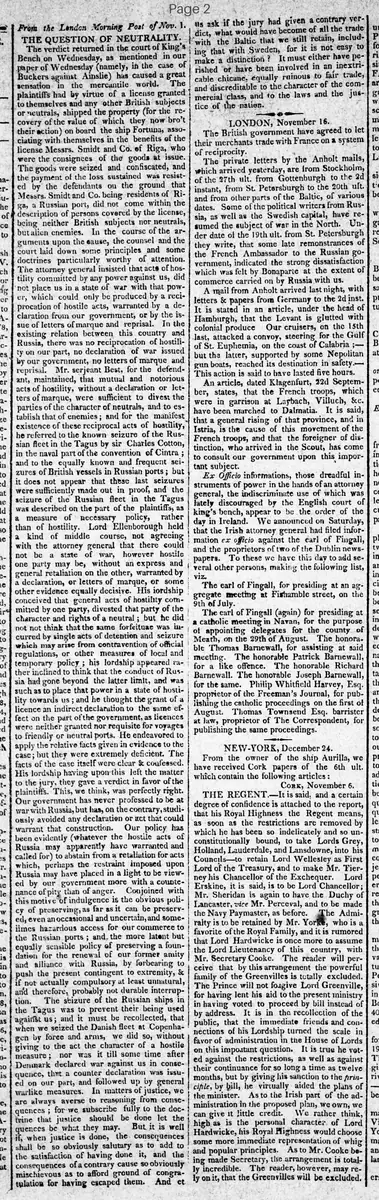
THE QUESTION OF NEUTRALITY.
The verdict returned in the court of King's Bench on Wednesday, as mentioned in our paper of Wednesday (namely, in the case of Buckers against Ainslie) has caused a great sensation in the mercantile world. The plaintiffs had by virtue of a license granted to themselves and any other British subjects or neutrals, shipped the property (for the recovery of the value of which they now bro't their action) on board the ship Fortuna, associating with themselves in the benefits of the license Messrs. Smidt and Co. of Riga, who were the consignees of the goods at issue. The goods were seized and confiscated; and the payment of the loss sustained was resisted by the defendants on the ground that Messrs. Smidt and Co. being residents of Riga, a Russian port, did not come within the description of persons covered by the license, being neither British subjects nor neutrals, but alien enemies. In the course of the arguments upon the cause, the counsel and the court laid down some principles and some doctrines particularly worthy of attention.
The attorney general insisted that acts of hostility committed by any power against us, did not place us in a state of war with that power, which could only be produced by a reciprocation of hostile acts, warranted by a declaration from our government, or by the issue of letters of marque and reprisal. In the existing relation between this country and Russia, there was no reciprocation of hostility on our part, no declaration of war issued by our government, no letters of marque and reprisal. Mr. Serjeant Best, for the defendant, maintained, that mutual and notorious acts of hostility, without a declaration or letters of marque, were sufficient to divest the parties of the character of neutrals, and to establish that of enemies; and for the manifest existence of these reciprocal acts of hostility, he referred to the known seizure of the Russian fleet in the Tagus by sir Charles Cotton, in the naval part of the convention of Cintra; and to the equally known and frequent seizures of British vessels in Russian ports; but it does not appear that these last seizures were sufficiently made out in proof, and the seizure of the Russian fleet in the Tagus was described on the part of the plaintiffs, as a measure of necessary policy, rather than of hostility. Lord Ellenborough held a kind of middle course, not agreeing with the attorney general that there could not be a state of war, however hostile one party may be, without an express and general retaliation on the other, warranted by a declaration, or letters of marque, or some other evidence equally decisive. His lordship conceived that general acts of hostility committed by one party, divested that party of the character and rights of a neutral; but he did not think that the same forfeiture was incurred by single acts of detention and seizure which may arise from contravention of official regulations, or other measures of local and temporary policy; his lordship appeared rather inclined to think that the conduct of Russia had gone beyond the latter limit, and was such as to place that power in a state of hostility towards us; and he thought the grant of a licence an indirect declaration to the same effect on the part of the government, as licences were neither granted nor requisite for voyages to friendly or neutral ports. He endeavored to apply the relative facts given in evidence to the case; but they were extremely deficient. The facts of the case itself were clear & confessed. His lordship having upon this left the matter to the jury, they gave a verdict in favor of the plaintiffs. This, we think, was perfectly right.
Our government has never professed to be at war with Russia, but has, on the contrary, studiously avoided any declaration or act that could warrant that construction. Our policy has been evidently (whatever the hostile acts of Russia may apparently have warranted and called for) to abstain from a retaliation for acts which, perhaps the restraint imposed upon Russia may have placed in a light to be viewed by our government more with a countenance of pity than of anger. Conjoined with this motive of indulgence is the obvious policy of preserving, as far as it can be preserved, even an occasional and uncertain, and sometimes hazardous access for our commerce to the Russian ports; and the more latent but equally sensible policy of preserving a foundation for the renewal of our former amity and alliance with Russia, by forbearing to push the present contingent to extremity, & if not actually compulsory at least unnatural, and therefore, probably not durable interruption. The seizure of the Russian ships in the Tagus was to prevent their being used against us; and it must be recollected, that when we seized the Danish fleet at Copenhagen by force and arms, we did so, without giving to the act the character of a hostile measure; nor was it till some time after Denmark declared war against us in consequence, that a counter declaration was issued on our part, and followed up by general warlike measures. In matters of justice, we are always averse to reasoning from consequences; for we subscribe fully to the doctrine that justice should be done let the consequences be what they may. But it is well if, when justice is done, the consequences shall be so obviously salutary as to add to the satisfaction of having done it, and the consequences of a contrary course so obviously mischievous as to afford ground of congratulation for having escaped them. And let us ask if the jury had given a contrary verdict, what would have become of all the trade with the Baltic that we still retain, including that with Sweden, for it is not easy to make a distinction? It must either have perished or have been involved in an inextricable chicane, equally ruinous to fair trade, and discreditable to the character of the commercial class, and to the laws and the justice of the nation.
What sub-type of article is it?
What keywords are associated?
What entities or persons were involved?
Where did it happen?
Foreign News Details
Primary Location
Russia
Event Date
Wednesday Before November 1
Key Persons
Outcome
verdict in favor of the plaintiffs
Event Details
The court examined whether Britain and Russia were at war, given seizures of vessels and the Russian fleet in the Tagus. The license covered British subjects and neutrals, but defendants claimed Smidt and Co. of Riga were alien enemies. Arguments debated if hostile acts without declaration constituted war. Jury ruled for plaintiffs, affirming neutrality and protecting trade.