Thank you for visiting SNEWPapers!
Sign up free
The Indianapolis Leader
Indianapolis, Marion County, Indiana
What is this article about?
Historical sketch of the Oneida Community, founded by John Humphrey Noyes in 1848, detailing its Perfectionist beliefs, communal practices including shared property and regulated relations, and connection to assassin Charles Guiteau's depravity. Community declined after Noyes' death.
Merged-components note: Section title 'COMMUNITY' merged with following story on the Oneida Community and John Humphrey Noyes, as the title introduces the focused narrative.
Clipping
OCR Quality
Full Text
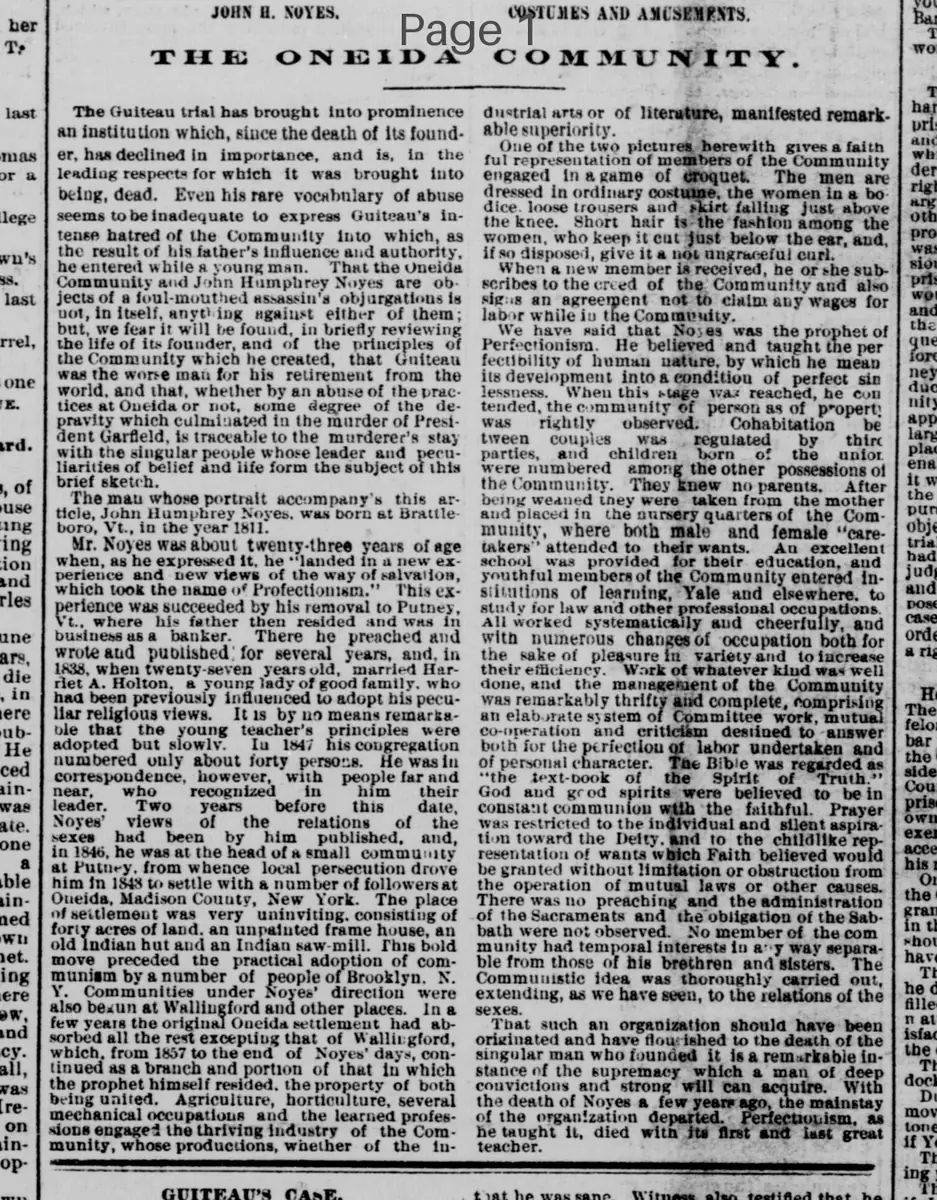
The Guiteau trial has brought into prominence an institution which, since the death of its founder, has declined in importance, and is, in the leading respects for which it was brought into being, dead. Even his rare vocabulary of abuse seems to be inadequate to express Guiteau's intense hatred of the Community into which, as the result of his father's influence and authority, he entered while a young man. That the Oneida Community and John Humphrey Noyes are objects of a foul-mouthed assassin's objurgations is not, in itself, anything against either of them; but, we fear it will be found, in briefly reviewing the life of its founder, and of the principles of the Community which he created, that Guiteau was the worse man for his retirement from the world, and that, whether by an abuse of the practices at Oneida or not, some degree of the depravity which culminated in the murder of President Garfield, is traceable to the murderer's stay with the singular people whose leader and peculiarities of belief and life form the subject of this brief sketch.
The man whose portrait accompanies this article, John Humphrey Noyes, was born at Brattleboro, Vt., in the year 1811.
Mr. Noyes was about twenty-three years of age when, as he expressed it, he "landed in a new experience and new views of the way of salvation, which took the name of Perfectionism." This experience was succeeded by his removal to Putney, Vt., where his father then resided and was in business as a banker.
There he preached and wrote and published; for several years, and, in 1838, when twenty-seven years old, married Harriet A. Holton, a young lady of good family, who had been previously influenced to adopt his peculiar religious views.
It is by no means remarkable that the young teacher's principles were adopted but slowly.
In 1847 his congregation numbered only about forty persons. He was in correspondence, however, with people far and near, who recognized in him their leader.
Two years before this date, Noyes' views of the relations of the sexes had been by him published, and, in 1846, he was at the head of a small community at Putney, from whence local persecution drove him in 1848 to settle with a number of followers at Oneida, Madison County, New York. The place of settlement was very uninviting, consisting of forty acres of land, an unpainted frame house, an old Indian hut and an Indian saw-mill. This bold move preceded the practical adoption of communism by a number of people of Brooklyn, N. Y. Communities under Noyes' direction were also begun at Wallingford and other places. In a few years the original Oneida settlement had absorbed all the rest excepting that of Wallingford, which, from 1857 to the end of Noyes' days, continued as a branch and portion of that in which the prophet himself resided, the property of both being united. Agriculture, horticulture, several mechanical occupations and the learned professions engaged the thriving industry of the Community, whose productions, whether of the industrial arts or of literature, manifested remarkable superiority.
One of the two pictures herewith gives a faithful representation of members of the Community engaged in a game of croquet. The men are dressed in ordinary costume, the women in a Bloomer-like costume, loose trousers and skirt falling just above the knee. Short hair is the fashion among the women, who keep it cut just below the ear, and, if so disposed, give it a not ungraceful curl.
When a new member is received, he or she subscribes to the creed of the Community and also signs an agreement not to claim any wages for labor while in the Community.
We have said that Noyes was the prophet of Perfectionism. He believed and taught the perfectibility of human nature, by which he meant its development into a condition of perfect sinlessness. When this stage was reached, he contended, the community of person as of property was rightly observed. Cohabitation between couples was regulated by third parties, and children born of the union were numbered among the other possessions of the Community. They knew no parents. After being weaned they were taken from the mother and placed in the nursery quarters of the Community, where both male and female "care-takers" attended to their wants.
An excellent school was provided for their education, and youthful members of the Community entered institutions of learning, Yale and elsewhere, to study for law and other professional occupations.
All worked systematically and cheerfully, and with numerous changes of occupation both for the sake of pleasure in variety and to increase their efficiency. Work of whatever kind was well done, and the management of the Community was remarkably thrifty and complete, comprising an elaborate system of Committee work, mutual co-operation and criticism designed to answer both for the perfection of labor undertaken and of personal character. The Bible was regarded as the text-book of the Spirit of Truth."
God and good spirits were believed to be in constant communion with the faithful. Prayer was restricted to the individual and silent aspiration toward the Deity, and to the childlike representation of wants which Faith believed would be granted without limitation or obstruction from the operation of natural laws or other causes.
There was no preaching and the administration of the Sacraments and the obligation of the Sabbath were not observed. No member of the community had temporal interests in any way separable from those of his brethren and sisters. The Communistic idea was thoroughly carried out, extending, as we have seen, to the relations of the sexes.
That such an organization should have been originated and have flourished to the death of the singular man who founded it is a remarkable instance of the supremacy which a man of deep convictions and strong will can acquire. With the death of Noyes a few years ago, the mainstay of the organization departed. Perfectionism, as he taught it, died with its first and last great teacher.
What sub-type of article is it?
What themes does it cover?
What keywords are associated?
What entities or persons were involved?
Where did it happen?
Story Details
Key Persons
Location
Oneida, Madison County, New York
Event Date
1811
Story Details
John Humphrey Noyes founded the Oneida Community based on Perfectionism, advocating communal property and regulated sexual relations. Guiteau, influenced by his time there, developed hatred leading to Garfield's assassination. The community thrived until Noyes' death.