Thank you for visiting SNEWPapers!
Sign up free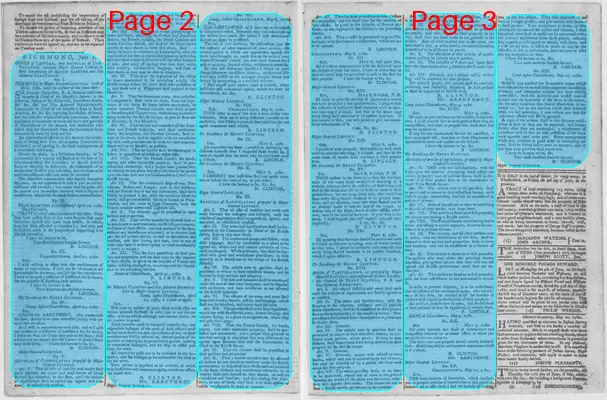
The Virginia Gazette
Richmond, Williamsburg, Richmond County, Virginia
What is this article about?
Historical correspondence and articles of capitulation between American Major General Benjamin Lincoln and British commanders Sir Henry Clinton and Vice Admiral Arbuthnot, detailing negotiations leading to the surrender of Charleston, South Carolina, in May 1780 during the Revolutionary War.
Merged-components note: Continuation of the story detailing the letters and articles of capitulation for Charlestown across pages.
Clippings
1 of 2
OCR Quality
Full Text
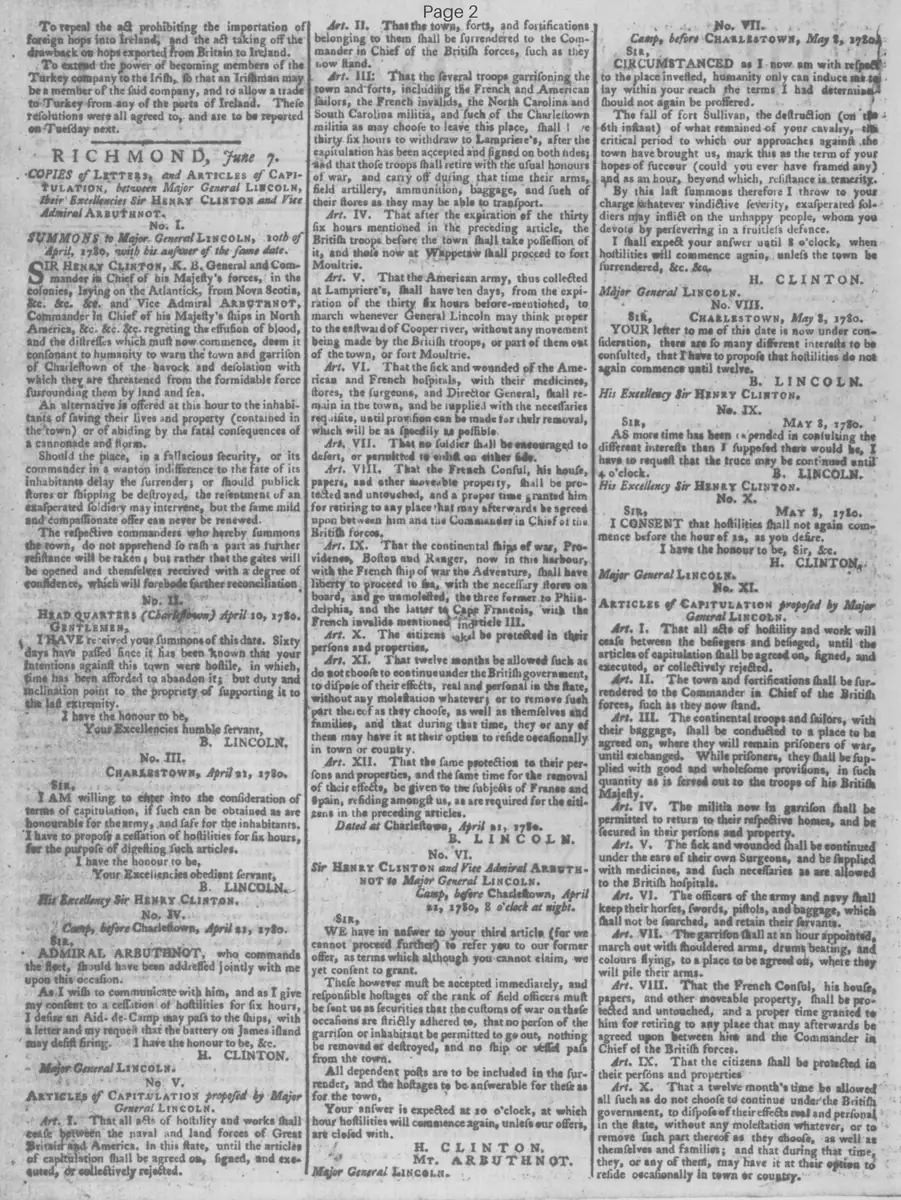
COPIES of LETTERS and Articles of CAPITULATION, between Major General LINCOLN, their Excellencies Sir HENRY CLINTON and Vice Admiral ARBUTHNOT
No. I.
SUMMONS to Major General LINCOLN, 20th of April, 1780, with his answer of the same date.
SIR HENRY CLINTON, K. B. General and Commander in Chief of his Majesty's forces, in the colonies lying on the Atlantick, from Nova Scotia, &c. &c. &c. and Vice Admiral ARBUTHNOT, Commander in Chief of his Majesty's ships in North America, &c. &c. &c. regretting the effusion of blood, and the distresses which must now commence, deem it consonant to humanity to warn the town and garrison of Charlestown of the havoc and desolation with which they are threatened from the formidable force surrounding them by land and sea.
An alternative is offered at this hour to the inhabitants of saving their lives and property (contained in the town) or of abiding by the fatal consequences of a cannonade and storm.
Should the place, in a fallacious security, or its commander in a wanton indifference to the fate of its inhabitants delay the surrender; or should public stores or shipping be destroyed, the resentment of an exasperated soldiery may intervene, but the same mild and compassionate offer can never be renewed.
The respective commanders who hereby summons the town, do not apprehend so rash a part as further resistance will be taken but rather that the gates will be opened and themselves received with a degree of confidence, which will forebode further reconciliation.
No. II.
HEAD QUARTERS, Charlestown, April 10, 1780.
GENTLEMEN,
I have received your summons of this date. Sixty days have passed since it has been known that your intentions against this town were hostile, in which time has been afforded to abandon it; but duty and inclination point to the propriety of supporting it to the last extremity.
I have the honour to be,
Your Excellencies humble servant,
B. LINCOLN.
No. III.
CHARLESTOWN, April 21, 1780.
SIR,
I am willing to enter into the consideration of terms of capitulation, if such can be obtained as are honourable for the army, and safe for the inhabitants.
I have to propose a cessation of hostilities for six hours, for the purpose of digesting such articles.
I have the honour to be,
Your Excellency's obedient servant,
B. LINCOLN.
His Excellency Sir Henry Clinton.
No. IV.
Camp, before Charlestown, April 21, 1780.
SIR,
ADMIRAL ARBUTHNOT, who commands the fleet, should have been addressed jointly with me upon this occasion.
As I wish to communicate with him, and as I give my consent to a cessation of hostilities for six hours, I desire an Aid-de-Camp may pass to the ships, with a letter and my request that the battery on James Island may desist firing. I have the honour to be, &c.
H. CLINTON.
Major General LINCOLN.
No. V.
ARTICLES of CAPITULATION proposed by Major General LINCOLN.
Art. I. That all acts of hostility and works shall cease between the naval and land forces of Great Britain and America, in this state, until the articles of capitulation shall be agreed on, signed, and executed, or collectively rejected.
Art. II. That the town, forts, and fortifications belonging to them shall be surrendered to the Commander in Chief of the British forces, such as they now stand.
Art. III. That the several troops garrisoning the town and forts, including the French and American sailors, the French invalids, the North Carolina and South Carolina militia, and such of the Charlestown militia as may choose to leave this place, shall have thirty six hours to withdraw to Lampriere's, after the capitulation has been accepted and signed on both sides; and that those troops shall retire with the usual honours of war, and carry off during that time their arms, field artillery, ammunition, baggage, and such of their stores as they may be able to transport.
Art. IV. That after the expiration of the thirty six hours mentioned in the preceding article, the British troops before the town shall take possession of it, and those now at Wappetaw shall proceed to Fort Moultrie.
Art. V. That the American army, thus collected at Lampriere's, shall have ten days, from the expiration of the thirty six hours before-mentioned, to march whenever General Lincoln may think proper to the eastward of Cooper river, without any movement being made by the British troops, or part of them out of the town, or Fort Moultrie.
Art. VI. That the sick and wounded of the American and French hospitals, with their medicines, stores, the Surgeons, and Director General, shall remain in the town, and be supplied with the necessaries requisite, until provision can be made for their removal, which will be as speedily as possible.
Art. VII. That no soldier shall be encouraged to desert, or permitted to enlist on either side.
Art. VIII. That the French Consul, his house, papers, and other moveable property, shall be protected and untouched, and a proper time granted him for retiring to any place that may afterwards be agreed upon between him and the Commander in Chief of the British forces.
Art. IX. That the continental ships of war, Providence, Boston and Ranger, now in this harbour, with the French Ship of war the Adventure, shall have liberty to proceed to sea, with the necessary stores on board, and go unmolested, the three former to Philadelphia, and the latter to Cape Francois, with the French invalids mentioned in Article III.
Art. X. The citizens shall be protected in their persons and properties.
Art. XI. That twelve months be allowed such as do not choose to continue under the British government, to dispose of their effects, real and personal in the state, without any molestation whatever; or to remove such part thereof as they choose, as well as themselves and families, and that during that time, they or any of them may have it at their option to reside occasionally in town or country.
Art. XII. That the same protection to their persons and properties, and the same time for the removal of their effects, be given to the subjects of France and Spain, residing amongst us, as are required for the citizens in the preceding articles.
Dated at Charlestown, April 21, 1780.
B. LINCOLN.
No. VI.
Sir Henry Clinton and Vice Admiral ARBUTHNOT to Major General LINCOLN.
Camp, before Charlestown, April 21, 1780, 8 o'clock at night.
SIR,
We have in answer to your third article (for we cannot proceed further) to refer you to our former offer, as terms which although you cannot claim, we yet consent to grant.
These however must be accepted immediately, and responsible hostages of the rank of field officers must be sent us as securities that the customs of war on these occasions are strictly adhered to, that no person of the garrison or inhabitant be permitted to go out, nothing be removed or destroyed, and no ship or vessel pass from the town.
All dependent posts are to be included in the surrender, and the hostages to be answerable for these as for the town.
Your answer is expected at 10 o'clock, at which hour hostilities will commence again, unless our offers are closed with.
H. CLINTON.
M. ARBUTHNOT.
Major General LINCOLN.
No. VII.
Camp, before CHARLESTOWN, May 8, 1780.
SIR,
CIRCUMSTANCED as I now am with respect to the place invested, humanity only can induce me to lay within your reach the terms I had determined should not again be proffered.
The fall of Fort Sullivan, the destruction (on the 6th instant) of what remained of your cavalry, the critical period to which our approaches against the town have brought us, mark this as the term of your hopes of succour (could you ever have framed any) and as an hour, beyond which, resistance is temerity.
By this last summons therefore I throw to your charge whatever vindictive severity, exasperated soldiers may inflict on the unhappy people, whom you devote by persevering in a fruitless defence.
I shall expect your answer until 8 o'clock, when hostilities will commence again, unless the town be surrendered, &c. &c.
H. CLINTON.
Major General LINCOLN.
No. VIII.
SIR,
CHARLESTOWN, May 8, 1780.
Your letter to me of this date is now under consideration, there are so many different interests to be consulted, that I have to propose that hostilities do not again commence until twelve.
B. LINCOLN.
His Excellency Sir Henry Clinton.
No. IX.
SIR,
MAY 8, 1780.
As more time has been expended in consulting the different interests than I supposed there would be, I have to request that the truce may be continued until 4 o'clock.
B. LINCOLN.
His Excellency Sir Henry CLINTON.
No. X.
SIR,
May 8, 1780.
I CONSENT that hostilities shall not again commence before the hour of 4, as you desire.
I have the honour to be, Sir, &c.
H. CLINTON.
Major General LINCOLN.
No. XI.
ARTICLES of CAPITULATION proposed by Major General LINCOLN.
Art. I. That all acts of hostility and work will cease between the besiegers and besieged, until the articles of capitulation shall be agreed on, signed, and executed, or collectively rejected.
Art. II. The town and fortifications shall be surrendered to the Commander in Chief of the British forces, such as they now stand.
Art. III. The continental troops and sailors, with their baggage, shall be conducted to a place to be agreed on, where they will remain prisoners of war, until exchanged. While prisoners, they shall be supplied with good and wholesome provisions, in such quantity as is served out to the troops of his British Majesty.
Art. IV. The militia now in garrison shall be permitted to return to their respective homes, and be secured in their persons and property.
Art. V. The sick and wounded shall be continued under the care of their own Surgeons, and be supplied with medicines, and such necessaries as are allowed to the British hospitals.
Art. VI. The officers of the army and navy shall keep their horses, swords, pistols, and baggage, which shall not be searched, and retain their servants.
Art. VII. The garrison shall at an hour appointed, march out with shouldered arms, drums beating, and colours flying, to a place to be agreed on, where they will pile their arms.
Art. VIII. That the French Consul, his house, papers, and other moveable property, shall be protected and untouched, and a proper time granted him for retiring to any place that may afterwards be agreed upon between him and the Commander in Chief of the British forces.
Art. IX. That the citizens shall be protected in their persons and properties.
Art. X. That a twelve month's time be allowed all such as do not choose to continue under the British government, to dispose of their effects real and personal in the state, without any molestation whatever, or to remove such part thereof as they choose, as well as themselves and families; and that during that time, they, or any of them, may have it at their option to reside occasionally in town or country.
Art. XI. That the same protection to their persons and properties, and the same time for the removal of their effects, be given to the subjects of France and Spain, as are required for the citizens in the preceding articles.
Art. XII. That a vessel be permitted to go to Philadelphia with the General's despatches, which are not to be opened.
B. LINCOLN.
CHARLESTOWN, May 8, 1780.
No. XII.
Sir,
May 8, half after five.
As I wish to communicate with the Admiral upon the subject of your last letter, I have to desire that an Aid-de-camp may be permitted to pass to the fleet for that purpose.
I have the honour to be, &c.
H. CLINTON.
Major General Lincoln.
No. XIII.
SIR,
May 8, 6 o'clock, P. M.
In order to give the articles of capitulation which you have proposed a due consideration, I propose that the cessation of hostilities shall continue until to-morrow morning 8 o'clock, and that in the mean time every thing shall continue in its present situation. If you accede to this, you will please to give me immediate information of it.
I am, Sir, &c.
H. CLINTON.
Major General Lincoln.
No. XIV.
Sir,
May 8, 1780.
I accede to your proposal, that hostilities shall cease until to-morrow morning, 8 o'clock, and that in the mean time all works shall continue in their present state.
B. LINCOLN.
His Excellency Sir Henry Clinton.
No. XV.
SIR,
May 8, 8 o'clock, P. M.
Your answer to my letter proposing the continuation of the truce until to-morrow morning at 8 clock, only accedes to the cessation of hostilities, and that in the mean time all works shall continue in their present state; but my proposition was, that until that time every thing should continue in its present situation; and my meaning was, that there should not be an attempt made to remove any of the troops, or destroy any of the ships, stores or other effects whatever, now in the town or harbour. If your idea is the same, I must request you will express yourself more explicitly.
I am, Sir, &c.
H. CLINTON.
No. XVI.
Sir,
May 8, 1780.
In agreeing that the truce should be continued until 8 o'clock to-morrow morning, and all works remain as they were, I meant to accede to your proposal that every thing should continue in its present situation, which I again assent to.
B. LINCOLN.
His Excellency Sir Henry Clinton.
No. XVII.
Articles of Capitulation, as proposed by Major General Lincoln, and answered by their Excellencies General Sir Henry Clinton, K. B. and Vice Admiral Arbuthnot.
Art. I. All acts of hostility and work shall cease until the articles of capitulation are finally agreed to or rejected.
Art. II. The town and fortifications, with the shipping on the wharves, artillery, and all publick stores whatsoever, shall be surrendered in their present fate to the commanders of the investing forces. Proper officers shall attend from the respective departments to receive them.
Art. III. Granted.
Art. IV. The militia now in garrison shall be permitted to return to their respective homes, as prisoners upon parole; which parole, so long as they observe, shall secure them from being molested in their property by the British troops.
Art. V. Granted.
Art. VI. Granted; except with respect to their horses, which will not be allowed to go out of town, but may be disposed of by a person left from each corps for that purpose.
Art. VII. The whole garrison shall, at an hour to be appointed, march out of town to the ground between the works of the place and the canal, where they will deposit their arms. The drums are not to beat a British march, or colours to be uncased.
Art. VIII. Agreed; with this restriction, that he is to consider himself as a prisoner on parole.
Art. IX. All civil officers, and the citizens who have borne arms during the siege, must be prisoners on parole; and with respect to their property in the city, shall have the same terms as are granted to the militia. And all other persons now in the town, not described in this, or other article, are notwithstanding understood to be prisoners on parole.
Art. X. The discussion of this article, of course, cannot possibly be entered into at present.
Art. XI. The subjects of France and Spain shall have the same terms as are granted to the French Consul.
Art. XII. Granted; and a proper vessel, with a flag, will be provided for that purpose.
All publick papers and records must be carefully preserved, and faithfully delivered, to such persons as shall be appointed to receive them.
H. CLINTON.
M. ARBUTHNOT.
Camp before Charlestown, May 9, 1780.
No. XVIII.
SIR,
May 9, 1780.
In reply to your answers on the articles of capitulation, I must remark that in their present state they are inadmissible, and have to propose that those now sent may be acceded to.
If any further explanation should be necessary, I have to propose also, that two or three Gentlemen be appointed to meet and confer on the subject.
I have the honour to be, &c.
B. LINCOLN.
His Excellency Sir Henry Clinton.
Alterations of articles of capitulation, proposed by Major General Lincoln.
Art. II. The town and fortifications, with the shipping at the wharves (excepting those which are private property) and all publick stores, shall be surrendered in their present state to the commander in chief of the British forces.
Art. IV. The militia now in the garrison, shall be permitted to return to their respective homes, with their baggage, unmolested, and not be considered as prisoners of war.
Art. VI. Such of the officers as may be unwilling to dispose of their horses, may keep them.
Art. VII. This article to stand as at first proposed, the drums not beating a British march.
Art. VIII. The French Consul never having borne arms, and acting in a civil capacity, is not to be considered as a prisoner of war.
Art. IX. The citizens, and all other persons now in town, who are inhabitants of this state, shall be secured in their persons and properties, both in town and country, and not be considered as prisoners of war.
Art. X. This article to stand as at first proposed. The persons who may claim the privilege therein expressed, giving their parole that they will not act against the British government until they are exchanged.
Art. XI. This article to stand as at first proposed, with the same restrictions as are mentioned in article X.
In order to prevent disputes, it is to be understood, that all officers of the continental army, who are citizens of this state, be entitled to all the benefits of citizens with regard to the security of their property.
All publick records now in town, will be delivered to such persons as may be appointed to receive them.
B. LINCOLN.
DONE at Charlestown, May 9, 1780.
No. XIX.
SIR,
May 9, 1780.
No other motives but those of forbearance and compassion induced us to renew offers of terms you certainly had no claim to.
The alterations you propose are all utterly inadmissible. Hostilities will in consequence commence afresh at 8 o'clock.
H. CLINTON,
M. ARBUTHNOT.
Major General Lincoln.
No. XX.
Charlestown, May 11, 1780.
SIR,
The same motives of humanity, which inclined you to propose articles of capitulation to this garrison, induced me to offer those I had the honour of sending you on the 8th instant. They then appeared to me such as I might proffer, and you receive with honour to both parties. Your exceptions to them, as they principally concerned the militia and citizens, I then conceived were such as could not be concurred with but a recent application from those people, wherein they express a willingness to comply with them, and a wish on my part to lessen as much as may be the distresses of war to individuals, lead me now to offer you my acceptance of them.
I have the honour to be, Sir,
Your most obedient humble servant,
B. LINCOLN.
No. XXI.
Camp before Charlestown, May 11, 1780.
SIR,
When you rejected the favourable terms which were dictated by an earnest desire to prevent the effusion of blood, and interposed articles that were wholly inadmissible, both the Admiral and myself were of opinion that the surrender of the town at discretion, was the only condition that should afterwards be attended to; but as the motives which then induced them, are still prevalent, I now inform you that the terms then offered will still be granted.
A copy of the articles shall be sent for your ratification as soon as they can be prepared, and immediately after they are exchanged, a detachment of grenadiers will be sent to take possession of the horn work opposite your main gate. Every arrangement which may conduce to good order in occupying the town, shall be settled before noon to-morrow, and at that time your garrison shall march out.
I have the honour to be, Sir,
Your most obedient humble servant,
H. CLINTON.
Major General Lincoln.
What sub-type of article is it?
What themes does it cover?
What keywords are associated?
What entities or persons were involved?
Where did it happen?
Story Details
Key Persons
Location
Charlestown
Event Date
April May 1780
Story Details
Series of summonses, refusals, truces, and proposed articles of capitulation exchanged between American commander Lincoln and British commanders Clinton and Arbuthnot, culminating in the surrender of the town, garrison, and fortifications after a prolonged siege.