Thank you for visiting SNEWPapers!
Sign up free
Literary
May 30, 1817
The Rhode Island American, And General Advertiser
Providence, Providence County, Rhode Island
What is this article about?
This philosophical essay critiques ambition's corrupting influence and the need for discreet truthfulness. It reflects on Solomon's proverb about the heart knowing its own bitterness, arguing that personal pains and experiences are uniquely intimate, hard to convey, fostering calls for empathy, candor, and acceptance of one's burdens under divine equity.
Merged-components note: These two components continue seamlessly as a single prose essay on truth, discretion, and human sympathy, forming one coherent literary piece.
Clipping
OCR Quality
95%
Excellent
Full Text
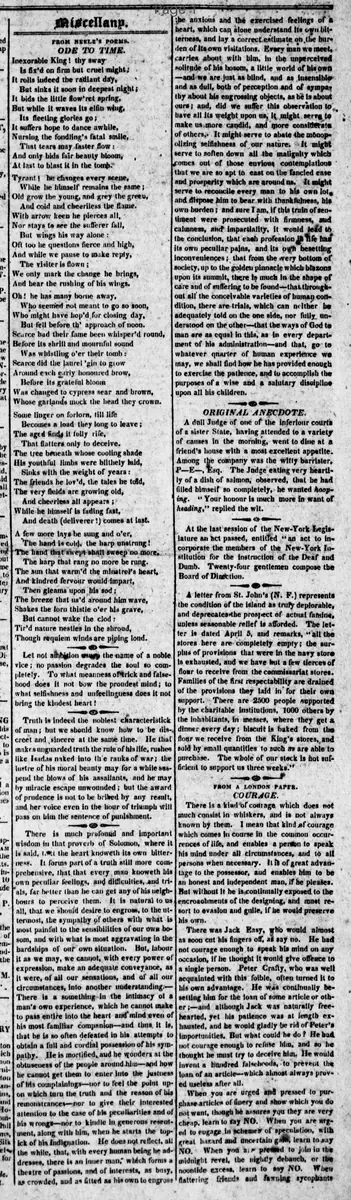
Let not ambition usurp the name of a noble vice; no passion degrades the soul so completely. To what meanness of trick and falsehood does it not bow the proudest mind; to what selfishness and unfeelingness does it not bring the kindest heart!
Truth is indeed the noblest characteristic of man; but we should know how to be discreet and sincere at the same time. He that makes unguarded truth the rule of his life, rushes like Isadas naked into the ranks of war; the lustre of his moral beauty may for a while suspend the blows of his assailants, and he may by miracle escape unwounded; but the award of prudence is not to be bribed by any result, and her voice even in the hour of triumph will pass on him the sentence of punishment.
There is much profound and important wisdom in that proverb of Solomon, where it is said, that the heart knoweth its own bitterness. It forms part of a truth still more comprehensive, that every man knoweth his own peculiar feelings, and difficulties, and trials, far better than he can get any of his neighbours to perceive them. It is natural to us all, that we should desire to engross, to the utmost, the sympathy of others with what is most painful to the sensibilities of our own bosom, and with what is most aggravating in the hardships of our own situation. But, labour it as we may, we cannot, with every power of expression, make an adequate conveyance, as it were, of all our sensations, and of all our circumstances, into another understanding.—There is a something in the intimacy of a man's own experience, which he cannot make to pass entire into the heart and mind even of his most familiar companion—and thus, it is, that he is so often defeated in his attempts to obtain a full and cordial possession of his sympathy. He is mortified, and he wonders at the obtuseness of the people around him—and how he cannot get them to enter into the justness of his complaining—for to feel the point upon which turn the truth and the reason of his remonstrances—nor to give their interested attention to the case of his peculiarities and of his wrongs—nor to kindle in generous resentment, along with him, when he starts the topic of his indignation. He does not reflect, all the while, that, with every human being he addresses, there is an "inner man," which forms a theatre of passions, and of interests, as busy, as crowded, and as fitted as his own to engross the anxious and the exercised feelings of a heart, which can alone understand its own bitterness, and lay a correct estimate on the burden of its own visitations. Every man we meet, carries about with him, in the unperceived solitude of his bosom, a little world of his own—and we are just as blind, and as insensible and as dull, both of perception and of sympathy about his engrossing objects, as he is about ours; and, did we suffer this observation to have all its weight upon us, it might serve to make us more candid, and more considerate of others. It might serve to abate the monopolizing selfishness of our nature. It might serve to soften down all the malignity which comes out of those envious contemplations that we are so apt to cast on the fancied ease and prosperity which are around us. It might serve to reconcile every man to his own lot, and dispose him to bear with thankfulness, his own burden; and sure I am, if this train of sentiment were prosecuted with firmness, and calmness, and impartiality, it would lead to the conclusion, that each profession of life has its own peculiar pains, and its own besetting inconveniences; that from the very bottom of society, up to the golden pinnacle which blazons upon its summit, there is much in the shape of care and of suffering to be found—that throughout all the conceivable varieties of human condition, there are trials, which can neither be adequately told on the one side, nor fully understood on the other—that the ways of God to man are as equal in this, as in every department of his administration—and that, go to whatever quarter of human experience we may, we shall find how he has provided enough to exercise the patience, and to accomplish the purposes of a wise and a salutary discipline upon all his children.
Truth is indeed the noblest characteristic of man; but we should know how to be discreet and sincere at the same time. He that makes unguarded truth the rule of his life, rushes like Isadas naked into the ranks of war; the lustre of his moral beauty may for a while suspend the blows of his assailants, and he may by miracle escape unwounded; but the award of prudence is not to be bribed by any result, and her voice even in the hour of triumph will pass on him the sentence of punishment.
There is much profound and important wisdom in that proverb of Solomon, where it is said, that the heart knoweth its own bitterness. It forms part of a truth still more comprehensive, that every man knoweth his own peculiar feelings, and difficulties, and trials, far better than he can get any of his neighbours to perceive them. It is natural to us all, that we should desire to engross, to the utmost, the sympathy of others with what is most painful to the sensibilities of our own bosom, and with what is most aggravating in the hardships of our own situation. But, labour it as we may, we cannot, with every power of expression, make an adequate conveyance, as it were, of all our sensations, and of all our circumstances, into another understanding.—There is a something in the intimacy of a man's own experience, which he cannot make to pass entire into the heart and mind even of his most familiar companion—and thus, it is, that he is so often defeated in his attempts to obtain a full and cordial possession of his sympathy. He is mortified, and he wonders at the obtuseness of the people around him—and how he cannot get them to enter into the justness of his complaining—for to feel the point upon which turn the truth and the reason of his remonstrances—nor to give their interested attention to the case of his peculiarities and of his wrongs—nor to kindle in generous resentment, along with him, when he starts the topic of his indignation. He does not reflect, all the while, that, with every human being he addresses, there is an "inner man," which forms a theatre of passions, and of interests, as busy, as crowded, and as fitted as his own to engross the anxious and the exercised feelings of a heart, which can alone understand its own bitterness, and lay a correct estimate on the burden of its own visitations. Every man we meet, carries about with him, in the unperceived solitude of his bosom, a little world of his own—and we are just as blind, and as insensible and as dull, both of perception and of sympathy about his engrossing objects, as he is about ours; and, did we suffer this observation to have all its weight upon us, it might serve to make us more candid, and more considerate of others. It might serve to abate the monopolizing selfishness of our nature. It might serve to soften down all the malignity which comes out of those envious contemplations that we are so apt to cast on the fancied ease and prosperity which are around us. It might serve to reconcile every man to his own lot, and dispose him to bear with thankfulness, his own burden; and sure I am, if this train of sentiment were prosecuted with firmness, and calmness, and impartiality, it would lead to the conclusion, that each profession of life has its own peculiar pains, and its own besetting inconveniences; that from the very bottom of society, up to the golden pinnacle which blazons upon its summit, there is much in the shape of care and of suffering to be found—that throughout all the conceivable varieties of human condition, there are trials, which can neither be adequately told on the one side, nor fully understood on the other—that the ways of God to man are as equal in this, as in every department of his administration—and that, go to whatever quarter of human experience we may, we shall find how he has provided enough to exercise the patience, and to accomplish the purposes of a wise and a salutary discipline upon all his children.
What sub-type of article is it?
Essay
What themes does it cover?
Moral Virtue
Religious
What keywords are associated?
Ambition
Truth
Discretion
Solomon Proverb
Personal Bitterness
Empathy
Human Suffering
Moral Wisdom
Literary Details
Subject
On The Proverb That The Heart Knoweth Its Own Bitterness
Key Lines
Let Not Ambition Usurp The Name Of A Noble Vice; No Passion Degrades The Soul So Completely.
Truth Is Indeed The Noblest Characteristic Of Man; But We Should Know How To Be Discreet And Sincere At The Same Time.
There Is Much Profound And Important Wisdom In That Proverb Of Solomon, Where It Is Said, That The Heart Knoweth Its Own Bitterness.
Every Man We Meet, Carries About With Him, In The Unperceived Solitude Of His Bosom, A Little World Of His Own.
That The Ways Of God To Man Are As Equal In This, As In Every Department Of His Administration