Thank you for visiting SNEWPapers!
Sign up free
The North Carolina Standard
Raleigh, Wake County, North Carolina
What is this article about?
North Carolina newspaper praises John C. Calhoun's March 5, 1850, speech on slavery, highlighting its defense of Southern rights, call for constitutional amendment against Northern hostility, and critique of California's statehood process. Discusses Foote's dissent and hopes for resolution with Webster's input.
Clipping
OCR Quality
Full Text
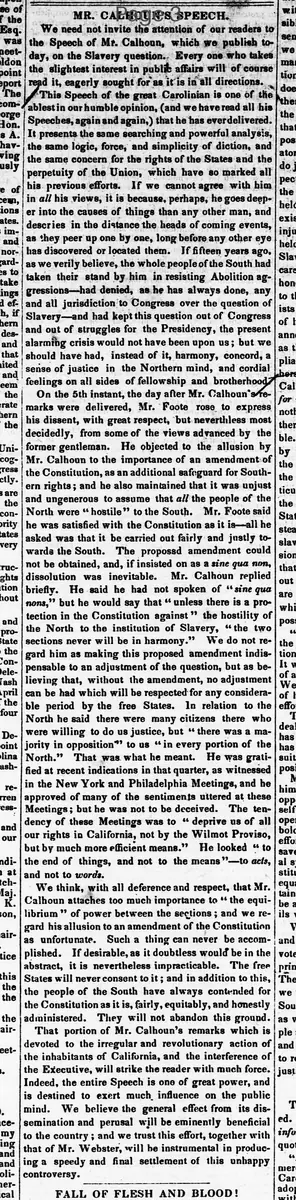
MR. CALHOUN'S SPEECH.
We need not invite the attention of our readers to the Speech of Mr. Calhoun, which we publish to-day, on the Slavery question. Every one who takes the slightest interest in public affairs will of course read it, eagerly sought for as it is in all directions. This Speech of the great Carolinian is one of the ablest, in our humble opinion, (and we have read all his Speeches, again and again,) that he has ever delivered. It presents the same searching and powerful analysis, the same logic, force, and simplicity of diction, and the same concern for the rights of the States and the perpetuity of the Union, which have so marked all his previous efforts. If we cannot agree with him in all his views, it is because, perhaps, he goes deeper into the causes of things than any other man, and descries in the distance the heads of coming events, as they peer up one by one, long before any other eye has discovered or located them. If fifteen years ago, as we verily believe, the whole people of the South had taken their stand by him in resisting Abolition aggressions—had denied, as he has always done, any and all jurisdiction to Congress over the question of Slavery—and had kept this question out of Congress and out of struggles for the Presidency, the present alarming crisis would not have been upon us; but we should have had, instead of it, harmony, concord, a sense of justice in the Northern mind, and cordial feelings on all sides of fellowship and brotherhood. On the 5th instant, the day after Mr. Calhoun's remarks were delivered, Mr. Foote rose to express his dissent, with great respect, but nevertheless most decidedly, from some of the views advanced by the former gentleman. He objected to the allusion by Mr. Calhoun to the importance of an amendment of the Constitution, as an additional safeguard for Southern rights; and he also maintained that it was unjust and ungenerous to assume that all the people of the North were "hostile" to the South. Mr. Foote said he was satisfied with the Constitution as it is—all he asked was that it be carried out fairly and justly towards the South. The proposed amendment could not be obtained, and, if insisted on as a sine qua non, dissolution was inevitable. Mr. Calhoun replied briefly. He said he had not spoken of "sine qua nons," but he would say that "unless there is a protection in the Constitution against the hostility of the North to the institution of Slavery," the two sections never will be in harmony. We do not regard him as making this proposed amendment indispensable to an adjustment of the question, but as believing that, without the amendment, no adjustment can be had which will be respected for any considerable period by the free States. In relation to the North he said there were many citizens there who were willing to do us justice, but "there was a majority in opposition" to us "in every portion of the North." That was what he meant. He was gratified at recent indications in that quarter, as witnessed in the New York and Philadelphia Meetings, and he approved of many of the sentiments uttered at these Meetings: but he was not to be deceived. The tendency of these Meetings was to "deprive us of all our rights in California, not by the Wilmot Proviso, but by much more efficient means." He looked "to the end of things, and not to the means"—to acts, and not to words. We think, with all deference and respect, that Mr. Calhoun attaches too much importance to "the equilibrium" of power between the sections; and we regard his allusion to an amendment of the Constitution as unfortunate. Such a thing can never be accomplished. If desirable, as it doubtless would be in the abstract, it is nevertheless impracticable. The free States will never consent to it; and in addition to this, the people of the South have always contended for the Constitution as it is, fairly, equitably, and honestly administered. They will not abandon this ground. That portion of Mr. Calhoun's remarks which is devoted to the irregular and revolutionary action of the inhabitants of California, and the interference of the Executive, will strike the reader with much force. Indeed, the entire Speech is one of great power, and is destined to exert much influence on the public mind. We believe the general effect from its dissemination and perusal will be eminently beneficial to the country; and we trust this effort, together with that of Mr. Webster, will be instrumental in producing a speedy and final settlement of this unhappy controversy.
What sub-type of article is it?
What themes does it cover?
What keywords are associated?
What entities or persons were involved?
Where did it happen?
Story Details
Key Persons
Location
Raleigh
Event Date
1850 03 05
Story Details
Newspaper editorial praises Calhoun's speech on slavery defending Southern rights and proposing constitutional amendment against Northern hostility; notes Foote's dissent favoring enforcement of existing Constitution; anticipates beneficial influence alongside Webster's efforts for resolution.