Thank you for visiting SNEWPapers!
Sign up free
The Weekly Arizona Miner
Prescott, Yavapai County, Arizona
What is this article about?
A group travels by wagon from Prescott through Arizona Territory to ranches along Lynx and Agua Fria creeks, observing improved farms and vast fertile valleys while recalling recent Apache attacks on settlers and praising pioneers' resilience against Indian threats.
Clipping
OCR Quality
Full Text
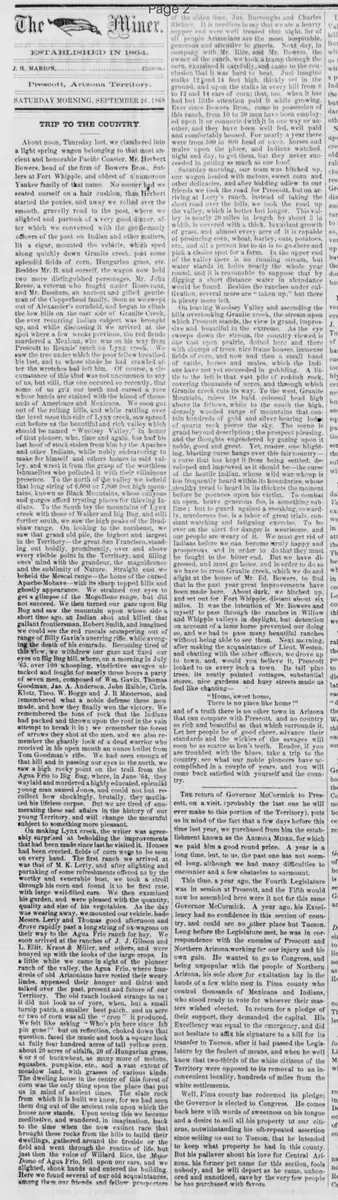
About noon, Thursday last, we clambered into a light spring wagon belonging to that most ancient and honorable Pacific Coaster, Mr. Herbert Bowers, head of the firm of Bowers Bros., Sutlers at Fort Whipple, and oldest of a numerous Yankee family of that name. No sooner had we seated ourselves on a hair cushion, than Herbert started the ponies, and away we rolled over the smooth, gravelly road to the post, where we alighted and partook of a very good dinner. After which we conversed with the gentlemanly officers of the post on Indian and other matters, lit a cigar, mounted the vehicle, which sped along quickly down Granite creek, past some splendid fields of corn, Hungarian grass, etc.
Besides Mr. B. and ourselves, the wagon now held two more distinguished personages, Mr. John Reese, a veteran who fought under Rosecrans, and Mr. Bassham, an ancient and gifted gentleman of the Copperhead family. Soon as we swept out of Alexander's cornfield, and began to climb the low hills on the east side of Granite Creek, the ever recurring Indian subject was brought up, and while discussing it we arrived at the spot where a few weeks previous, the red fiends murdered a Mexican, who was on his way from Prescott to Reamis' ranch on Lynx creek. We saw the tree under which the poor fellow breathed his last, and to whose shade he had crawled after the wretches had left him. Of course, a circumstance of this kind was not uncommon to any of us, but still, this one occurred so recently, that some of us grit our teeth and cursed a race whose hands are stained with the blood of thousands of Americans and Mexicans. We soon got out of the rolling hills, and while rattling over the level mesa this side of Lynx creek, saw spread out before us the beautiful and rich valley which should be named "Woolsey Valley," in honor of that pioneer, who, time and again, has had his last hoof of stock stolen from him by the Apaches and other Indians, while nobly endeavoring to make for himself and others homes in said valley, and wrest it from the grasp of the worthless Ishmaelites who polluted it with their villainous presence. To the north of the valley we beheld that long string of 6,000 or 7,000 feet high mountains, known as Black Mountains, whose canyons and gorges afford trysting places for thieving Indians. To the South lay the mountains of Lynx creek with those of Walker and Big Bug, and still further south, we saw the high peaks of the Bradshaw range. On looking to the northeast, we saw that grand old pile, the highest and largest in the Territory—the great San Francisco, standing out boldly, prominently, over and above every visible point in the Territory, and filling one's mind with the grandeur, the magnificence and the sublimity of Nature. Straight east we beheld the Mescal range—the home of the cursed Apache-Mohave with its sharp topped hills and ghostly appearance. We strained our eyes to get a glimpse of the Mogollon range, but did not succeed. We then turned our gaze upon Big Bug and saw the mountain upon whose side a short time ago, an Indian shot and killed that gallant frontiersman, Robert Smith, and imagined we could see the red rascals scampering out of range of Billy Gavin's unerring rifle, while avenging the death of his comrade. Becoming tired of this view, we withdrew our gaze and fixed our eyes on Big Bug hill, where, on a morning in July '65, over 100 whooping, vindictive savages attacked and fought for nearly three hours a party of seven men, composed of Wm. Gavin, Thomas Goodman, Jas. A. Anderson, John Raible, Chris. Klotz, Theo. W. Boggs and J. R. Masterson, and remembered what a noble defense these men made, and how they finally won the victory. We remembered the tons of rock that the Indians had packed and thrown upon the roof in the vain attempt to break it in; we remember the forest of arrows they shot at the men, and we also remember the ghastly look of a dead warrior who received in his open mouth an ounce bullet from Tom Goodman's rifle. We had seen enough of that hill and in passing our eyes to the north, we saw a high rocky point on the trail from the Agua Fria to Big Bug, where, in June '64, they waylaid and murdered a highly educated, splendid young man named Jones, and could not but recollect how shockingly, brutally, they mutilated his lifeless corpse. But we are tired of enumerating these sad affairs in the history of our young Territory, and will change the mournful subject to something more pleasant.
On making Lynx creek, the writer was agreeably surprised at beholding the improvements that had been made since last he visited it. Houses had been erected, fields of corn were to be seen on every hand. The first ranch we arrived at was that of M. K. Lerty, and after alighting and partaking of some refreshments offered us by the worthy and venerable host, we took a stroll through his corn and found it to be first rate, with large well-filled ears. We then examined his garden, and were pleased with the quantity, quality and size of his vegetables. As the day was wearing away, we mounted our vehicle, bade Messrs. Lerty and Thomas good afternoon and drove rapidly past a long string of ox-wagons on their way to the Agua Fria ranch for hay. We soon arrived at the ranches of J. J. Gibson and L. Ellicott, Kraus & Miller, and others, and were buoyed up with the looks of the large crops. In a little while we came in sight of the pioneer ranch of the valley, the Agua Fria, where hundreds of old Arizonians have rested their weary limbs, appeased their hunger and thirst and talked over the past, present and future of our Territory. The old ranch looked strange to us; it did not look as of yore, when, but a small turnip patch, a smaller beet patch, and an acre or two of corn was all the "crop" it produced. We felt like asking "Who's been here since I's been gone?" but on reflection, choked down that question, faced the music and took a square look at fully four hundred acres of tall yellow corn, about 20 acres of alfalfa, 20 of Hungarian grass, 6 or 8 of buckwheat, as many more of melons, squashes, pumpkins, etc., and a vast extent of meadow land, with grasses of various kinds. The dwelling house in the centre of this forest of corn was the only thing upon the place that put us in mind of ancient times. The slate rock from which it is built we knew, for we had seen them dug out of the ancient ruin upon which the house now stands. Upon seeing this we became meditative, and wandered, in imagination, back to the time when the now extinct race that brought these rocks from the hills to build their dwellings, gathered around the fireside or the field and went through the routine of life, but just then the voice of Willard Rice, the Major Domo of Agua Fria, fell upon our ears, and we alighted, shook hands and entered the building. Here we found several of our old acquaintances, among them our friends and fellow prospectors of the olden time, Jos. Burroughs and Charles Richter. It is needless to say that we ate a hearty supper and were well treated that night, for of all people Arizonians are the most hospitable, generous and attentive to guests. Next day, in company with Mr. Rice, and Mr. Bowers, the owner of the ranch, we took a tramp through the corn, examined it carefully, and came to the conclusion that it was hard to beat. Just imagine stalks 12 and 14 feet high, thickly set in the ground, and upon the stalks in every hill from 6 to 12 and 14 ears of corn; that too, when it has had but little attention paid it while growing. Ever since Bowers Bros., came in possession of this ranch, from 10 to 30 men have been employed upon it or connected with it in one way or another, and they have been well fed, well paid and comfortably housed. For nearly a year there were from 500 to 800 head of oxen, horses and mules upon the place, and Indians watched night and day, to get them, but they never succeeded in getting as much as one hoof.
Saturday morning, our team was hitched up, our wagon loaded with melons, sweet corn and other delicacies, and after bidding adieu to our friends we took the road for Prescott, but on arriving at Lerty's ranch, instead of taking the short road over the hills, we took the road up the valley, which is better but longer. This valley is nearly 20 miles in length by about 3 in width, is covered with a thick, luxuriant growth of grass, and almost every acre of it is capable of producing corn, wheat, barley, oats, potatoes, etc., and all a person has to do is to go there and pick a choice spot for a farm. In the upper end of the valley there is no running stream, but water stands in holes nearly the whole year round, and it is reasonable to suppose that by digging a short distance water in abundance would be found. Besides the ranches under cultivation, several more are "taken up," but there is plenty more left.
On leaving Woolsey Valley and ascending the hills overlooking Granite creek, the stream upon which Prescott stands, the view is grand, impressive and beautiful in the extreme. As the eye sweeps down the stream, the country viewed is one vast open prairie, dotted here and there with clumps of trees, nice frame houses, immense fields of corn, and now and then a small band of cattle, horses and mules, which the Indians have not yet succeeded in gobbling. A little to the left is that vast pile of reddish rock, covering thousands of acres, and through which Granite creek cuts its way. To the west, Granite Mountain, raises its bald, colossal head high above its fellows, while to the south the high, densely wooded range of mountains that contain hundreds of gold and silver-bearing lodes of quartz rock pierce the sky. The scene is grand beyond description; the prospect pleasing, and the thoughts engendered by gazing upon it noble, good and great. Yet, reader, one blighting, blasting curse hangs over this fair country—a curse that has kept it from being settled, developed and improved as it should be—the curse of the hostile Indian, whose wild war-whoop is too frequently heard within its boundaries, whose stealthy tread is heard in its thickets the moment before he pounces upon his victim. To combat an open, brave generous foe, is something sublime; but to guard against a sneaking, cowardly, murderous foe, is a labor of great trials, constant watching and fatiguing exercise. To be ever on the alert for danger is wearisome, and our people are weary of it. We must get rid of Indians before we can become truly happy and prosperous, and in order to do that they must be fought to the bitter end. But we have digressed, and must go home, and in order to do so we have to cross Granite creek, which we do and alight at the house of Mr. Ed. Bowers, to find that in the past year great improvements have been made here. About dark, we hitched up, and set out for Fort Whipple, distant about six miles. It was the intention of Mr. Bowers and myself to pass through the ranches in Willow and Whipple valleys in daylight, but detention on account of a lame horse prevented our doing so, and we had to pass many beautiful ranches without being able to see them. Next morning, after making the acquaintance of Lieut. Weston, and chatting with the other officers, we drove up to town, and, would you believe it, Prescott looked to us every inch a town. Its tall pine trees, its neatly painted cottages, substantial stores, nice gardens and busy streets made us feel like chanting—
"Home, sweet home,
There is no place like home!"
and of a truth there is no other town in Arizona that can compare with Prescott, and no country so rich and beautiful as that which surrounds it. Let her people be of good cheer, advance their standards and the wickets of the savages will soon be as scarce as hen's teeth. Reader, if you are troubled with the blues, take a trip to the country, see what our noble pioneers have accomplished in a couple of years, and you will come back satisfied with yourself and the country.
What sub-type of article is it?
What themes does it cover?
What keywords are associated?
What entities or persons were involved?
Where did it happen?
Story Details
Key Persons
Location
Prescott, Arizona Territory; Granite Creek; Lynx Creek; Woolsey Valley; Agua Fria Ranch; Fort Whipple
Event Date
Thursday Last (Circa 1866); References To July 1865 And June 1864
Story Details
Narrator and companions travel by wagon from Prescott to country ranches, visiting improvements at Lynx Creek and Agua Fria, admiring fertile valleys and crops, while reflecting on past Apache murders and attacks on settlers, and urging elimination of Indian threats to enable prosperity.