Thank you for visiting SNEWPapers!
Sign up free
Editorial
September 17, 1811
Kentucky Gazette
Lexington, Fayette County, Kentucky
What is this article about?
Editorial introduces and republishes first essay by 'An Old American' from Baltimore American, outlining origins of US Republican (pro-liberty) and Federal (pro-aristocratic power) parties, critiquing Federalists' ambitions and deceptive tactics. Dated Aug. 27, 1811.
Clipping
OCR Quality
95%
Excellent
Full Text
"NO PARTY MEN"
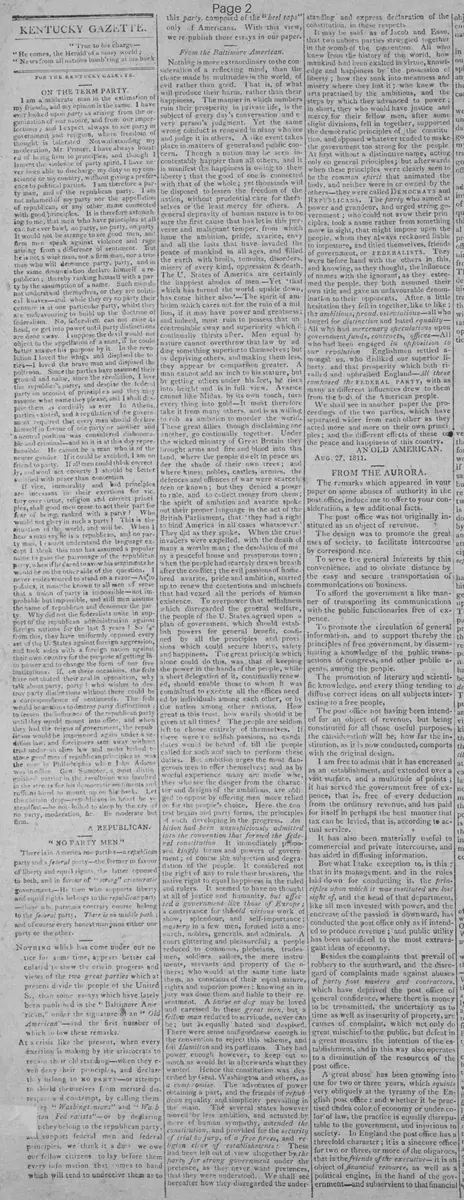
There is in America two parties—a republican party and a federal party—the former in favour of liberty and equal rights, the latter opposed to both, and in favour of "strong" aristocratic government.—He then who supports liberty and equal rights belongs to the republican party—those who pursue a contrary course belong to the federal party. There is no middle path; and of course every honest man joins either one party or the other.
Nothing which has come under our notice for some time, appears better calculated to show the origin progress and views of the two great parties which at present divide the people of the United States, than some essays which have lately been published in the "Baltimore American," under the signature of an "Old American"—and the first number of which to follow these remarks.
At a crisis like the present, when every exertion is making by the aristocrats to regain their old standing—when they even deny their principles, and declare they belong to No party—or attempt to shield themselves from merited disgrace and contempt, by calling themselves "Washingtonians" and "Washington Federalists"—or by declaring that they belong to the republican party, and support federal men and federal principles, we think it a duty we owe our fellow citizens to lay before them every information that comes to hand which will tend to undeceive them as to this party, composed of the "heel taps" only of Americans. With this view, we re-publish those essays in our paper.
from the Baltimore American,
Nothing is more extraordinary to the consideration of a reflecting mind, than the choice made by multitudes in the world, of evil rather than good. That is, of what will produce their harm, rather than their happiness. The manner in which numbers ruin their prosperity in private life, is the subject of every day's conversation and every person's judgment. Yet the same wrong conduct is renewed in many who see and judge it in others. A like event takes place in matters of general and public concern. Though a nation may be seen incontestably happier than all others, and it is manifest the happiness is owing to their liberty; that the good of one is connected with that of the whole; yet thousands will be disposed to lessen the freedom of the nation, without prudential care for themselves or the least mercy for others. A general depravity of human nature is to be sure the first cause that has let in this perverse and malignant temper, from which issue the ambition, pride, avarice, envy and all the lusts that have invaded the peace of mankind in all ages, and filled the earth with broils, tumults, disorders, misery of every kind, oppression & death.
The U. States of America are certainly the happiest abodes of men.—Yet 'that which has turned the world upside down, has come hither also.'—The spirit of ambition which cares not for the ruin of a million, if it may have power and greatness; and indeed, must ruin to possess that uncontrollable sway and superiority which it continually thirsts after. Men equal by nature cannot overthrow that law by adding something superior to themselves; but by depriving others, and making them less, they appear by comparison greater. A man cannot add an inch to his stature, but by getting others under his feet, he rises into height and is in full view. Avarice cannot like Midas, by its own touch, turn every thing into gold—It must therefore take it from many others, and is as willing to rob as ambition to murder the world.
These great allies though disclaiming one another, go continually together. Under the wicked ministry of Great Britain they brought arms and fire and blood into this land, where the people dwelt in peace under the shade of their own trees; and where kings, nobles, castles, arms, the defences and offences of war were scarcely seen or known; but they denied a power to rule, and to collect money from them; the spirit of ambition and avarice spoke out their proper language in the act of the British Parliament, that 'they had a right to bind America in all cases whatsoever.' They did as they spoke. When the cruel invaders were expelled, with the death of many a worthy man; the desolation of many a peaceful house and prosperous town; when the people had scarcely drawn breath after the conflict; the evil passions of home-bred avarice, pride and ambition, started up to renew the contentions and mischiefs that had vexed all the periods of human existence. To overpower that selfishness which disregarded the general welfare, the people of the U. States agreed upon a plan of government, which should establish powers for general benefit, confined by all the principles and provisions which could secure liberty, safety and happiness. The great principle which alone could do this, was that of keeping the power in the hands of the people, while a short delegation of it, continually renewed, should enable those to whom it was committed to execute all the offices needed by individuals among each other, or by the nation among other nations. How great is this trust, how warily should it be given at all times? The people are seldom left to choose entirely of themselves. If there were no selfish passions, no Candidates would be heard of, till the people called for such and such to perform these duties. But ambition urges the most dangerous men to offer themselves; and as by woeful experience many are made wise, they who see the danger from the character and designs of the ambitious, are obliged to oppose by offering men more relied on for the people's choice. Here the contest begins and party forms, the principles of each developing in the progress. Ambition had been suspiciously admitted into the convention that formed the federal constitution. It immediately proposed kingly forms and powers of government; of course the subjection and degradation of the people. It considered not the right of any to rule their brethren, the native right to equal happiness in the ruled and rulers. It seemed to have no thought at all of justice and humanity, but affected a government like those of Europe; a contrivance for the old vicious work of show, splendour, and self-importance; mastery in a few men, formed into a monarch, nobles, generals, and admirals. A court glittering and pleasurable; a people reduced to commons, plebeians, tradesmen, soldiers, sailors, the mere instruments, servants and property of the others: who would at the same time hate them, as conscious of their equal nature, rights and superior power: knowing an injury was done them and liable to their resentment. A horse or dog may be beloved and caressed by these great men, but a fellow man reduced to servitude, never can be; but is equally hated and despised.
There were sense and goodness enough in the convention to reject this scheme, and foil Hamilton and its partizans. They had power enough however, to keep out so much as would let in afterwards what they wanted. Hence the constitution was described by Genl. Washington and others, as a compromise. The advocates of power obtaining a part, and the friends of republican equality and simplicity prevailing in the main. The several states however, moved by less ambition, and actuated by more of human sympathy, amended the constitution, and provided for the security of trial by jury, of a free press, and religion clear of establishments: These had been left out of view altogether by the party for strong government under the pretence, as they never want pretences, that they were understood. We shall see hereafter how they disregarded the understanding and express declaration of the constitution, in these respects.
It may be said as of Jacob and Esau, that two unborn parties struggled together in the womb of the convention. All who knew from the history of the world, how mankind had been exalted in virtue, knowledge and happiness by the possession of liberty; how they sunk into meanness and misery where they lost it: who knew the arts practised by the ambitious, and the steps by which they advanced to power; in short, they who would have justice and mercy for their fellow men, after some slight divisions, fell in together, supported the democratic principles of the Constitution, and opposed whatever tended to make the government too strong for the people. At first without a distinctive name, acting only on general principles; but afterwards when these principles were clearly seen to be the common spirit that animated the body, and neither were in or owned by the others—they were called DEMOCRATS and REPUBLICANS. The party who aimed at power and grandeur, and urged strong government; who could not avow their principles, took a name rather from something more in sight, that might impose upon the people, whom they always reckoned liable to imposture, and titled themselves, friends of government, or FEDERALISTS. They were before hand with the others in this, and knowing, as they thought, the influence of names with the ignorant, as they esteemed the people, they both assumed their own title and gave an unfavourable denomination to their opponents. After a little hesitation they fell in together, like to like; the ambitious, proud, ostentatious—all who longed for distinction and hated equality—All who had mercenary speculations upon government funds, contracts, offices—All who had been engaged in opposition to our revolution—Englishmen settled amongst us, who disliked our superior liberty, and that prosperity which both rivalled and upbraided England—All these composed the FEDERAL PARTY, with as many as different influences drew to them from the body of the American people.
We shall see in another paper the proceedings of the two parties, which have separated wider from each other as they acted more and more on their own principles: and the different effects of these on the peace and happiness of this country.
AN OLD AMERICAN.
AUG. 27, 1811.
There is in America two parties—a republican party and a federal party—the former in favour of liberty and equal rights, the latter opposed to both, and in favour of "strong" aristocratic government.—He then who supports liberty and equal rights belongs to the republican party—those who pursue a contrary course belong to the federal party. There is no middle path; and of course every honest man joins either one party or the other.
Nothing which has come under our notice for some time, appears better calculated to show the origin progress and views of the two great parties which at present divide the people of the United States, than some essays which have lately been published in the "Baltimore American," under the signature of an "Old American"—and the first number of which to follow these remarks.
At a crisis like the present, when every exertion is making by the aristocrats to regain their old standing—when they even deny their principles, and declare they belong to No party—or attempt to shield themselves from merited disgrace and contempt, by calling themselves "Washingtonians" and "Washington Federalists"—or by declaring that they belong to the republican party, and support federal men and federal principles, we think it a duty we owe our fellow citizens to lay before them every information that comes to hand which will tend to undeceive them as to this party, composed of the "heel taps" only of Americans. With this view, we re-publish those essays in our paper.
from the Baltimore American,
Nothing is more extraordinary to the consideration of a reflecting mind, than the choice made by multitudes in the world, of evil rather than good. That is, of what will produce their harm, rather than their happiness. The manner in which numbers ruin their prosperity in private life, is the subject of every day's conversation and every person's judgment. Yet the same wrong conduct is renewed in many who see and judge it in others. A like event takes place in matters of general and public concern. Though a nation may be seen incontestably happier than all others, and it is manifest the happiness is owing to their liberty; that the good of one is connected with that of the whole; yet thousands will be disposed to lessen the freedom of the nation, without prudential care for themselves or the least mercy for others. A general depravity of human nature is to be sure the first cause that has let in this perverse and malignant temper, from which issue the ambition, pride, avarice, envy and all the lusts that have invaded the peace of mankind in all ages, and filled the earth with broils, tumults, disorders, misery of every kind, oppression & death.
The U. States of America are certainly the happiest abodes of men.—Yet 'that which has turned the world upside down, has come hither also.'—The spirit of ambition which cares not for the ruin of a million, if it may have power and greatness; and indeed, must ruin to possess that uncontrollable sway and superiority which it continually thirsts after. Men equal by nature cannot overthrow that law by adding something superior to themselves; but by depriving others, and making them less, they appear by comparison greater. A man cannot add an inch to his stature, but by getting others under his feet, he rises into height and is in full view. Avarice cannot like Midas, by its own touch, turn every thing into gold—It must therefore take it from many others, and is as willing to rob as ambition to murder the world.
These great allies though disclaiming one another, go continually together. Under the wicked ministry of Great Britain they brought arms and fire and blood into this land, where the people dwelt in peace under the shade of their own trees; and where kings, nobles, castles, arms, the defences and offences of war were scarcely seen or known; but they denied a power to rule, and to collect money from them; the spirit of ambition and avarice spoke out their proper language in the act of the British Parliament, that 'they had a right to bind America in all cases whatsoever.' They did as they spoke. When the cruel invaders were expelled, with the death of many a worthy man; the desolation of many a peaceful house and prosperous town; when the people had scarcely drawn breath after the conflict; the evil passions of home-bred avarice, pride and ambition, started up to renew the contentions and mischiefs that had vexed all the periods of human existence. To overpower that selfishness which disregarded the general welfare, the people of the U. States agreed upon a plan of government, which should establish powers for general benefit, confined by all the principles and provisions which could secure liberty, safety and happiness. The great principle which alone could do this, was that of keeping the power in the hands of the people, while a short delegation of it, continually renewed, should enable those to whom it was committed to execute all the offices needed by individuals among each other, or by the nation among other nations. How great is this trust, how warily should it be given at all times? The people are seldom left to choose entirely of themselves. If there were no selfish passions, no Candidates would be heard of, till the people called for such and such to perform these duties. But ambition urges the most dangerous men to offer themselves; and as by woeful experience many are made wise, they who see the danger from the character and designs of the ambitious, are obliged to oppose by offering men more relied on for the people's choice. Here the contest begins and party forms, the principles of each developing in the progress. Ambition had been suspiciously admitted into the convention that formed the federal constitution. It immediately proposed kingly forms and powers of government; of course the subjection and degradation of the people. It considered not the right of any to rule their brethren, the native right to equal happiness in the ruled and rulers. It seemed to have no thought at all of justice and humanity, but affected a government like those of Europe; a contrivance for the old vicious work of show, splendour, and self-importance; mastery in a few men, formed into a monarch, nobles, generals, and admirals. A court glittering and pleasurable; a people reduced to commons, plebeians, tradesmen, soldiers, sailors, the mere instruments, servants and property of the others: who would at the same time hate them, as conscious of their equal nature, rights and superior power: knowing an injury was done them and liable to their resentment. A horse or dog may be beloved and caressed by these great men, but a fellow man reduced to servitude, never can be; but is equally hated and despised.
There were sense and goodness enough in the convention to reject this scheme, and foil Hamilton and its partizans. They had power enough however, to keep out so much as would let in afterwards what they wanted. Hence the constitution was described by Genl. Washington and others, as a compromise. The advocates of power obtaining a part, and the friends of republican equality and simplicity prevailing in the main. The several states however, moved by less ambition, and actuated by more of human sympathy, amended the constitution, and provided for the security of trial by jury, of a free press, and religion clear of establishments: These had been left out of view altogether by the party for strong government under the pretence, as they never want pretences, that they were understood. We shall see hereafter how they disregarded the understanding and express declaration of the constitution, in these respects.
It may be said as of Jacob and Esau, that two unborn parties struggled together in the womb of the convention. All who knew from the history of the world, how mankind had been exalted in virtue, knowledge and happiness by the possession of liberty; how they sunk into meanness and misery where they lost it: who knew the arts practised by the ambitious, and the steps by which they advanced to power; in short, they who would have justice and mercy for their fellow men, after some slight divisions, fell in together, supported the democratic principles of the Constitution, and opposed whatever tended to make the government too strong for the people. At first without a distinctive name, acting only on general principles; but afterwards when these principles were clearly seen to be the common spirit that animated the body, and neither were in or owned by the others—they were called DEMOCRATS and REPUBLICANS. The party who aimed at power and grandeur, and urged strong government; who could not avow their principles, took a name rather from something more in sight, that might impose upon the people, whom they always reckoned liable to imposture, and titled themselves, friends of government, or FEDERALISTS. They were before hand with the others in this, and knowing, as they thought, the influence of names with the ignorant, as they esteemed the people, they both assumed their own title and gave an unfavourable denomination to their opponents. After a little hesitation they fell in together, like to like; the ambitious, proud, ostentatious—all who longed for distinction and hated equality—All who had mercenary speculations upon government funds, contracts, offices—All who had been engaged in opposition to our revolution—Englishmen settled amongst us, who disliked our superior liberty, and that prosperity which both rivalled and upbraided England—All these composed the FEDERAL PARTY, with as many as different influences drew to them from the body of the American people.
We shall see in another paper the proceedings of the two parties, which have separated wider from each other as they acted more and more on their own principles: and the different effects of these on the peace and happiness of this country.
AN OLD AMERICAN.
AUG. 27, 1811.
What sub-type of article is it?
Partisan Politics
What keywords are associated?
Republican Party
Federal Party
Political Parties
Liberty
Ambition
Constitution
Aristocratic Government
Human Depravity
What entities or persons were involved?
An Old American
Baltimore American
Hamilton
Genl. Washington
Republican Party
Federal Party
Editorial Details
Primary Topic
Origins And Principles Of Republican And Federal Parties
Stance / Tone
Strongly Pro Republican Anti Federalist
Key Figures
An Old American
Baltimore American
Hamilton
Genl. Washington
Republican Party
Federal Party
Key Arguments
America Has Two Parties: Republicans For Liberty And Equal Rights, Federalists For Strong Aristocratic Government
No Middle Path; Every Honest Man Joins One Or The Other
Federalists Deny Principles, Call Themselves No Party Or Washingtonians To Deceive
Essay Explains Choice Of Evil Over Good Due To Human Depravity Like Ambition And Avarice
Us Happiest Due To Liberty, But Ambition Seeks To Undermine It
Constitution A Compromise; Republicans Added Amendments For Jury Trial, Free Press, Religion
Parties Formed In Convention: Democrats/Republicans For Equality, Federalists For Power And Grandeur