Thank you for visiting SNEWPapers!
Sign up free
Letter to Editor
April 13, 1867
Springfield Weekly Republican
Springfield, Hampden County, Massachusetts
What is this article about?
A special correspondent from Boston reports on local topics including a debate on prohibition vs. license, efforts to annex Roxbury for expansion and infrastructure, successful Cretan relief efforts, opera performances by Parepa, the winter music scene, art market trends, and critiques of spring goods.
Clipping
OCR Quality
98%
Excellent
Full Text
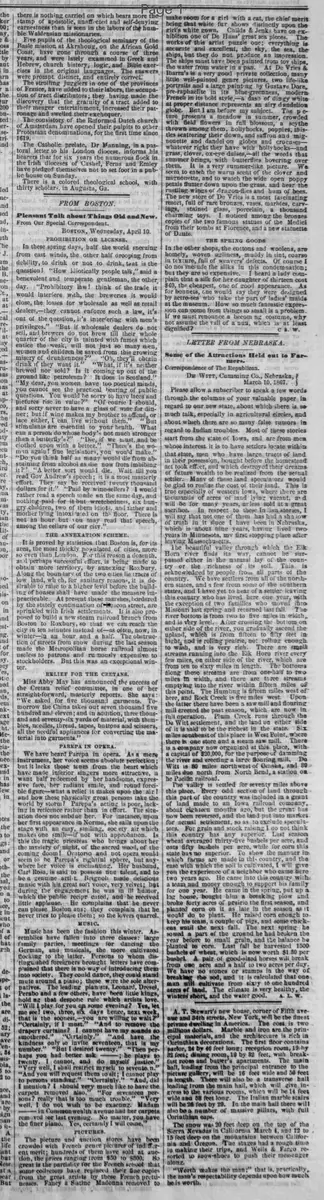
FROM BOSTON.
Pleasant Talk about Things Old and New.
From Our Special Correspondent.
Boston, Wednesday, April 10.
PROHIBITION OR LICENSE.
In these spring days, half the world sneezing from east winds, the other half drooping from debility, to drink or not to drink, that is the question! "How idiotically people talk," said a benevolent and temperate gentleman, the other day. "Prohibitory law! think of the trade it would interfere with, the breweries it would close, the losses for wholesale as well as retail dealers,—they cannot enforce such a law, it's out of the question, it's interfering with men's privileges." "But if wholesale dealers do not sell, and brewers do not brew till their whole quarter of the city is tainted with fumes which entice the weak, will not just so many men, women and children be saved from this growing misery of drunkenness?" "Oh, they'll obtain drink if they want it." "What, if it's neither brewed nor sold? Is it coming up out of the ground like petroleum? It does in Scotland." "My dear, you women have too poetical minds, you cannot see the practical bearing of public questions. You would be sorry to have laces and pictures rise in value?" "Of course I should, and sorry never to have a glass of wine for dinner; but if wine makes my brother to offend, or lace either, I can live without them." "But stimulants are essential to your health. What can a person do whose body's not much stronger than a butterfly's?" "Die, if we must, and be clothed upon with a better." "There's the woman again! fine legislators you would make." "Do you think half as many would die from abstaining from alcohol as die now from imbibing it?" "A better sort would die. Wait till you read Gov. Andrew's speech; it is a most masterly effort. They say he received twenty thousand dollars for it." "Paid by wine-sellers? I would rather read a speech made on the same day, and nothing paid for it but wretchedness, six hungry children, two of them idiots, and father and mother lying intoxicated on the floor. There is not an hour but you may read that speech, among the cellars of our city."
THE ANNEXATION SCHEME.
It is proved by statistics that Boston is, for its area, the most thickly populated of cities, more so even than London. For this reason a dozenth, and perhaps successful effort, is being made to obtain more territory, by annexing Roxbury. Along the boundary of the two cities lie tracts of low land, which, for sanitary reasons, it is desirable to raise to a higher level before the building of houses shall have made the measure impracticable. At present these marshes, bordered by the stately continuation of Beacon street, are sprinkled with Irish settlements. It is also proposed to build a new steam railroad branch from Boston to Roxbury, so that we can reach the city in ten minutes instead of—as often, now, in winter—in an hour and a half. The obstruction of streets from snow during the last season made the Metropolitan horse railroad almost useless to patrons and ruinously expensive to stockholders. But this was an exceptional winter.
RELIEF FOR THE CRETANS.
Miss Abby May has announced the success of the Cretan relief committee, in one of her straight-forward, masterly reports. She says: "We asked for five thousand garments. Tomorrow the China takes out seven thousand five hundred and eleven; and in addition, three thousand and seventy-six yards of material, with thimbles, needles, thread, tapes, buttons and scissors, all the needful appliances for converting the material into garments."
PAREPA IN OPERA.
We have heard Parepa in opera. As a mere instrument, her voice seems absolute perfection; but it lacks those tones from the heart which have made inferior singers more attractive, a want half redeemed by her handsome, expressive face, her radiant smile, and round forcible figure—what a relief it makes upon the air! and how these physically great persons take the world by storm! Parepa's acting is poor, lacking in reticence rather than in effort. The situation does not subdue her. For instance, upon her first appearance in Norma, she sails upon the stage with an easy, sailing, society air which makes one smile if not with approbation. Is this the tragic priestess who brings about her the mystery of night, of the sacred wood, of the coming doom! Oratorio and not opera would seem to be Parepa's rightful sphere, but anywhere her voice is enchanting. Her husband, Carl Rosa, is said to possess fine talent, and to be a genuine artist. Brignoli made delicious music with his great soft voice, very velvet; but during the engagement he was in ill humor which the public reciprocated, and he received little applause. He complains that he never can please Bostonians; they complain that he never tries to please them; so the lovers quarrel.
MUSIC.
Music has been the fashion this winter. Assemblies have fallen into three classes: large family parties, meetings for dancing the German, and musicals, the more cultivated flocking to the latter. Persons to whom distinguished foreigners brought letters have complained that there is no way of introducing them into society. They could dance, they could stand mute around a piano; these were the sole alternatives. The leading pianists, Lehnert, Dresel, Perabo and a few others, have been little kings, holding that despotic rule which artists love. "Will I play for you on some evening? Yes, let me see! two, three, six days hence, next week, that is the soonest,—you are willing to wait?" "Certainly, if I must." "And to remove the drapery curtains? I cannot have my sounds so smothered." "Certainly." "And have the kindness only to invite seventeen, that is my number." "But I desired twenty." "Then perhaps you had better ask —; he plays to twenty. I cannot, and do myself justice." "Very well, I shall restrict myself to seventeen." "And you will request them to sit; I cannot play to persons standing." "Certainly." "And, did I mention? I should very much like to have the carpets removed also." "For seventeen persons? really that is too much trouble." "Very well. I do not wish to be exacting." Madam — in Commonwealth avenue had her carpets removed for last evening. No matter, you have the finer piano. Yes, certainly I will come.
PICTURES.
The picture and auction stores have been crowded with French genre pictures of indifferent merit; hundreds of them have sold at auction, the prices ranging from $50 to $900. So great is the partiality for the French school that some collectors have replaced their Gude copies from the great artists by these French prettinesses. Fancy a Sistine Madonna removed to make room for a girl with a cat, the chief merit being that white fur shows distinctly upon the girl's white gown. Childs & Jenks have on exhibition one of De Haas' great sea pieces. The works of this artist puzzle one; everything is accurate and excellent, the sky, the sea, the ships, but they do not produce an impression. The ships must have been painted from toy ships, the water from water in a pan. At De Vries & Ibarra's is a very good private collection, many little well-painted genre pictures, two life-like portraits and a large painting by Gustave Dore, pre-raphaelite in its blue-greenness, modern French in its bold style,—a dash of dingy white at proper distance represents an airy dandelion globe. But I am before my subject. The picture presents a meadow in summer, crowded with field flowers in full blossom, a scythe thrown among them, hollyhocks, poppies, thistles scattering their down, and saffron and mignonette and dandelion globes and crocuses—whatever right they have with hollyhocks—and grass, clover, ox-eye daisies,—all the weeds that summer brings, with butterflies hovering over them. It is a very summer-like picture. We seem to catch the warm scent of the clover and mignonette, and to watch the wide open poppy petals flutter down upon the grass, and hear the rustling wings of dragon-flies and hum of bees. The new store of De Vries is a most fascinating resort, full of rare bronzes, vases, marbles, Carrara, stained glass, porcelain, a thousand charming toys. I noticed among the bronzes copies of the two famous statues of the Medici from their tombs at Florence, and a new statuette of Dante.
THE SPRING GOODS
In the other shops, the cottons and woolens, are homely, woven ugliness, muddy in tint, coarse in texture, full of weavers' defects. Of course I do not include the silks in this condemnation; but they are so expensive. I heard a lady complain that a silk for her daughter of thirteen cost $40, the cheapest, one of good appearance. As for bonnets, one would say they were designed by actresses who take the part of ladies' maids at the museum. How so much fantastic expression can come from things so small is a problem. If we must renounce a becoming costume, why not assume the veil of a nun, which is at least dignified?
Pleasant Talk about Things Old and New.
From Our Special Correspondent.
Boston, Wednesday, April 10.
PROHIBITION OR LICENSE.
In these spring days, half the world sneezing from east winds, the other half drooping from debility, to drink or not to drink, that is the question! "How idiotically people talk," said a benevolent and temperate gentleman, the other day. "Prohibitory law! think of the trade it would interfere with, the breweries it would close, the losses for wholesale as well as retail dealers,—they cannot enforce such a law, it's out of the question, it's interfering with men's privileges." "But if wholesale dealers do not sell, and brewers do not brew till their whole quarter of the city is tainted with fumes which entice the weak, will not just so many men, women and children be saved from this growing misery of drunkenness?" "Oh, they'll obtain drink if they want it." "What, if it's neither brewed nor sold? Is it coming up out of the ground like petroleum? It does in Scotland." "My dear, you women have too poetical minds, you cannot see the practical bearing of public questions. You would be sorry to have laces and pictures rise in value?" "Of course I should, and sorry never to have a glass of wine for dinner; but if wine makes my brother to offend, or lace either, I can live without them." "But stimulants are essential to your health. What can a person do whose body's not much stronger than a butterfly's?" "Die, if we must, and be clothed upon with a better." "There's the woman again! fine legislators you would make." "Do you think half as many would die from abstaining from alcohol as die now from imbibing it?" "A better sort would die. Wait till you read Gov. Andrew's speech; it is a most masterly effort. They say he received twenty thousand dollars for it." "Paid by wine-sellers? I would rather read a speech made on the same day, and nothing paid for it but wretchedness, six hungry children, two of them idiots, and father and mother lying intoxicated on the floor. There is not an hour but you may read that speech, among the cellars of our city."
THE ANNEXATION SCHEME.
It is proved by statistics that Boston is, for its area, the most thickly populated of cities, more so even than London. For this reason a dozenth, and perhaps successful effort, is being made to obtain more territory, by annexing Roxbury. Along the boundary of the two cities lie tracts of low land, which, for sanitary reasons, it is desirable to raise to a higher level before the building of houses shall have made the measure impracticable. At present these marshes, bordered by the stately continuation of Beacon street, are sprinkled with Irish settlements. It is also proposed to build a new steam railroad branch from Boston to Roxbury, so that we can reach the city in ten minutes instead of—as often, now, in winter—in an hour and a half. The obstruction of streets from snow during the last season made the Metropolitan horse railroad almost useless to patrons and ruinously expensive to stockholders. But this was an exceptional winter.
RELIEF FOR THE CRETANS.
Miss Abby May has announced the success of the Cretan relief committee, in one of her straight-forward, masterly reports. She says: "We asked for five thousand garments. Tomorrow the China takes out seven thousand five hundred and eleven; and in addition, three thousand and seventy-six yards of material, with thimbles, needles, thread, tapes, buttons and scissors, all the needful appliances for converting the material into garments."
PAREPA IN OPERA.
We have heard Parepa in opera. As a mere instrument, her voice seems absolute perfection; but it lacks those tones from the heart which have made inferior singers more attractive, a want half redeemed by her handsome, expressive face, her radiant smile, and round forcible figure—what a relief it makes upon the air! and how these physically great persons take the world by storm! Parepa's acting is poor, lacking in reticence rather than in effort. The situation does not subdue her. For instance, upon her first appearance in Norma, she sails upon the stage with an easy, sailing, society air which makes one smile if not with approbation. Is this the tragic priestess who brings about her the mystery of night, of the sacred wood, of the coming doom! Oratorio and not opera would seem to be Parepa's rightful sphere, but anywhere her voice is enchanting. Her husband, Carl Rosa, is said to possess fine talent, and to be a genuine artist. Brignoli made delicious music with his great soft voice, very velvet; but during the engagement he was in ill humor which the public reciprocated, and he received little applause. He complains that he never can please Bostonians; they complain that he never tries to please them; so the lovers quarrel.
MUSIC.
Music has been the fashion this winter. Assemblies have fallen into three classes: large family parties, meetings for dancing the German, and musicals, the more cultivated flocking to the latter. Persons to whom distinguished foreigners brought letters have complained that there is no way of introducing them into society. They could dance, they could stand mute around a piano; these were the sole alternatives. The leading pianists, Lehnert, Dresel, Perabo and a few others, have been little kings, holding that despotic rule which artists love. "Will I play for you on some evening? Yes, let me see! two, three, six days hence, next week, that is the soonest,—you are willing to wait?" "Certainly, if I must." "And to remove the drapery curtains? I cannot have my sounds so smothered." "Certainly." "And have the kindness only to invite seventeen, that is my number." "But I desired twenty." "Then perhaps you had better ask —; he plays to twenty. I cannot, and do myself justice." "Very well, I shall restrict myself to seventeen." "And you will request them to sit; I cannot play to persons standing." "Certainly." "And, did I mention? I should very much like to have the carpets removed also." "For seventeen persons? really that is too much trouble." "Very well. I do not wish to be exacting." Madam — in Commonwealth avenue had her carpets removed for last evening. No matter, you have the finer piano. Yes, certainly I will come.
PICTURES.
The picture and auction stores have been crowded with French genre pictures of indifferent merit; hundreds of them have sold at auction, the prices ranging from $50 to $900. So great is the partiality for the French school that some collectors have replaced their Gude copies from the great artists by these French prettinesses. Fancy a Sistine Madonna removed to make room for a girl with a cat, the chief merit being that white fur shows distinctly upon the girl's white gown. Childs & Jenks have on exhibition one of De Haas' great sea pieces. The works of this artist puzzle one; everything is accurate and excellent, the sky, the sea, the ships, but they do not produce an impression. The ships must have been painted from toy ships, the water from water in a pan. At De Vries & Ibarra's is a very good private collection, many little well-painted genre pictures, two life-like portraits and a large painting by Gustave Dore, pre-raphaelite in its blue-greenness, modern French in its bold style,—a dash of dingy white at proper distance represents an airy dandelion globe. But I am before my subject. The picture presents a meadow in summer, crowded with field flowers in full blossom, a scythe thrown among them, hollyhocks, poppies, thistles scattering their down, and saffron and mignonette and dandelion globes and crocuses—whatever right they have with hollyhocks—and grass, clover, ox-eye daisies,—all the weeds that summer brings, with butterflies hovering over them. It is a very summer-like picture. We seem to catch the warm scent of the clover and mignonette, and to watch the wide open poppy petals flutter down upon the grass, and hear the rustling wings of dragon-flies and hum of bees. The new store of De Vries is a most fascinating resort, full of rare bronzes, vases, marbles, Carrara, stained glass, porcelain, a thousand charming toys. I noticed among the bronzes copies of the two famous statues of the Medici from their tombs at Florence, and a new statuette of Dante.
THE SPRING GOODS
In the other shops, the cottons and woolens, are homely, woven ugliness, muddy in tint, coarse in texture, full of weavers' defects. Of course I do not include the silks in this condemnation; but they are so expensive. I heard a lady complain that a silk for her daughter of thirteen cost $40, the cheapest, one of good appearance. As for bonnets, one would say they were designed by actresses who take the part of ladies' maids at the museum. How so much fantastic expression can come from things so small is a problem. If we must renounce a becoming costume, why not assume the veil of a nun, which is at least dignified?
What sub-type of article is it?
Informative
Reflective
Social Critique
What themes does it cover?
Temperance
Infrastructure
Social Issues
What keywords are associated?
Prohibition Debate
Boston Annexation
Cretan Relief
Parepa Opera
Boston Music
French Pictures
Spring Fashions
What entities or persons were involved?
Our Special Correspondent
Letter to Editor Details
Author
Our Special Correspondent
Notable Details
Dialogue On Prohibition And Temperance
Annexation Of Roxbury To Boston
Cretan Relief Committee Success
Review Of Parepa In Opera
Winter Music Scene In Boston
Art And Picture Market Observations
Complaints About Spring Goods Quality