Thank you for visiting SNEWPapers!
Sign up free
Republican Herald
Providence, Providence County, Rhode Island
What is this article about?
Article on skating in Norway as vital transport and military tool, detailing a skating regiment and a daring 17th-century French ice assault on Dutch forts during Louis XIV's war, succeeding through surprise amid perilous thawing conditions.
Clipping
OCR Quality
Full Text
From Chambers' Edinburgh Magazine.
THE SKATING REGIMENT.
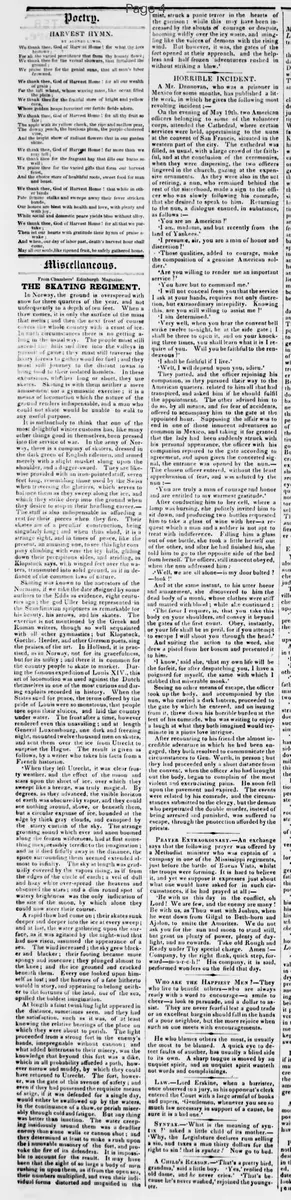
In Norway, the ground is overspread with snow for three quarters of the year, and not unfrequently to a depth of ten feet. When a thaw comes, it is only the surface of the mass that melts; and then the next frost of course covers the whole country with a crust of ice. In such circumstances there is no getting along in the usual way. The people must still ascend the hills and dive into the valleys in pursuit of game; they must still traverse the hoary forests to gather wood for fuel; and they must still journey to the distant towns to bring food to their isolated hamlets. In these excursions, whether long or short, they use skates. Skating is with them neither a mere amusement nor a gymnastic exercise; it is a means of locomotion which the nature of the ground renders indispensable, and a man who could not skate would be unable to walk to any useful purpose. It is melancholy to think that one of the most delightful winter customs has, like many other things good in themselves, been pressed into the service of war. In the army of Norway, there is a company of skaters, dressed in the dark green of English riflemen, and armed merely with a slight musket slung upon the shoulder, and a dagger-sword. They are likewise provided with an iron-pointed staff, seven feet long, resembling those used by the Swiss when traversing the glaciers, which serves to balance them as they sweep along the ice, and which they strike deep into the ground when they desire to stop in their headlong career. The staff is also indispensable as affording a rest for their pieces when they fire. Their skates are of a peculiar construction, being singularly long; and when thus shod, it is a strange sight, and in times of peace, like the present, an amusing one, to see this light company climbing with ease the icy hills, gliding down their precipitous sides, and striding, as Klopstock says, with winged feet over the waters, transmuted into solid ground, as if in defiance of the common laws of nature. Skating was known to the ancestors of the Normans, if we take the date assigned by some authors to the Edda as evidence, eight centuries ago; the god Uller being represented in the Scandinavian scriptures as remarkable for his beauty, his arrows, and his skates. The exercise is not mentioned by the Greek and Roman writers, though so well acquainted with all other gymnastics; but Klopstock, Goethe, Herder, and other German poets, sing the praises of the art. In Holland, it is practised, as in Norway, not for its gracefulness, but for its utility; and there it is common for the country people to skate to market. During the famous expedition of Louis XIV., this art of locomotion was used against the Dutch themselves in one of the most curious and daring exploits recorded in history. When the States sued for peace, the terms offered by the pride of Louis were so monstrous, that people tore open their sluices, and laid the country under water. The frost after a time, however rendered even this unavailing; and at length General Luxembourg, one dark and freezing night, mounted twelve thousand men on skates, and sent them over the ice from Utrecht to surprise the Hague. The result is given as follows, by a writer who takes his facts from a French historian. When they left Utrecht, it was clear frosty weather, and the effect of the moon and stars upon the sheet of ice, over which they swept like a breeze, was truly magical. By degrees, as they advanced, the visible horizon of earth was obscured by vapor, and they could see nothing around, above, or beneath them, but a circular expanse of ice, bounded at the edge by thick gray clouds, and canopied by the starry curtain of the sky. The strange groaning sound which ever and anon boomed along the frozen wilderness, had at first something inexpressibly terrific to the imagination; and as it died fitfully away in the distance, the space surrounding them seemed extended almost to infinity. The sky at length was gradually covered by the vapors rising, as if from the edges of the circle of earth; a veil of dull and hazy white over-spread the heavens and obscured the stars; and a dim round spot of watery brightness was the only indication of the site of the moon, by which alone they could now steer their course. A rapid thaw had come on; their skates sunk deeper and deeper into the ice at every sweep; and at last, the water gathering upon the surface, as it was agitated by the night-wind that had now risen, assumed the appearance of a sea. The wind increased; the sky grew blacker and blacker; their footing became more spongy and insecure; they plunged almost to the knee; and the ice groaned and cracked beneath them. Every one looked upon himself as lost; and the horrors of a fate hitherto untold in story, and appearing to belong neither to the fortunes of the land, nor of the sea, appalled the boldest imagination. At length a faint twinkling light appeared in the distance, sometimes seen and they had the satisfaction, such as it was, of at least knowing the relative bearings of the place on which they were about to perish. The light proceeded from a strong fort in the enemy's hands, impregnable without cannon; and what added bitterness to their misery, was the knowledge that beyond this fort was a dike, which in all probability afforded a path, however narrow and muddy, by which they could have returned to Utrecht. The fort, however, was the gate of this avenue of safety; and even if they had possessed the requisite means of siege, if it was defended for a single day, would either be swallowed up by the waters, in the continuance of a thaw, or perish miserably through cold and fatigue. But any thing was better than inaction. The water creeping insidiously around them was a deadlier enemy than stone walls or cannon shot; and they determined at least to make a rush upon the immovable masonry of the fort, and provoke the fire of its defenders. It is impossible to account for the result. It may have been that the sight of so large a body of men rushing in upon them, as if from the open sea, their numbers multiplied, and even their individual forms distorted and magnified in the mist, struck a panic terror in the hearts of the garrison: while this may have been increased by the shouts of courage or despair, booming wildly over the icy waste, and mingling like the voices of demons with the rising wind. But however it was, the gates of the fort opened at their approach, and the helpless and half frozen adventurers rushed in without striking a blow.
What sub-type of article is it?
What themes does it cover?
What keywords are associated?
What entities or persons were involved?
Where did it happen?
Story Details
Key Persons
Location
Norway; Utrecht To The Hague
Event Date
During The Expedition Of Louis Xiv
Story Details
Description of skating as essential locomotion in snowy Norway, including a military skating company; historical use in war, exemplified by General Luxembourg's 12,000 men skating over frozen Dutch lands to surprise the Hague during Louis XIV's expedition, entering a fort without resistance amid thawing ice and panic.