Thank you for visiting SNEWPapers!
Sign up free
Story
December 4, 1931
The Independent
Elizabeth City, Pasquotank County, North Carolina
What is this article about?
North Carolina Supreme Court Justice Brogden rules that driving faster than visibility allows in fog, rain, or mist constitutes negligence, emphasizing safety amid rising highway accidents.
Clipping
OCR Quality
98%
Excellent
Full Text
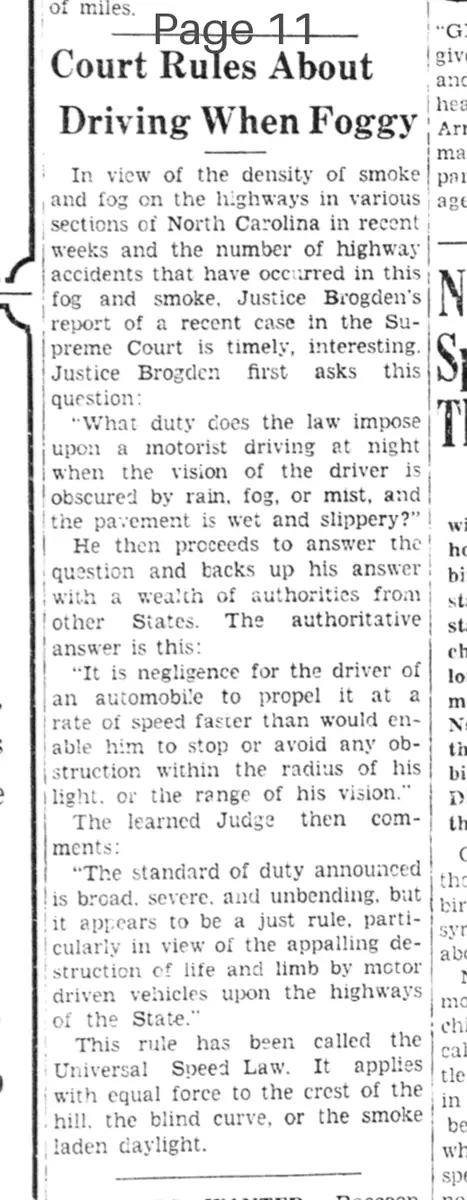
Court Rules About Driving When Foggy
In view of the density of smoke and fog on the highways in various sections of North Carolina in recent weeks and the number of highway accidents that have occurred in this fog and smoke, Justice Brogden's report of a recent case in the Supreme Court is timely, interesting.
Justice Brogden first asks this question:
"What duty does the law impose upon a motorist driving at night when the vision of the driver is obscured by rain, fog, or mist, and the pavement is wet and slippery?"
He then proceeds to answer the question and backs up his answer with a wealth of authorities from other States. The authoritative answer is this:
"It is negligence for the driver of an automobile to propel it at a rate of speed faster than would enable him to stop or avoid any obstruction within the radius of his light, or the range of his vision."
The learned Judge then comments:
"The standard of duty announced is broad, severe, and unbending, but it appears to be a just rule, particularly in view of the appalling destruction of life and limb by motor driven vehicles upon the highways of the State."
This rule has been called the Universal Speed Law. It applies with equal force to the crest of the hill, the blind curve, or the smoke laden daylight.
In view of the density of smoke and fog on the highways in various sections of North Carolina in recent weeks and the number of highway accidents that have occurred in this fog and smoke, Justice Brogden's report of a recent case in the Supreme Court is timely, interesting.
Justice Brogden first asks this question:
"What duty does the law impose upon a motorist driving at night when the vision of the driver is obscured by rain, fog, or mist, and the pavement is wet and slippery?"
He then proceeds to answer the question and backs up his answer with a wealth of authorities from other States. The authoritative answer is this:
"It is negligence for the driver of an automobile to propel it at a rate of speed faster than would enable him to stop or avoid any obstruction within the radius of his light, or the range of his vision."
The learned Judge then comments:
"The standard of duty announced is broad, severe, and unbending, but it appears to be a just rule, particularly in view of the appalling destruction of life and limb by motor driven vehicles upon the highways of the State."
This rule has been called the Universal Speed Law. It applies with equal force to the crest of the hill, the blind curve, or the smoke laden daylight.
What sub-type of article is it?
Historical Event
Curiosity
What themes does it cover?
Justice
Misfortune
Moral Virtue
What keywords are associated?
Driving Negligence
Fog Accidents
Supreme Court Ruling
Highway Safety
Visibility Speed Limit
What entities or persons were involved?
Justice Brogden
Where did it happen?
Highways In North Carolina
Story Details
Key Persons
Justice Brogden
Location
Highways In North Carolina
Story Details
Justice Brogden addresses the duty of motorists in obscured visibility, ruling it negligence to drive faster than can stop within vision range, supported by authorities and applied universally including in fog and smoke.