Thank you for visiting SNEWPapers!
Sign up free
Morning Star
Limerick, York County, Maine
What is this article about?
Correspondence from Washington, D.C., dated January 14, 1856, reports on the House of Representatives' failed night session to elect a Speaker, political maneuvers by Democrats and others, candidates' responses to questions, criticism of President Pierce, local weather, and a detailed account of Rev. Mr. Arthur's Sabbath sermon in the Capitol emphasizing loving God as the highest duty.
Clipping
OCR Quality
Full Text
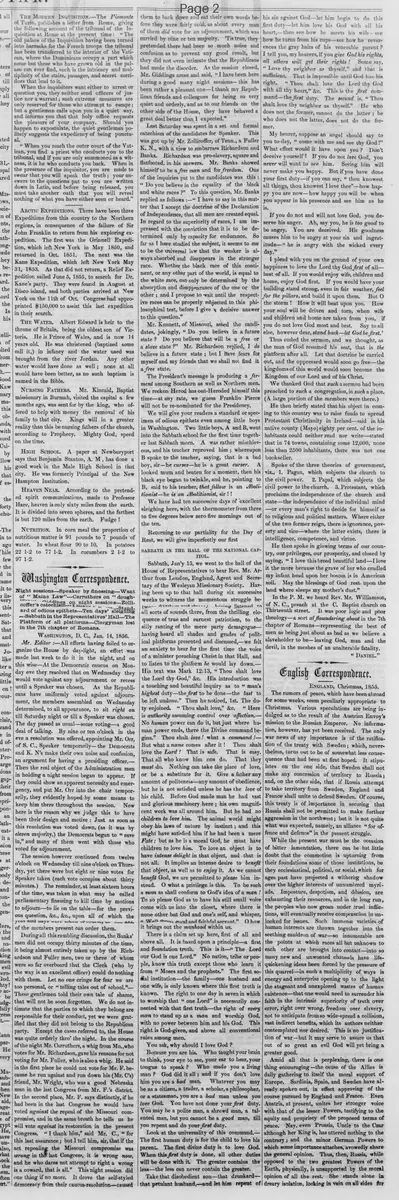
Night sessions—Speaker by finessing—Want of "Maine Law".—Carruthers on "dough coffer's" proceedings and of odious epithets—Ten days' sleighing on all snow—Sabbath in the Representatives' Hall.—The Platform of all platforms—Clergyman lost in the 7th chapter of Romans.
WASHINGTON, D. C., Jan. 14, 1856.
Mr. Editor:—All efforts having failed to organize the House by day-light, an effort was made last week to do it in the night, and on this wise—At the Democratic caucus on Monday eve they resolved that on Wednesday they would vote against any adjournment or recess until a Speaker was chosen. As the Republicans have uniformly voted against adjournment, the members assembled on Wednesday determined, to all appearance, to sit right on till Saturday night or till a Speaker was chosen.
The day passed as usual—some voting—a good deal of talking. By nine or ten o'clock in the eve a resolution was offered, appointing Mr. Orr, of S. C., Speaker temporarily—the Democrats and K. N's make their own noise and confusion, an argument for having a presiding officer.— Then the real object of the Administration men in holding a night session began to appear. If they could show an apparent necessity and emergency, and put Mr. Orr into the chair temporarily, they evidently hoped by some means to keep him there throughout the session. Now here is the reason why we judge this to have been their design and motive: Just as soon as this resolution was voted down, (as it was by eleven majority,) the Democrats began to "cave in," and many of them went with those who voted for adjournment.
The session however continued from twelve o'clock on Wednesday till nine o'clock on Thursday, yet there were but eight or nine votes for Speaker taken (each vote occupies about thirty minutes.) The remainder, at least sixteen hours of the time, was taken in what may be called parliamentary finessing to kill time by motions to adjourn—to lie on the table—for the previous question, &c., &c., upon all of which the yeas and nays were called of course as a matter of courtesy to any five of the members present can order them.
During all this rambling discussion, the Banks men did not occupy thirty minutes of the time, it being almost entirely taken up by the Richardson and Fuller men, two or three of whom were so far overboard that the Clerk (who by the way is an excellent officer) could do nothing with them. Let no one cringe for fear we are too personal, or "telling tales out of school." These gentlemen told their own tale of shame, that will not be soon forgotten. We do not intimate that the parties to which they belong are responsible for their conduct, yet we were gratified that they did not belong to the Republican party. Except the cases referred to, the House was quite orderly thro' the night. In the course of the night Mr. Carruthers, a whig from Mo., who votes for Mr. Richardson, gave his reasons for not voting for Mr. Fuller, who is also a whig. He said in the first place he could not vote for Mr. F. because he run against and run down his (Mr. C's) friend, Mr. Wright, who was a good Nebraska man in the last Congress from Mr. F.'s district.
In the second place, Mr. F. says distinctly, if he had been in the last Congress he would have voted against the repeal of the Missouri compromise, and in the same breath he tells us he will vote against its restoration in the present Congress. "I thank him," said Mr. C., "for this last assurance; but I tell him, sir, that if the act repealing the Missouri compromise was wrong in the last Congress, it is wrong now, and he who dares not attempt to right a wrong is a coward, that is all." This night session did one thing if no more. It drove the self-styled democracy from their caucus-resolutions—caused them to back down and eat their own words before they were fairly cold, as about every man of them did vote for an adjournment, which was carried by nine or ten majority. "Tis true, they pretended there had been so much noise and confusion as to prevent any good result, but they did not even intimate that the Republicans had made the disorder. As the session closed, Mr. Giddings arose and said, "I have been here during a good many night sessions—this has been rather a pleasant one—I thank my Republican friends and colleagues for being so very quiet and orderly, and as to our friends on the other side of the House, they have behaved a great deal better than I expected."
Last Saturday was spent in a set and formal catechism of the candidates for Speaker. This was got up by Mr. Zollicoffer, of Tenn., a Fuller K. N., with a view to embarrass Richardson and Banks. Richardson was pro-slavery, square and flatfooted, in his answers. Mr. Banks showed himself to be a free man and for freedom. One of the inquiries put to the candidates was this: "Do you believe in the equality of the black and white races?" To this question, Mr. Banks replied as follows: "I have to say in this matter that I accept the doctrine of the Declaration of Independence, that all men are created equal. In regard to the superiority of races, I am impressed with the conviction that it is to be determined only by capacity for endurance. So far as I have studied the subject, it seems to me to be the universal law that the weaker is always absorbed and disappears in the stronger race. Whether the black race of this continent, or any other part of the world, is equal to the white race, can only be determined by the absorption and disappearance of the one or the other; and I propose to wait until the respective races can be properly subjected to this philosophical test, before I give decisive answer to this question."
Mr. Kennett, of Missouri, asked the candidates, jokingly, "Do you believe in a future state? Do you believe that will be a free or a slave state?" Mr. Richardson replied, I do believe in a future state; but I have fears for myself and my friends that we shall not find it a free state.
The President's message is producing a ferment among Southern as well as Northern men, We reckon Herod has out-Heroded himself this time—at any rate, we guess Franklin Pierce will not be re-nominated for the Presidency
We will give your readers a standard or specimen of odious epithets even among little boys in Washington. Two little boys, A and B, went into the Sabbath school for the first time together last Sabbath morn. A was rather mischievous, and his teacher reproved him; whereupon B spoke to the teacher, saying, that is a bad boy, sir—he curses—he is a great curser. A looked mum and beaten for a moment, then his black eye began to twinkle, and he, pointing to B, said to his teacher, that fellow is an Abolitionist—he is an Abolitionist, sir!!
We have had ten successive days of excellent sleighing here, with the thermometer from three to five degrees below zero five mornings out of the ten.
Returning to our partiality for the Day of Rest, we will give imperfectly our first SABBATH IN THE HALL OF THE NATIONAL CAPITOL.
Sabbath, Jan'y 13, we went to the hall of the House of Representatives to hear Rev. Mr. Arthur from London, England, Agent and Secretary of the Wesleyan Missionary Society. Having been up to that hall during six successive weeks to witness the momentous struggle between sacred rights and slavery—having listened to all sorts of sounds there, from the thrilling eloquence of true and earnest patriotism, to the silly ranting of the mere party demagogue— having heard all shades and grades of political platforms presented and discussed,—we felt an anxiety to hear for the first time the voice of a minister preaching Christ in that Hall, and to listen to the platform he would lay down.—
His text was Mark 12:13, "Thou shalt love the Lord thy God," &c. His introduction was a touching and beautiful inquiry as to "man's highest duty—the first to be done—the last to be left undone." Then he noticed, 1st. The duty enjoined. "Thou shalt love," &c. "Here is authority assuming control over affection.— No human power can do it, but just where human power ends, there the Divine command begins." Thou shalt love! what a command! But what a name comes after it! Thou shalt love the Lord! That is safe. That is easy. That all who know him can do. That they must do. Nothing can take the place of love, or be a substitute for it. Give a father any amount of politeness—any amount of obedience. but he is not satisfied unless he has the love of his child. Before God made man he had vast and glorious machinery here; his own magnificent work was all around him. But he had no children to love him. The animal world might obey his laws of nature by instinct; and this might have satisfied him if he had been a mere Fate: but as he is a moral God, he must have children to love him. To love an object is to have intense delight in that object, and that is not all. It implies an intense desire to benefit that object, as well as to enjoy it. As we cannot benefit God, we are permitted to please him instead. O what a privilege is this. To be such a man as shall conform to God's idea of a man! To so please God as to have his still small voice come with us into the closet, where there is none other but God and one's self, and whisper "Well done, good and faithful servant."
O how it brings out the manhood within us.
There is a claim set up here, first of all and above all. It is based upon a principle—a first and foundation truth. This is it "The Lord our God is one Lord." No nation, tribe or people, know this truth except those who learn it from "Moses and the prophets." The first social institution—the family—one husband and one wife, is only known where this first truth is known. The right to one day in seven in which to worship that "one Lord" is necessarily connected with that first truth—the right of every man to stand up as a man and worship God, with no power between him and his God. This right is God-given, and above all conventional rules among men.
You ask, why should I love God? Because you are his. Who taught your brain to think, your eye to see, your ear to hear, your tongue to speak? Who made you a living man? God did it all; and if you don't love him you are a bad man. Whatever you may be as a citizen, a trader, a scholar, a philosopher, or a statesman, you are a bad man unless you love God. You have not done your first duty. You may be a polite man, a shrewd man, a talented man, but you cannot be a good man, till you repent and do your first duty.
Look at the universality of this command.— The first human duty is for the child to love his parent. The first divine duty is to love God. When this first duty is done, all other duties will be done with it. The greater contains the less—the less can never contain the greater.
Take that disobedient son—that drunkard— that petulant husband,—and let him repent of his sin against God—let him begin to do this first duty—let him love his God with all his heart,—then see how he meets his wife—see how he turns from his cups—see how he reverences the gray hairs of his venerable parent? I tell you, my hearers, if you give God his rights, all others will get their rights! Some say, "Love thy neighbor as thyself," and that is sufficient. That is impossible until God has his right. "Thou shalt love the Lord thy God with all thy heart," &c. This is the first command—the first duty. The second is, "Thou shalt love thy neighbor as thyself." He who does not the former, cannot do the latter; he who does not the latter, does not do the former.
My hearer, suppose an angel should say to you to-day, "come with me and see thy God!" What effect would it have upon you? Don't deceive yourself! If you do not love God, you never will want to see him. Seeing him will never make you happy. But if you have done your first duty—if you can say, "thou knowest all things, thou knowest I love thee" —how happy you are now—how happy you will be, when you appear in his presence and see him as he is.
If you do not and will not love God, you deserve his anger. Ah, say you, he is too good to be angry. You are deceived. His goodness causes him to be angry at your sin and ingratitude—"he is angry with the wicked every day."
I plead with you on the ground of your own happiness to love the Lord thy God first of all— best of all. If you would enjoy wife, children and home, enjoy God first. If you would have your building stand strong, even in fair weather, feel for the pillars, and build it upon them. But O the storm! How it will beat upon you. How your soul will be driven and torn, when wife and children and home are taken from you, if you do not love God most and best. Say to all else, however dear, stand back—let God be first.'
Thus ended the sermon, and we thought, as the man of God resumed his seat, that is the platform after all. Let that doctrine be carried out, and the oppressed would soon go free—the kingdoms of this world would soon become the Kingdom of our Lord and of his Christ.
We thanked God that such a sermon had been preached to such a congregation, in such a place. (A large portion of the members were there.)
He then briefly stated that his object in coming to this country was to raise funds to spread Protestant Christianity in Ireland—said in his native county (Mayo) eighty per cent. of the inhabitants could neither read nor write—stated that in 74 towns, containing some 12,000, none less than 2500 inhabitants, there was not one bookseller.
Spoke of the three theories of government, viz., 1. Pagan, which subjects the church to the civil power. 2. Papal, which subjects the civil power to the church. 3. Protestant, which proclaims the independence of the church and state—the independence of the individual mind—or every man's right to decide for himself as to religious and political matters. Where either of the two former reign, there is ignorance, poverty and vice—where the latter exists, there is intelligence, competence, and virtue.
He then spoke in glowing terms of our country, our privileges, our prosperity, and closed by saying, "I love this broad beautiful land—I love it the more because the grave of her who cradled my infant head upon her bosom is in American soil. May the blessings of God rest upon the land where sleeps my mother's dust."
In the P. M. we heard Rev. Mr. Williamson, of N. C., preach at the C. Baptist church on Thirteenth street. It was poor logic and poor theology—a sort of floundering about in the 7th chapter of Romans—representing the best of men as being just about as bad as we believe a slaveholder to be—leaving God, man and the devil, in the meshes of an unalterable fatality.
DANIEL.
What sub-type of article is it?
What themes does it cover?
What keywords are associated?
What entities or persons were involved?
Letter to Editor Details
Author
Daniel
Recipient
Mr. Editor
Main Argument
reports on the political deadlock in organizing the house of representatives through night sessions and maneuvers, critiques candidates and parties, and praises a sermon on loving god as the foundational duty that resolves all moral and social issues.
Notable Details