Thank you for visiting SNEWPapers!
Sign up free
Alexandria Daily Gazette, Commercial & Political
Alexandria, Virginia
What is this article about?
Editorial in the Gleaner criticizes President Madison's administration for domestic divisions, economic distress, suspected subservience to France, mishandled relations with England including the Erskine arrangement, and inadequate defense, urging a change in government for the public good.
Merged-components note: These two components are a continuation of the same editorial piece from 'The Gleaner', with sequential reading order and thematic flow on political prospects and reasoning.
Clipping
OCR Quality
Full Text
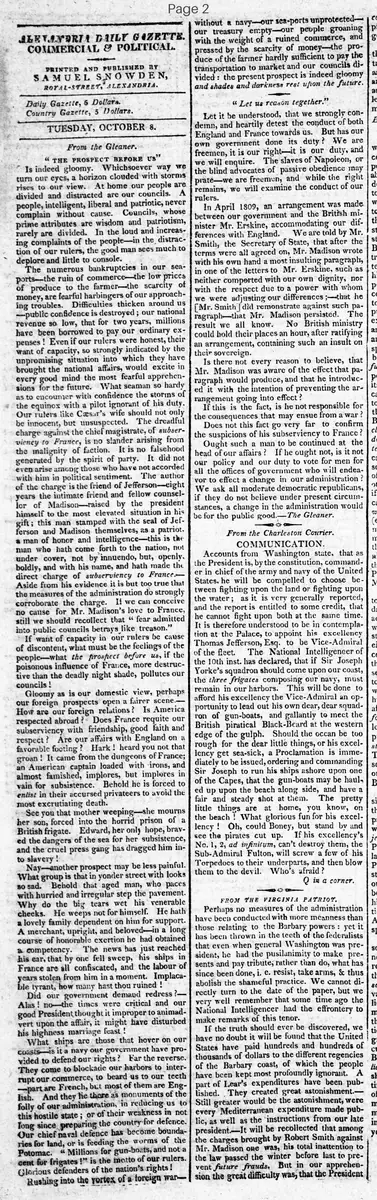
"THE PROSPECT BEFORE US"
Is indeed gloomy. Whichsoever way we turn our eyes, a horizon clouded with storms rises to our view. At home our people are divided and distracted are our councils. A people, intelligent, liberal and patriotic, never complain without cause. Councils, whose prime attributes are wisdom and patriotism, rarely are divided. In the loud and increasing complaints of the people--in the distraction of our rulers, the good man sees much to deplore and little to console.
The numerous bankruptcies in our seaports--the ruin of commerce--the low prices of produce to the farmer--the scarcity of money, are fearful harbingers of our approaching troubles. Difficulties thicken around us--public confidence is destroyed; our national revenue so low, that for two years, millions have been borrowed to pay our ordinary expenses! Even if our rulers were honest, their want of capacity, so strongly indicated by the unpromising situation into which they have brought the national affairs, would excite in every good mind the most fearful apprehensions for the future. What seaman so hardy as to encounter with confidence the storms of the equinox with a pilot ignorant of his duty.
Our rulers like Cæsar's wife should not only be innocent, but unsuspected. The dreadful charge against the chief magistrate, of subserviency to France, is no slander arising from the malignity of faction. It is no falsehood generated by the spirit of party. It did not even arise among those who have not accorded with him in political sentiment. The author of the charge is the friend of Jefferson--eight years the intimate friend and fellow counsellor of Madison--raised by the president himself to the most elevated situation in his gift; this man stamped with the seal of Jefferson and Madison themselves, as a patriot, a man of honor and intelligence--this is the man who hath come forth to the nation, not under cover, not by innuendo, but, openly, boldly, and with his name, and hath made the direct charge of subserviency to France.
Aside from his evidence it is but too true that the measures of the administration do strongly corroborate the charge. If we can conceive no cause for Mr. Madison's love to France, still we should recollect that "fear admitted into public councils betrays like treason."
If want of capacity in our rulers be cause of discontent, what must be the feelings of the people--what the prospect before us, if the poisonous influence of France, more destructive than the deadly night shade, pollutes our councils!
Gloomy as is our domestic view, perhaps our foreign prospects open a fairer scene.
How are our foreign relations? Is America respected abroad? Does France requite our subserviency with friendship, good faith and respect? Are our affairs with England on a favorable footing? Hark! heard you not that groan! It came from the dungeons of France; an American captain loaded with irons, and almost famished, implores, but implores in vain for subsistence. Behold he is forced to enlist in their accursed privateers to avoid the most excrutiating death.
See you that mother weeping--she mourns her son, forced into the horrid prison of a British frigate. Edward, her only hope, braved the dangers of the sea for her subsistence, and the cruel press gang has dragged him into slavery!
Nay--another prospect may be less painful. What group is that in yonder street with looks so sad. Behold that aged man, who paces with hurried and irregular step the pavement. Why do the big tears wet his venerable cheeks. He weeps not for himself. He hath a lovely family dependent on him for support. A merchant, upright, and beloved--in a long course of honorable exertion he had obtained a competency. The news has just reached his ear, that by one fell sweep, his ships in France are all confiscated, and the labour of years stolen from him in a moment. Implacable tyrant, how many hast thou ruined!
Did our government demand redress?--Alas! no--the times were critical and our good President thought it improper to animadvert upon the affair, it might have disturbed his highness marriage feast!
What ships are those that hover on our coasts is it a navy our government have provided to defend our rights? Far the reverse. They come to blockade our harbors to interrupt our commerce, to beard us to our teeth--part are French, but most of them are English. And they lie there as monuments of the folly of our administration, in reducing us to this hostile state; or of their weakness in not long since preparing the country for defence.
Our chief naval defence has become boundaries for land, or is feeding the worms of the Potomac. "Millions for gun-boats, and not a cent for frigates!" is the motto of our rulers. Glorious defenders of the nation's rights!
Rushing into the vortex of a foreign war--
"Let us reason together."
Let it be understood, that we strongly condemn, and heartily detest the conduct of both England and France towards us. But has our own government done its duty? We are freemen, it is our right--it is our duty, and we will enquire. The slaves of Napoleon, or the blind advocates of passive obedience may prate--we are freemen, and while the right remains, we will examine the conduct of our rulers.
In April 1809, an arrangement was made between our government and the British minister Mr. Erskine, accommodating our differences with England. We are told by Mr. Smith, the Secretary of State, that after the terms were all agreed on, Mr. Madison wrote with his own hand a most insulting paragraph in one of the letters to Mr. Erskine, such as neither comported with our own dignity, nor with the respect due to a power with whom we were adjusting our differences; that he Mr. Smith did remonstrate against such paragraph--that Mr. Madison persisted. The result we all know. No British ministry could hold their places an hour, after ratifying an arrangement, containing such an insult on their sovereign.
Is there not every reason to believe, that Mr. Madison was aware of the effect that paragraph would produce, and that he introduced it with the intention of preventing the arrangement going into effect?
If this is the fact, is he not responsible for the consequences that may ensue from a war? Does not this fact go very far to confirm the suspicions of his subserviency to France? Ought such a man to be continued at the head of our affairs? If he ought not, is it not our policy and our duty to vote for men for all the offices of government who will endeavor to effect a change in our administration?
We ask all moderate democratic republicans, if they do not believe under present circumstances, a change in the administration would be for the public good.--The Gleaner.
What sub-type of article is it?
What keywords are associated?
What entities or persons were involved?
Editorial Details
Primary Topic
Critique Of Madison's Administration For Subserviency To France And Mishandling Of Relations With England
Stance / Tone
Strongly Critical, Urging Change In Administration
Key Figures
Key Arguments