Thank you for visiting SNEWPapers!
Sign up free
Alexandria Daily Gazette, Commercial & Political
Alexandria, Virginia
What is this article about?
Extract of a letter from Tehran, May 22, 1810, detailing the English embassy's journey from Shiraz to Tehran in January 1810, their honored reception, audience with the Persian king despite mourning customs, presentation of gifts including a valuable diamond, and insights into Persian court, anti-French sentiments, and the embassy's influence on military matters.
Clipping
OCR Quality
Full Text
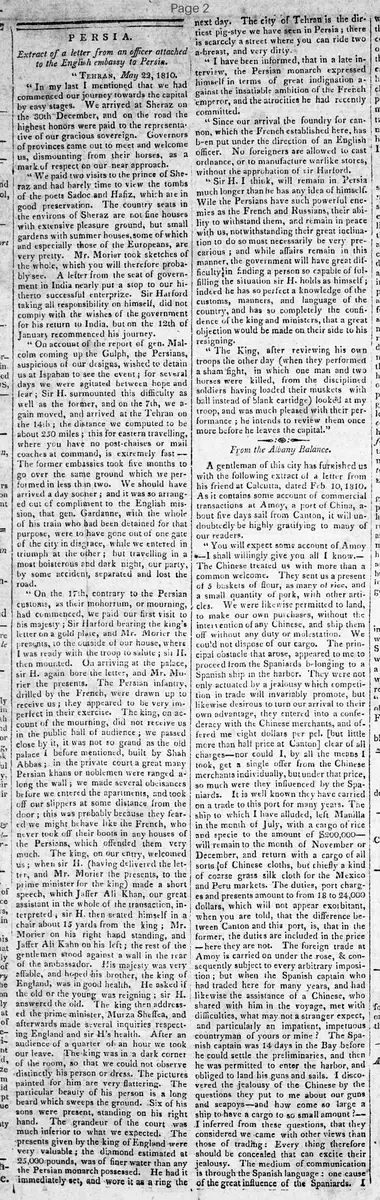
Extract of a letter from an officer attached to the English embassy to Persia.
TEHRAN, May 22, 1810.
In my last I mentioned that we had commenced our journey towards the capital by easy stages. We arrived at Shiraz on the 30th December, and on the road the highest honors were paid to the representative of our gracious sovereign. Governors of provinces came out to meet and welcome us, dismounting from their horses, as a mark of respect on our near approach.
We paid two visits to the prince of Shiraz and had barely time to view the tombs of the poets Saadi and Hafiz, which are in good preservation. The country seats in the environs of Shiraz are not fine houses with extensive pleasure ground, but small gardens with summer houses, some of which and especially those of the Europeans, are very pretty. Mr. Morier took sketches of the whole, which you will therefore probably see. A letter from the seat of government in India nearly put a stop to our hitherto successful enterprize. Sir Harford taking all responsibility on himself, did not comply with the wishes of the government for his return to India, but on the 12th of January recommenced his journey.
On account of the report of gen. Malcolm coming up the Gulph, the Persians, suspicious of our designs, wished to detain us at Ispahan to see the event; or several days we were agitated between hope and fear; Sir H. surmounted this difficulty as well as the former, and on the 7th, we again moved, and arrived at the Tehran on the 14th; the distance we computed to be about 250 miles; this for eastern travelling, where you have no post-chaises or mail coaches at command, is extremely fast--The former embassies took five months to go over the same ground which we performed in less than two. We should have arrived a day sooner; and it was so arranged out of compliment to the English mission, that gen. Gardanne, with the whole of his train who had been detained for that purpose, were to have gone out of one gate of the city in disgrace, while we entered in triumph at the other; but travelling in a most boisterous and dark night, our party, by some accident, separated and lost the road.
On the 17th, contrary to the Persian customs, as their moharrum, or mourning, had commenced, we paid our first visit to his majesty; Sir Harford bearing the king's letter on a gold plate, and Mr. Morier the presents, to the outside of our house, where I was ready with the troop to salute; sir H. then mounted. On arriving at the palace. sir H. again bore the letter, and Mr. Morier the presents. The Persian infantry, drilled by the French, were drawn up to receive us; they appeared to be very imperfect in their exercise. The king, on account of the mourning, did not receive us in the public hall of audience; we passed close by it, it was not so grand as the old palace I before mentioned, built by Shah Abbas; in the private court a great many Persian khans or noblemen were ranged along the wall; we made several obeisances before we entered the apartments, and took off our slippers at some distance from the door; this was probably because they feared we might behave like the French, who never took off their boots in any houses of the Persians, which offended them very much. The king, on our entry, welcomed us; when sir H. (having delivered the letter, and Mr. Morier the presents, to the prime minister or the king) made a short speech, which Jaffer Ali Khan, our great assistant in the whole of the transaction, interpreted; sir H. then seated himself in a chair about 15 yards from the king; Mr. Morier on his right hand standing, and Jaffer Ali Khan on his left; the rest of the gentlemen stood against a wall in the rear of the ambassador. His majesty was very affable, and hoped his brother, the king of England, was in good health. He asked if the old or the young was reigning; sir H. answered the old. The king then addressed the prime minister, Mirza Sheffea, and afterwards made several inquiries respecting England and sir H's health. After an audience of a quarter of an hour we took our leave. The king was in a dark corner of the room, so that we could not observe distinctly his person or dress. The pictures painted for him are very flattering. The particular beauty of his person is a long beard which sweeps the ground. Six of his sons were present, standing on his right hand. The grandeur of the court was much inferior to what we expected. The presents given by the king of England were very valuable; the diamond estimated at 25,000 pounds, was of finer water than any the Persian monarch possessed. He had it immediately set, and wore it as a ring the next day. The city of Tehran is the dirtiest pig-stye we have seen in Persia; there is scarcely a street where you can ride two a-breast, and very dirty.
I have been informed, that in a late interview, the Persian monarch expressed himself in terms of great indignation against the insatiable ambition of the French emperor, and the atrocities he had recently committed.
Since our arrival the foundry or cannon, which the French established here, has been put under the direction of an English officer. No foreigners are allowed to cast ordnance, or to manufacture warlike stores, without the approbation of sir Harford.
Sir H. I think, will remain in Persia much longer than he has any idea of himself. While the Persians have such powerful enemies as the French and Russians, their ability to withstand them, and remain in peace with us, notwithstanding their great inclination to do so must necessarily be very precarious; and while affairs remain in this manner, the government will have great difficulty in finding a person so capable of fulfilling the situation sir H. holds as himself: indeed he has so perfect a knowledge of the customs, manners, and language of the country, and has so completely the confidence of the king and ministers, that a great objection would be made on their side to his resigning
The King, after reviewing his own troops the other day (when they performed a sham fight, in which one man and two horses were killed, from the disciplined soldiers having loaded their muskets with ball instead of blank cartridge) looked at my troop, and was much pleased with their performance; he intends to review them once more before he leaves the capital.
What sub-type of article is it?
What keywords are associated?
What entities or persons were involved?
Where did it happen?
Foreign News Details
Primary Location
Tehran, Persia
Event Date
Tehran, May 22, 1810
Key Persons
Outcome
successful embassy arrival and audience; valuable presents including a 25,000 pound diamond given and admired; french foundry placed under english direction; persian king's anti-french sentiments expressed; one man and two horses killed in sham fight accident.
Event Details
The English embassy, led by Sir Harford, journeyed from Shiraz to Tehran, arriving January 14, 1810, after overcoming delays and suspicions due to reports of General Malcolm. They received high honors en route and timed their entry to contrast with the departing French mission under General Gardanne. On January 17, despite mourning customs, they had an audience with the Persian king, presenting letters and gifts; the king was affable, inquired about the English monarch, and the embassy noted the court's modest grandeur and the city's dirtiness. Ongoing: English oversight of cannon foundry; king's review of troops with accidental deaths; expectation of prolonged embassy stay amid threats from France and Russia.