Thank you for visiting SNEWPapers!
Sign up free
Rhode Island American
Providence, Providence County, Rhode Island
What is this article about?
In 1824 Rhode Island state convention, Mr. Pierce's speech advocates general suffrage, criticizing property-based voting restrictions for excluding industrious citizens, ignoring their military burdens, enabling electoral fraud, and denying equal rights; quotes Blackstone in support.
Merged-components note: Continuation of Mr. Pierce's speech on general suffrage across pages.
Clippings
1 of 2
OCR Quality
Full Text
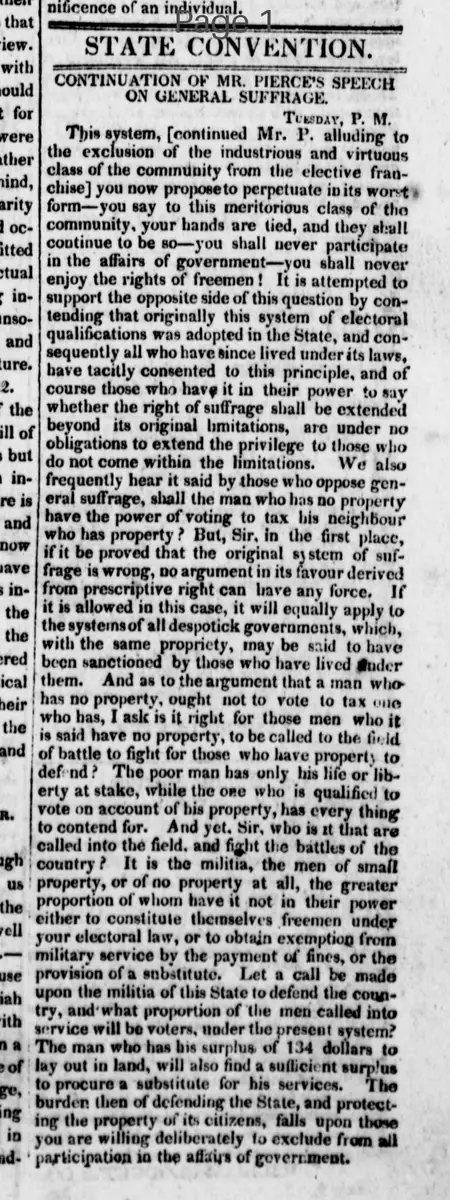
CONTINUATION OF MR. PIERCE'S SPEECH
ON GENERAL SUFFRAGE.
TUESDAY, P. M.
This system, [continued Mr. P. alluding to the exclusion of the industrious and virtuous class of the community from the elective franchise] you now propose to perpetuate in its worst form-you say to this meritorious class of the community, your hands are tied, and they shall continue to be so-you shall never participate in the affairs of government-you shall never enjoy the rights of freemen! It is attempted to support the opposite side of this question by contending that originally this system of electoral qualifications was adopted in the State, and consequently all who have since lived under its laws, have tacitly consented to this principle, and of course those who have it in their power to say whether the right of suffrage shall be extended beyond its original limitations, are under no obligations to extend the privilege to those who do not come within the limitations. We also frequently hear it said by those who oppose general suffrage, shall the man who has no property have the power of voting to tax his neighbour who has property ? But, Sir, in the first place, if it be proved that the original system of suffrage is wrong, no argument in its favour derived from prescriptive right can have any force. If it is allowed in this case, it will equally apply to the systems of all despotick governments, which, with the same propriety, may be said to have been sanctioned by those who have lived under them. And as to the argument that a man who has no property, ought not to vote to tax one who has, I ask is it right for those men who it is said have no property, to be called to the field of battle to fight for those who have property to defend? The poor man has only his life or liberty at stake, while the one who is qualified to vote on account of his property, has every thing to contend for. And yet. Sir, who is it that are called into the field, and fight the battles of the country? It is the militia, the men of small property, or of no property at all, the greater proportion of whom have it not in their power either to constitute themselves freemen under your electoral law, or to obtain exemption from military service by the payment of fines, or the provision of a substitute. Let a call be made upon the militia of this State to defend the country, and what proportion of the men called into service will be voters, under the present system? The man who has his surplus, of $134 dollars to lay out in land, will also find a sufficient surplus to procure a substitute for his services. The burden then of defending the State, and protecting the property of its citizens, falls upon those you are willing deliberately to exclude from all participation in the affairs of government.
Besides, if property is the sole criterion of the rights of a freeman, where is the propriety that a man possessing barely the requisite qualification of a voter, should have the same vote as the gentleman on my right, (General Carrington) who possesses his tens of thousands? Why should he not have as many votes as he has means of qualifying voters? And what greater right has a man possessing 134 dollars in land to vote for a tax which is to affect to so great an extent that gentleman's property, than one possessing but little or even no property at all, has to vote for a tax which is to affect in so slight a degree the property of the small landholder?
If the possession of land is the only thing that can give a man any consideration in the State, let those who have this property defend it themselves. The poor man's life is as valuable as the rich man's, and much more so to his family, who depend on him alone for support. On what principle, then, can you compel him to expose that life for the benefit of others, when he is denied the rights of a freeman?
The prejudices of this Committee are appealed to, to destroy the proposition now before you, and it will be urged that if suffrage is extended, the influence of the honest yeomanry will be swallowed up by the sea-port towns who will raise their hordes of voters, and carry everything before them. But look at things as they heretofore have existed. All those men whom you fear will have so much influence in your elections, have already, in times of excitement, been called into service in the sea-port towns. A wealthy merchant living in these places can easily make his hundred voters and bring them to the polls. He can so divide his rents and his houses as to make those voters for a special purpose: but the farmer has not an equal chance. He cannot cut up his farm into small parcels, and even if he would do so there is too much honour in the young men in the country, to accept of these fraudulent qualifications. But in commercial places they can readily be found.
Commercial towns, from their compact situation, have it more in their power to act in concert, and the opportunities of making fraudulent voters, are greater than in the country. What has once taken place, we may infer will again happen. Fraudulent voters have been repeatedly made in your seaport towns, notwithstanding the guards of your electoral law, and they will continue to be made, as long as party excitement exists. In speaking of commercial towns I would by no means be understood as excluding Newport. Fraudulent voters have been made here to a considerable extent, but in Providence it has been carried to a greater extent, and a man would almost stagger under the weight of the deeds to make fraudulent voters that at times have been brought into their Town-Meetings. In the country but few instances of the kind have been found. The commercial towns under the old system, gained all the influence that could be gained, and I believe we are all satisfied from past experience, it is easy for the wealthy men in those places to qualify voters whenever they please, to suit a particular purpose. We all remember an instance in the late war, of a citizen of a commercial town qualifying nine men as voters, on the property of a little island in Seekonk river, which was nearly swept away in the September gale, and which, the owner himself declared, could not support two merino bucks a year! These facilities which exist in making voters show that the land-holding system is no safe-guard against fraud.
Take an instance in this town (Newport.) There is a brick store that would rent for $700. Suppose a few men are anxious to carry a particular question; what need they do to effect their purpose but to combine together in the purchase of such a building, and then convey it in parcels to one hundred men? Even if your laws were so strict they could not be evaded, in such case they might convey it bona fide, on the condition of insuring the votes of one hundred men, to secure the success of a favourite measure—or if they have confidence in the persons they select, they may convey it to 100 men under their control, and take a mortgage for one year. If they have confidence in these men, they have only to run the risk for one year, and their property comes back to them again.
From this view of the case it is evident there are the same facilities for fraud under the old system, as there can be in the one proposed. There will be frauds practised, more or less, in every system that can be devised, and notwithstanding all the precautions that have been taken, what mortal man doubts that deeds have repeatedly been given, and persons have taken the qualifications under them, knowing the interest did not pass? It is in this way your system of suffrage is calculated to render the commission of perjury frequent. These evils will be remedied by the proposed amendment.
If you say it will make voters of the refuse of society, I answer they are already introduced. It is the young men of small capital who are engaged in trade, in commercial pursuits, and the mechanic, who is only able to support his family by his labour, who are excluded by your laws.
The plan which I propose, does not introduce foreigners and non-residents. The necessary qualification is a residence of one year, next before the time of voting. It is intended to introduce to the privileges of freemen, the man who pays his tax or does military service, or who possesses his $100 dollars in Bank Stock, in a river boat, in his implements of industry, or stock in trade. And have not such men as great a proportional interest in the laws that are made, and in the welfare of the community, as the wealthiest citizen in the State, or as the owner of a few acres of land?
It is said that if we introduce this general suffrage, the manufacturers will come to the polls with all their workmen, and have a too great influence in the State: but it cannot be so. A very great proportion of the workmen in our manufacturing establishments are foreigners, and of course cannot become voters in any case. Has a change in politics ever been effected in manufacturing towns by means of such persons? No! But it has been done by freeholders who may have a real or specious interest in land. In this respect, the evils under the old system are greater than those that can arise from the one proposed.
If a wealthy manufacturer in Warwick, for instance, wishes to change the politics of the town, all he has to do is to select from his workmen those men who have the appearance of possessing sufficient real estate, or to whom he can give that appearance, when in fact the property is in himself, and he may then control the affairs of the town. And this is effected by introducing people who do not belong to the town, and who need not have resided in it but a few months.
There are no difficulties to be apprehended from manufacturing establishments, if you adopt the plan that the man who has resided one year in the town where he claims the right to vote, and who can show 100 dollars of personal property, shall become a freeman. The evils have arisen from the old system; but let personal services to the State, or the possession of personal property to a certain amount, constitute the qualifications, and the industrious and meritorious class of the community will have an influence more than sufficient to counteract the influence of the vicious and the unprincipled, who may avail themselves of the extension of the right of suffrage; and this deserving class of the community will be placed on an equal footing with those who now exercise the elective franchise, under the false and specious pretence of the requisite qualifications.
As to the question of right or equity, on what principle can you give the right of suffrage to a man who owns a pittance of real estate, and deny it to one who possesses $10,000 dollars in bank stock? Has not this man as great, and a much greater interest in the flourishing condition of the country? Is he not as much attached to his home, to his wife and children—and are not his local attachments as strong as those of the man who owns a few acres of land? The principle that real estate is the only basis of local attachment, if correct once, is no longer so; and the ties which bind the owners of that property to the soil are as easily broken as those which attach a man to his home who does not own a spot of earth. Look at the fact! Who is it that emigrate from your State? Is it your commercial men, or those engaged in manufactures? No, it is your small farmers. Men who can readily dispose of their little possessions and seek their fortunes in more fertile regions, and while the farming interest is as unproductive as it now is, there will be a much greater inducement for that class to emigrate, than for the mechanic or trader who has established himself in profitable business that yields him a comfortable support, though it does not enable him to invest any of his little property in land.
There is clearly no foundation for the argument that commercial and trading men are not as much to be relied on for permanent inhabitants of the State as the farmers and yeomanry. The principles of our elective franchise were imported from England by our ancestors, and grew out of the distinctions and grades which have been established in that country. To prove this I need only refer to an English writer of undoubted authority. Examine the 171st page of Blackstone, vol. I. and you will find that the principle on which that system is founded is the exclusion from a participation in the Government, of those, who, by that aristocratical doctrine, are considered in a mean situation, persons in the lower grades of society. The avowed object is to exclude all who are not of the higher orders, those who are not of the aristocracy, on the preservation of which the existence of the government of that country depends.
The genius of our government admits of no such distinctions. Every citizen is supposed to have an influence in the government, and the free expression of his opinions, and the choice of his rulers, are his inalienable right. And yet how do you propose, if you adopt the report of the Committee, to preserve those rights? You are willing to give the citizen every privilege of a freeman, except the first privilege, the foundation of all his rights—the right of voting for his rulers.
Mr. P. proceeded to read some extracts from Blackstone, in which, he said he was happy to find that author supporting in the main, the same principles he advocated.
"The true reason of requiring any qualification, with regard to property, in voters, is to exclude such persons as are in so mean a situation that they are esteemed to have no will of their own. If these persons had votes, they would be tempted to dispose of them under some undue influence or other. This would give a great, an artful, or a wealthy man, a larger share in elections than is consistent with general liberty. If it were probable that every man would give his vote freely and without influence of any kind, then, upon the true theory and genuine principles of liberty, every member of the community; however poor, should have a vote in electing those delegates, to whose charge is committed the disposal of his property, his liberty, and his life. But, since that can hardly be expected in persons of indigent fortunes, or such as are under the immediate dominion of others, all popular states have been obliged to establish certain qualifications; whereby some who are suspected to have no will of their own, are excluded from voting, in order to set other individuals, whose wills may be supposed independent, more thoroughly upon a level with each other."
This is the spirit of our Constitution: not that I assert it is in fact, quite so perfect as I have here endeavoured to describe it; for, if any alteration might be wished or suggested in the present frame of parliaments, it should be in favour of a more complete representation of the people.
The reasons which exist for this law in England, if they ever existed here, ceased to do so in 1776. Since that period, we have no policy among us which requires the preservation of distinct grades and orders; all men are alike, free in principle, and ought they not to be equally so in practice? The operation of the Report of the Committee is calculated to keep up these distinctions, and denies the equal rights of the citizens. The man who is liable to do military duty, has no choice in selecting his Commander-in-Chief, and he may be called upon to render personal services, without the least power of selecting those who all control those services. Is he not liable to be drafted and marched to the confines of his country to repel invasion, and yet he has no voice in the choice of those who have power to declare war, and he cannot raise his voice in the election of the President, who, by the Constitution, becomes his Commander-in-Chief.
The citizens of Vermont, of Massachusetts, of Ohio, New-York, and other States, have that right, and almost every State that has adopted a Constitution since '76, has extended this privilege to that class of citizens whose claims I now advocate. Jefferson has recommended to the State of Virginia, where the landholding system crept in during the aristocracy of that State previous to the Revolution, to extend the right of suffrage, and the opinion throughout this country has become almost universally in favour of the system of unrestrained elective franchise. And shall it be said of Rhode-Island, that a Convention for framing a Constitution, in the year 1824, still adhered to the exploded doctrine of the English law of elections, and did not consider the citizens of the State possessed of sufficient virtue to trust them with the exercise of their free opinions in the choice of their rulers?
I have expressed my opinions freely on this subject, nor shall I shrink from avowing them, if they are not sustained by another person in this House. Some gentlemen have spoken in relation to the feelings of their constituents on this subject. I know the feelings of the mechanics, the honest, industrious young men on this question, and I am proud of their approbation, and of their good opinion for the course I have pursued; and I know too, that so long as they shall be excluded by the Constitution from their just and equal rights as citizens of the State, they will use all their influence to put down such a Constitution. They will never, and they ought never to sanction such a Constitution, which ties their hands and excludes them from all share in the government—a Constitution that denies to them the rights and privileges of freemen.
Erratum.—In our last, the motion of Mr. P. to introduce general suffrage, was inadvertently misrepresented. It was in the disjunctive. The person who did military duty or paid taxes, or who possesses 100 dollars of personal property. The substitution of or, for and, will correct the error.
What sub-type of article is it?
What themes does it cover?
What keywords are associated?
What entities or persons were involved?
Where did it happen?
Story Details
Key Persons
Location
Rhode Island
Event Date
1824
Story Details
Mr. Pierce argues in a state constitutional convention for extending suffrage beyond property qualifications to include those paying taxes, performing military duty, or holding $100 in personal property, critiquing inequities, fraud, and historical precedents while quoting Blackstone.