Thank you for visiting SNEWPapers!
Sign up free
Editorial
April 20, 1803
The Recorder
Richmond, Virginia
What is this article about?
Editorial recounts Republican celebration in Richmond escalating into riots and a fatal duel between Terrel and Grymes, criticizes duelling culture among youth, and presents a memorial urging punishment for Skelton Jones's 1801 murder of Gill A. Selden in an unpunished duel.
Clipping
OCR Quality
98%
Excellent
Full Text
The RECORDER.
RICHMOND.
APRIL 20th. 1803.
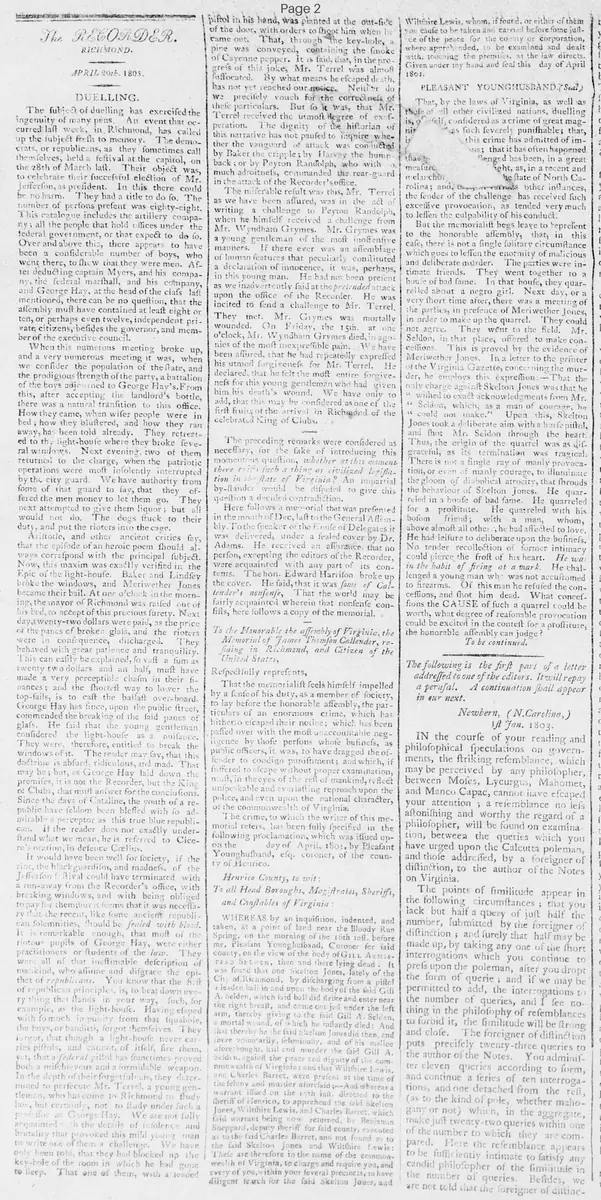
DUELLING.
The subject of duelling has exercised the ingenuity of many pens. An event that occurred last week, in Richmond, has called up the subject fresh to memory. The democrats, or republicans, as they sometimes call themselves, held a festival at the capitol, on the 28th of March last. Their object was, to celebrate their successful election of Mr. Jefferson, as president. In this there could be no harm. They had a title to do so. The number of persons present was eighty-eight. This catalogue includes the artillery company; all the people that hold offices under the federal government, or that expect to do so. Over and above this, there appears to have been a considerable number of boys, who went there, to show that they were men. After deducting captain Myers, and his company, the federal marshal, and his company, and George Hay, at the head of the class last mentioned, there can no question, that the assembly must have contained at least eight or ten, or perhaps even twelve, independent private citizens, besides the governor, and member of the executive council.
When this numerous meeting broke up, and a very numerous meeting it was, when we consider the population of the state, and the prodigious strength of the party, a battalion of the boys adjourned to George Hay's. From this, after accepting the landlord's bottle, there was a natural transition to this office. How they came, when wiser people were in bed; how they blustered, and how they ran away, has been told already. They retreated to the light-house where they broke several windows. Next evening, two of them returned to the charge, when the patriotic operations were most insolently interrupted by the city guard. We have authority from some of that guard to say, that they offered the men money to let them go. They next attempted to give them liquor; but all would not do. The dogs stuck to their duty, and put the rioters into the cage.
Aristotle, and other ancient critics say, that the episode of an heroic poem should always correspond with the principal subject. Now, this maxim was exactly verified in the Epic of the light-house. Baker and Lindsey broke the windows, and Meriwether Jones became their bail. At one o'clock in the morning, the mayor of Richmond was raised out of his bed, to accept of this precious surety. Next day, twenty-two dollars were paid, as the price of the panes of broken glass, and the rioters were in consequence, discharged. They behaved with great patience and tranquility. This can easily be explained, so vast a sum as twenty two dollars and an half, must have made a very perceptible chasm in their finances; and the shortest way to lower the top-sails, is to cast the ballast over-board.
George Hay has since, upon the public street, commended the breaking of the said panes of glass. He said that the young gentlemen considered the light-house as a nuisance. They were, therefore, entitled to break the windows of it. The reader may say, that this doctrine is absurd, ridiculous, and mad. That may be; but, as George Hay laid down the premises, it is not the Recorder, but the King of Clubs, that must answer for the conclusions.
Since the days of Catiline, the youth of a republic have seldom been blessed with so admirable a preceptor as this true blue republican. If the reader does not exactly understand what we mean, he is referred to Cicero's oration, in defence of Caelius.
It would have been well for society, if the riot, the blackguardism, and madness, of the Jefferson Jovial could have terminated with a run-away from the Recorder's office, with breaking windows, and with being obliged to pay for them; but it seems that it was necessary that the revel, like some ancient republican solemnities, should be sealed with blood.
It is remarkable enough, that most of the riotous pupils of George Hay, were either practitioners or students of the law. They were all of that inestimable description of mankind, who assume and disgrace the epithet of republicans. You know that the first of republican principles, is, to beat down everything that stands in your way, such, for example, as the light-house. Having escaped with so much impunity from that squabble, the boys, or banditti, forgot themselves. They forgot, that though a light-house never carries pistols, and cannot, of itself, fire them, yet, that a federal pistol has sometimes proved both a mischievous and a formidable weapon.
In the depth of their forgetfulness, they determined to persecute Mr. Terrel, a young gentleman, who has come to Richmond to study law, but certainly, not to study under such a professor as George Hay. We are not fully acquainted with the details of insolence and brutality that provoked this mild young man to write one of them a challenge. We have only been told, that they had blocked up the key-hole of the room in which he had gone to sleep. That one of them, with a loaded pistol in his hand, was planted at the outside of the door, with orders to shoot him when he came out. That, through the key-hole, a pipe was conveyed, containing the smoke of Cayenne pepper. It is said, that, in the progress of this joke, Mr. Terrel was almost suffocated. By what means he escaped death, has not yet reached our notice. Neither do we precisely vouch for the correctness of these particulars. But so it was, that Mr. Terrel received the utmost degree of exasperation. The dignity of the historian of this narrative has not paused to inquire whether the vanguard of attack was conducted by Baker the cripple; by Harpy the hump-back; or by Peyton Randolph, who with much adroitness, commanded the rear-guard in the attack of the Recorder's office.
The miserable result was this, Mr. Terrel, as we have been assured, was in the act of writing a challenge to Peyton Randolph, when he himself received a challenge from Mr. Wyndham Grymes. Mr. Grymes was a young gentleman of the most inoffensive manners. If there ever was an assemblage of human features that peculiarly constituted a declaration of innocence, it was, perhaps, in this young man. He had not been present, as we inadvertently said at the pretended attack upon the office of the Recorder. He was incited to send a challenge to Mr. Terrel. They met. Mr. Grymes was mortally wounded. On Friday, the 15th, at one o'clock, Mr. Wyndham Grymes died, in agonies of the most inexpressible pain. We have been assured, that he had repeatedly expressed his utmost forgiveness for Mr. Terrel. He declared, that he felt the most entire forgiveness for this young gentleman who had given him his death's wound. We have only to add, that this may be considered as one of the first fruits of the arrival in Richmond of the celebrated King of Clubs.
The preceding remarks were considered as necessary, for the sake of introducing this momentous question, whether at this moment there exists such a thing as civilized legislation in the state of Virginia? An impartial by-stander would be disposed to give this question a decided contradiction.
Here follows a memorial that was presented in the month of Dec. last to the General Assembly. To the speaker of the house of Delegates it was delivered, under a sealed cover by Dr. Adams. He received an assurance, that no person, excepting the editors of the Recorder, were acquainted with any part of its contents. The hon. Edward Harrison broke up the cover. He said, that it was some of Callender's nonsense. That the world may be fairly acquainted wherein that nonsense consists, here follows a copy of the memorial.
To the Honorable the assembly of Virginia, the Memorial of James Thomson Callender, residing in Richmond, and Citizen of the United States,
Respectfully represents,
That the memorialist feels himself impelled by a sense of his duty, as a member of society, to lay before the honorable assembly, the particulars of an enormous crime, which has hitherto escaped their notice; which has been passed over with the most unaccountable negligence by those persons whose business, as public officers, it was, to have dragged the offender to condign punishment; and which, if suffered to escape without proper examination, must, in the eyes of the rest of mankind, reflect unspeakable and everlasting reproach upon the police, and even upon the rational character, of the commonwealth of Virginia.
The crime, to which the writer of this memorial refers, has been fully specified in the following proclamation, which was issued upon the
day of April, 1801, by Pleasant Younghusband, esq, coroner, of the county of Henrico.
Henrico County, to wit:
To all Head Boroughs, Magistrates, Sheriffs, and Constables of Virginia:
WHEREAS by an inquisition, indented, and taken, at a point of land near the Bloody Run Spring, on the morning of the 16th inst. before me, Pleasant Younghusband, Coroner for said county, on the view of the body of Gill A. Selden, then and there lying dead: It was found that one Skelton Jones, lately of the City of Richmond, by discharging from a pistol a leaden ball in and upon the body of the said Gill A. Selden, which said ball did strike and enter near the right breast, and come out just under the left arm, thereby giving to the said Gill A. Selden, a mortal wound, of which he instantly died: And that thereby he the said Skelton Jones did then, and there voluntarily, feloniously, and of his malice aforethought, kill and murder the said Gill A. Selden, against the peace and dignity of the commonwealth of Virginia; and that Wiltshire Lewis, and Charles Barret, were present at the time of the felony and murder aforesaid;—And whereas a warrant issued on the 17th inst. directed to the sheriff of Henrico, to apprehend the said Skelton Jones, Wiltshire Lewis, and Charles Barret, which said warrant being now returned, by Benjamin Sheppard, deputy sheriff for said county, executed as to the said Charles Barret, and not found as to the said Skelton Jones and Wiltshire Lewis:
These are therefore in the name of the commonwealth of Virginia, to charge and require you, and every of you, within your several precincts, to have diligent search for the said Skelton Jones, and Wiltshire Lewis, whom, if found, or either of them you cause to be taken and carried before some justice of the peace for the county or corporation, where apprehended, to be examined and dealt with, touching the premises, as the law directs.
Given under my hand and seal this 18th day of April 1801.
PLEASANT YOUNGHUSBAND. (Seal)
That, by the laws of Virginia, as well as those of all other civilized nations, duelling is, as itself, considered as a crime of great magnitude, as such severely punishable; that, this crime has admitted of instances; that it has often happened that the avenged has been, in a great measure slight, as, in a recent and melancholy case, in the state of North Carolina; and, that various other instances, the sender of the challenge has received such excessive provocation, as tended very much to lessen the culpability of his conduct.
But the memorialist begs leave to represent to the honorable assembly, that, in this case, there is not a single solitary circumstance which goes to lessen the enormity of malicious and deliberate murder. The parties were intimate friends. They went together to a house of bad fame. In that house, they quarrelled about a negro girl. Next day, or a very short time after, there was a meeting of the parties, in presence of Meriwether Jones, in order to make up the quarrel. They could not agree. They went to the field. Mr. Selden, in that place, offered to make concessions. This is proved by the evidence of Meriwether Jones. In a letter to the printer of the Virginia Gazette, concerning the murder, he employs this expression:—That the only charge against Skelton Jones was that he "wished to exact acknowledgments from Mr. Selden, which, as a man of courage, he could not make." Upon this, Skelton Jones took a deliberate aim with a horse pistol, and shot Mr. Selden through the heart.
Thus, the origin of the quarrel was as disgraceful, as its termination was tragical. There is not a single ray of manly provocation, or even of manly courage, to illuminate the gloom of diabolical atrocity, that shrouds the behaviour of Skelton Jones. He quarrelled in a house of bad fame. He quarrelled for a prostitute. He quarrelled with his bosom friend; with a man, whom, above almost all others, he had affected to love. He had leisure to deliberate upon the business. No tender recollection of former intimacy could pierce the frost of his heart. He was in the habit of firing at a mark. He challenged a young man who was not accustomed to firearms. Of this man he refused the concessions, and shot him dead. What concessions the cause of such a quarrel could be worth, what degree of reasonable provocation could be excited in the contest for a prostitute, the honorable assembly can judge?
To be continued.
RICHMOND.
APRIL 20th. 1803.
DUELLING.
The subject of duelling has exercised the ingenuity of many pens. An event that occurred last week, in Richmond, has called up the subject fresh to memory. The democrats, or republicans, as they sometimes call themselves, held a festival at the capitol, on the 28th of March last. Their object was, to celebrate their successful election of Mr. Jefferson, as president. In this there could be no harm. They had a title to do so. The number of persons present was eighty-eight. This catalogue includes the artillery company; all the people that hold offices under the federal government, or that expect to do so. Over and above this, there appears to have been a considerable number of boys, who went there, to show that they were men. After deducting captain Myers, and his company, the federal marshal, and his company, and George Hay, at the head of the class last mentioned, there can no question, that the assembly must have contained at least eight or ten, or perhaps even twelve, independent private citizens, besides the governor, and member of the executive council.
When this numerous meeting broke up, and a very numerous meeting it was, when we consider the population of the state, and the prodigious strength of the party, a battalion of the boys adjourned to George Hay's. From this, after accepting the landlord's bottle, there was a natural transition to this office. How they came, when wiser people were in bed; how they blustered, and how they ran away, has been told already. They retreated to the light-house where they broke several windows. Next evening, two of them returned to the charge, when the patriotic operations were most insolently interrupted by the city guard. We have authority from some of that guard to say, that they offered the men money to let them go. They next attempted to give them liquor; but all would not do. The dogs stuck to their duty, and put the rioters into the cage.
Aristotle, and other ancient critics say, that the episode of an heroic poem should always correspond with the principal subject. Now, this maxim was exactly verified in the Epic of the light-house. Baker and Lindsey broke the windows, and Meriwether Jones became their bail. At one o'clock in the morning, the mayor of Richmond was raised out of his bed, to accept of this precious surety. Next day, twenty-two dollars were paid, as the price of the panes of broken glass, and the rioters were in consequence, discharged. They behaved with great patience and tranquility. This can easily be explained, so vast a sum as twenty two dollars and an half, must have made a very perceptible chasm in their finances; and the shortest way to lower the top-sails, is to cast the ballast over-board.
George Hay has since, upon the public street, commended the breaking of the said panes of glass. He said that the young gentlemen considered the light-house as a nuisance. They were, therefore, entitled to break the windows of it. The reader may say, that this doctrine is absurd, ridiculous, and mad. That may be; but, as George Hay laid down the premises, it is not the Recorder, but the King of Clubs, that must answer for the conclusions.
Since the days of Catiline, the youth of a republic have seldom been blessed with so admirable a preceptor as this true blue republican. If the reader does not exactly understand what we mean, he is referred to Cicero's oration, in defence of Caelius.
It would have been well for society, if the riot, the blackguardism, and madness, of the Jefferson Jovial could have terminated with a run-away from the Recorder's office, with breaking windows, and with being obliged to pay for them; but it seems that it was necessary that the revel, like some ancient republican solemnities, should be sealed with blood.
It is remarkable enough, that most of the riotous pupils of George Hay, were either practitioners or students of the law. They were all of that inestimable description of mankind, who assume and disgrace the epithet of republicans. You know that the first of republican principles, is, to beat down everything that stands in your way, such, for example, as the light-house. Having escaped with so much impunity from that squabble, the boys, or banditti, forgot themselves. They forgot, that though a light-house never carries pistols, and cannot, of itself, fire them, yet, that a federal pistol has sometimes proved both a mischievous and a formidable weapon.
In the depth of their forgetfulness, they determined to persecute Mr. Terrel, a young gentleman, who has come to Richmond to study law, but certainly, not to study under such a professor as George Hay. We are not fully acquainted with the details of insolence and brutality that provoked this mild young man to write one of them a challenge. We have only been told, that they had blocked up the key-hole of the room in which he had gone to sleep. That one of them, with a loaded pistol in his hand, was planted at the outside of the door, with orders to shoot him when he came out. That, through the key-hole, a pipe was conveyed, containing the smoke of Cayenne pepper. It is said, that, in the progress of this joke, Mr. Terrel was almost suffocated. By what means he escaped death, has not yet reached our notice. Neither do we precisely vouch for the correctness of these particulars. But so it was, that Mr. Terrel received the utmost degree of exasperation. The dignity of the historian of this narrative has not paused to inquire whether the vanguard of attack was conducted by Baker the cripple; by Harpy the hump-back; or by Peyton Randolph, who with much adroitness, commanded the rear-guard in the attack of the Recorder's office.
The miserable result was this, Mr. Terrel, as we have been assured, was in the act of writing a challenge to Peyton Randolph, when he himself received a challenge from Mr. Wyndham Grymes. Mr. Grymes was a young gentleman of the most inoffensive manners. If there ever was an assemblage of human features that peculiarly constituted a declaration of innocence, it was, perhaps, in this young man. He had not been present, as we inadvertently said at the pretended attack upon the office of the Recorder. He was incited to send a challenge to Mr. Terrel. They met. Mr. Grymes was mortally wounded. On Friday, the 15th, at one o'clock, Mr. Wyndham Grymes died, in agonies of the most inexpressible pain. We have been assured, that he had repeatedly expressed his utmost forgiveness for Mr. Terrel. He declared, that he felt the most entire forgiveness for this young gentleman who had given him his death's wound. We have only to add, that this may be considered as one of the first fruits of the arrival in Richmond of the celebrated King of Clubs.
The preceding remarks were considered as necessary, for the sake of introducing this momentous question, whether at this moment there exists such a thing as civilized legislation in the state of Virginia? An impartial by-stander would be disposed to give this question a decided contradiction.
Here follows a memorial that was presented in the month of Dec. last to the General Assembly. To the speaker of the house of Delegates it was delivered, under a sealed cover by Dr. Adams. He received an assurance, that no person, excepting the editors of the Recorder, were acquainted with any part of its contents. The hon. Edward Harrison broke up the cover. He said, that it was some of Callender's nonsense. That the world may be fairly acquainted wherein that nonsense consists, here follows a copy of the memorial.
To the Honorable the assembly of Virginia, the Memorial of James Thomson Callender, residing in Richmond, and Citizen of the United States,
Respectfully represents,
That the memorialist feels himself impelled by a sense of his duty, as a member of society, to lay before the honorable assembly, the particulars of an enormous crime, which has hitherto escaped their notice; which has been passed over with the most unaccountable negligence by those persons whose business, as public officers, it was, to have dragged the offender to condign punishment; and which, if suffered to escape without proper examination, must, in the eyes of the rest of mankind, reflect unspeakable and everlasting reproach upon the police, and even upon the rational character, of the commonwealth of Virginia.
The crime, to which the writer of this memorial refers, has been fully specified in the following proclamation, which was issued upon the
day of April, 1801, by Pleasant Younghusband, esq, coroner, of the county of Henrico.
Henrico County, to wit:
To all Head Boroughs, Magistrates, Sheriffs, and Constables of Virginia:
WHEREAS by an inquisition, indented, and taken, at a point of land near the Bloody Run Spring, on the morning of the 16th inst. before me, Pleasant Younghusband, Coroner for said county, on the view of the body of Gill A. Selden, then and there lying dead: It was found that one Skelton Jones, lately of the City of Richmond, by discharging from a pistol a leaden ball in and upon the body of the said Gill A. Selden, which said ball did strike and enter near the right breast, and come out just under the left arm, thereby giving to the said Gill A. Selden, a mortal wound, of which he instantly died: And that thereby he the said Skelton Jones did then, and there voluntarily, feloniously, and of his malice aforethought, kill and murder the said Gill A. Selden, against the peace and dignity of the commonwealth of Virginia; and that Wiltshire Lewis, and Charles Barret, were present at the time of the felony and murder aforesaid;—And whereas a warrant issued on the 17th inst. directed to the sheriff of Henrico, to apprehend the said Skelton Jones, Wiltshire Lewis, and Charles Barret, which said warrant being now returned, by Benjamin Sheppard, deputy sheriff for said county, executed as to the said Charles Barret, and not found as to the said Skelton Jones and Wiltshire Lewis:
These are therefore in the name of the commonwealth of Virginia, to charge and require you, and every of you, within your several precincts, to have diligent search for the said Skelton Jones, and Wiltshire Lewis, whom, if found, or either of them you cause to be taken and carried before some justice of the peace for the county or corporation, where apprehended, to be examined and dealt with, touching the premises, as the law directs.
Given under my hand and seal this 18th day of April 1801.
PLEASANT YOUNGHUSBAND. (Seal)
That, by the laws of Virginia, as well as those of all other civilized nations, duelling is, as itself, considered as a crime of great magnitude, as such severely punishable; that, this crime has admitted of instances; that it has often happened that the avenged has been, in a great measure slight, as, in a recent and melancholy case, in the state of North Carolina; and, that various other instances, the sender of the challenge has received such excessive provocation, as tended very much to lessen the culpability of his conduct.
But the memorialist begs leave to represent to the honorable assembly, that, in this case, there is not a single solitary circumstance which goes to lessen the enormity of malicious and deliberate murder. The parties were intimate friends. They went together to a house of bad fame. In that house, they quarrelled about a negro girl. Next day, or a very short time after, there was a meeting of the parties, in presence of Meriwether Jones, in order to make up the quarrel. They could not agree. They went to the field. Mr. Selden, in that place, offered to make concessions. This is proved by the evidence of Meriwether Jones. In a letter to the printer of the Virginia Gazette, concerning the murder, he employs this expression:—That the only charge against Skelton Jones was that he "wished to exact acknowledgments from Mr. Selden, which, as a man of courage, he could not make." Upon this, Skelton Jones took a deliberate aim with a horse pistol, and shot Mr. Selden through the heart.
Thus, the origin of the quarrel was as disgraceful, as its termination was tragical. There is not a single ray of manly provocation, or even of manly courage, to illuminate the gloom of diabolical atrocity, that shrouds the behaviour of Skelton Jones. He quarrelled in a house of bad fame. He quarrelled for a prostitute. He quarrelled with his bosom friend; with a man, whom, above almost all others, he had affected to love. He had leisure to deliberate upon the business. No tender recollection of former intimacy could pierce the frost of his heart. He was in the habit of firing at a mark. He challenged a young man who was not accustomed to firearms. Of this man he refused the concessions, and shot him dead. What concessions the cause of such a quarrel could be worth, what degree of reasonable provocation could be excited in the contest for a prostitute, the honorable assembly can judge?
To be continued.
What sub-type of article is it?
Crime Or Punishment
Legal Reform
Partisan Politics
What keywords are associated?
Duelling
Republican Riots
Richmond Festival
Skelton Jones
Gill Selden Murder
Virginia Legislation
Fatal Duel
What entities or persons were involved?
George Hay
Mr. Terrel
Mr. Wyndham Grymes
Skelton Jones
Gill A. Selden
James Thomson Callender
Jefferson Republicans
Meriwether Jones
Peyton Randolph
Editorial Details
Primary Topic
Critique Of Duelling And Unpunished Murders In Virginia
Stance / Tone
Strongly Condemnatory Of Duelling, Republican Youth Riots, And Lack Of Enforcement
Key Figures
George Hay
Mr. Terrel
Mr. Wyndham Grymes
Skelton Jones
Gill A. Selden
James Thomson Callender
Jefferson Republicans
Meriwether Jones
Peyton Randolph
Key Arguments
Republican Festival In Richmond Led To Riots, Window Breaking, And A Fatal Duel
Duelling Stems From Riotous Behavior Encouraged By Figures Like George Hay
Memorial Details Unpunished 1801 Murder Of Selden By Jones Over Trivial Quarrel
Virginia Lacks Civilized Legislation Against Duelling Despite Laws
Calls For Examination And Punishment Of Duel Related Crimes To Uphold Justice